 App DevelopmentCross Platform App Development: How It Saves Time and MoneyHow shared code across iOS and Android cuts build and maintenance effort, which frameworks to consider in 2026, and when native development is still the better call.
App Development Cost Factors: What Drives the Price of an App
The factors that drive app development cost: features, platforms, design, back end, integrations, security and team, plus hidden costs and ways to stay on budget.
The cost of building an app is driven mainly by scope: how many features it has, how complex they are, how many platforms it runs on and how much back-end work sits behind it. Design quality, third party integrations, security needs, the team's location and experience, and the ongoing cost of hosting and maintenance make up most of the rest. Two apps that look similar on the surface can differ hugely in cost because of what happens behind the screens.
This guide breaks down each cost factor, shows how app complexity changes the budget and lists the costs people forget, so you can plan a realistic budget before talking to developers.
The main factors that drive app development cost
1. Features and their complexity
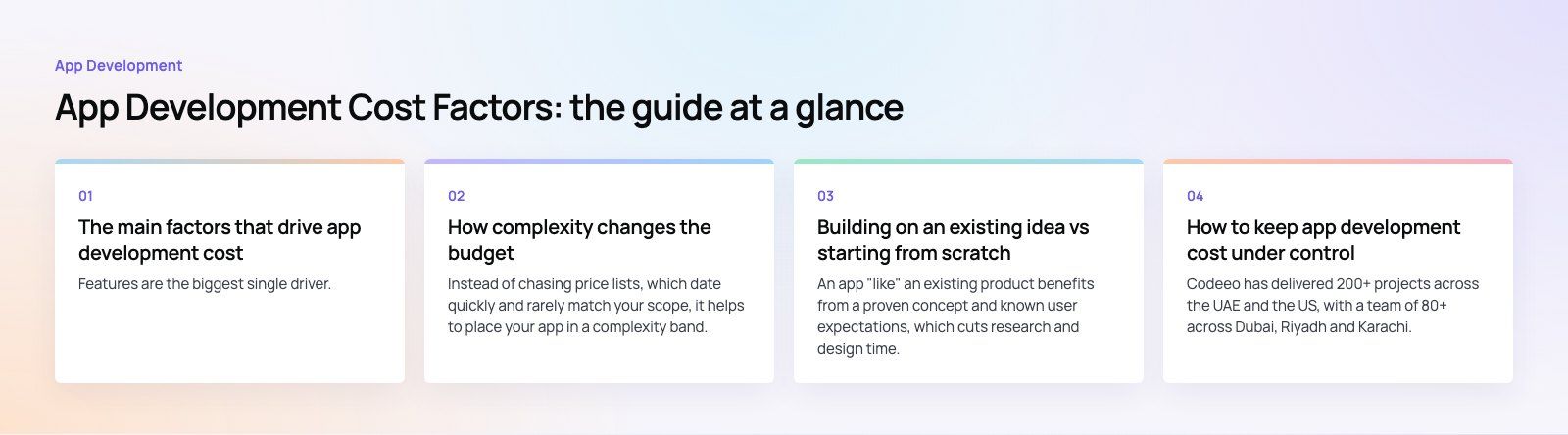
Features are the biggest single driver. A login screen, a product list and a contact form are quick to build. Real-time chat, live location tracking, payments, video, offline sync and recommendation engines each add weeks of design, development and testing.
Write a feature list before you ask for quotes. Mark each feature as "must have for launch" or "can wait". That one document lets developers estimate properly and gives you a lever to control cost.
2. Platforms: iOS, Android or both
Building one native app for iOS or Android costs less than building two. If you need both, you have two broad routes:
- Two native apps built separately in Swift and Kotlin. Best performance and full access to device features, but two codebases to build and maintain.
- One cross-platform app built with a framework like Flutter or React Native. One shared codebase usually reduces build and maintenance effort, with a small trade off in some device specific features.
Android apps often need more testing because they run on a far wider range of devices and screen sizes. iOS apps face a stricter store review. Neither platform is free to maintain.
3. Design and user experience
A clean interface built from standard components is cheaper than a fully custom design with animations and illustrations. Good UX work, including user flows, wireframes, prototypes and testing with real users, adds cost up front but reduces expensive rework after launch.
4. Back end and infrastructure
Most apps need a server side: databases, APIs, user accounts, admin panels, notifications and business logic. The back end is often a large share of the total effort and is easy to underestimate because users never see it. An admin panel for your team to manage content, users and orders is frequently forgotten in early budgets.
5. Third party integrations
Payment gateways, maps, messaging, analytics, CRMs, ERPs and identity providers all save time compared with building from scratch, but each adds integration work, testing and, often, a usage fee. Older or poorly documented systems take longer to connect.
6. Security and compliance
Apps that handle payments, health data, children's data or financial information need extra security work: encryption, secure authentication, audit logs, penetration testing and compliance reviews. That work is not optional in regulated sectors and should be budgeted from day one.
7. Team experience and location
Rates vary widely by region and seniority. An experienced team usually costs more per hour but makes fewer architectural mistakes and finishes faster. A cheaper team that has never built your type of app can cost more overall once rework is counted.
How complexity changes the budget
Instead of chasing price lists, which date quickly and rarely match your scope, it helps to place your app in a complexity band.
| Complexity | Typical features | Relative effort | Main cost risks |
|---|---|---|---|
| Simple | A few screens, basic login, content from an API, contact forms | Low | Scope creep once building starts |
| Moderate | User accounts, payments, push notifications, a custom back end and admin panel | Medium | Integrations and admin features added late |
| Complex | Real-time chat or tracking, multiple user roles, marketplaces, offline sync | High | Real-time infrastructure, edge cases, testing load |
| Enterprise | Several connected apps, deep integrations with ERP or CRM, strict security and scale | Very high | Compliance, legacy systems, long approval cycles |
Cost drivers by app category
- E-commerce apps: catalog, search, cart, checkout and payment gateways, plus sync with stock and order systems.
- On-demand and delivery apps: usually three products in one: a customer app, a driver or rider app and an admin, with live tracking and dispatch logic.
- Social and community apps: profiles, feeds, chat, moderation tools and privacy controls.
- Healthcare apps: secure data storage, appointments, consent and regulatory compliance.
- Education apps: courses, progress tracking, quizzes, video and sometimes integration with a learning management system.
- Booking and travel apps: availability, reservations, third party supplier APIs and changing prices.
For example, the Teachers Lunch platform includes a customer app, a rider app, restaurant menus, payments and an admin that sees the whole day. Each of those parts carries its own design, build and testing effort.
Building on an existing idea vs starting from scratch
An app "like" an existing product benefits from a proven concept and known user expectations, which cuts research and design time. It still needs custom work to differentiate it, and copying a competitor's feature list in full is the fastest way to overspend.
A truly new product needs more discovery: user research, prototypes and often a first version focused on testing one core idea. That costs more in planning but protects you from building features nobody uses.
In both cases, a minimum viable product (MVP) with only the essential features is usually the most cost effective first release. You learn from real users before committing the full budget.
Costs people forget to budget for
- Project management and QA: coordination, testing on real devices and bug fixing are part of the build, not extras.
- Hosting and cloud services: servers, databases, storage and bandwidth grow with your user base.
- Third party services: maps, SMS, email, analytics, video and AI services often charge by usage.
- App store accounts: Apple charges an annual fee for the Apple Developer Program, and Google charges a one-time registration fee for a Google Play developer account. Both stores also take a commission on many in-app sales.
- Maintenance and updates: every new iOS and Android release can require changes, and libraries need security updates. Plan an ongoing maintenance budget each year.
- Marketing and user acquisition: an app nobody finds earns nothing. Budget for launch, store listing optimization and campaigns.
How to keep app development cost under control
- Write a clear scope with user roles, features and priorities before asking for quotes.
- Start with an MVP and add features based on real usage.
- Choose cross-platform when your app does not depend on heavy device specific features.
- Use proven services for payments, authentication and notifications instead of building them.
- Agree on change control so new ideas are estimated before they are built.
- Test early and often because bugs found after launch cost far more to fix.
- Plan for year two, not just launch day: maintenance, hosting and updates.
Codeeo has delivered 200+ projects across the UAE and the US, with a team of 80+ across Dubai, Riyadh and Karachi. If you want a realistic estimate, our product scoping session turns an idea into a prioritized feature list, and our mobile app development team can then build it. You can browse our case studies for examples of apps at different levels of complexity, or contact us to talk through your project.
Frequently asked questions
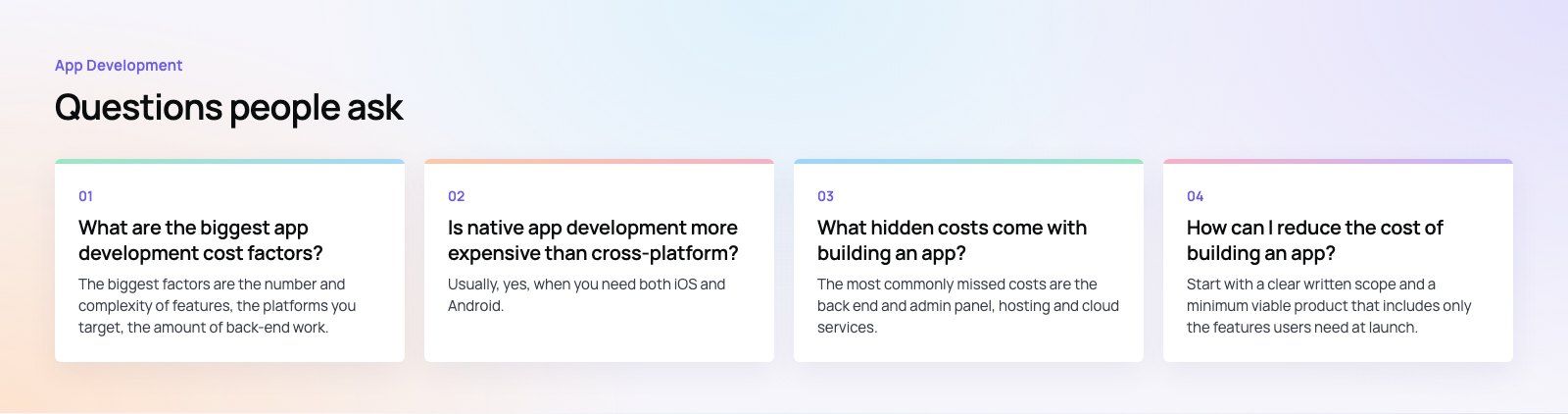
The biggest factors are the number and complexity of features, the platforms you target, the amount of back-end work, design depth, third party integrations and security requirements.
The team's experience and location also change the hourly rate. Ongoing costs such as hosting, maintenance, store fees and marketing should be included in the total budget, not treated as extras after launch.
App DevelopmentCross Platform App Development: How It Saves Time and MoneyHow shared code across iOS and Android cuts build and maintenance effort, which frameworks to consider in 2026, and when native development is still the better call. App DevelopmentHow to Plan an App Development Project From Start to FinishA step by step plan for an app project: define users and goals, scope an MVP, choose platforms, design, build the team, phase the timeline, test and launch.
 App DevelopmentMust Have Features of an HR Management AppThe features an HR management app needs, from onboarding and self service to payroll, performance and analytics, plus when to buy or build.
Tell us what the business needs. We will tell you what to build first.
Schedule a free consultation and get a written recommendation, with costs, before you commit to anything.
Get in touchPROVEN RESULTS
4.7 / 5verified reviews on Google