 App DevelopmentCross Platform App Development: How It Saves Time and MoneyHow shared code across iOS and Android cuts build and maintenance effort, which frameworks to consider in 2026, and when native development is still the better call.
Top Apps Built with Flutter and What They Show Businesses
Well known apps built with Flutter, from Google Pay to My BMW and Nubank, what they show about the framework, and when Flutter fits your app.
Well known apps built with Flutter include Google Ads, Google Pay, the My BMW app, eBay Motors, Alibaba's Xianyu marketplace, Nubank, Realtor.com and talabat, along with products from The New York Times and Toyota. What they show is that a single Flutter codebase can power large, high traffic apps on both iOS and Android while keeping design consistent. For businesses, the appeal is shipping to several platforms with one team without giving up native quality.
This guide explains what Flutter is, how it compiles, why businesses choose it, the apps that use it and when it is or is not the right choice for your project.
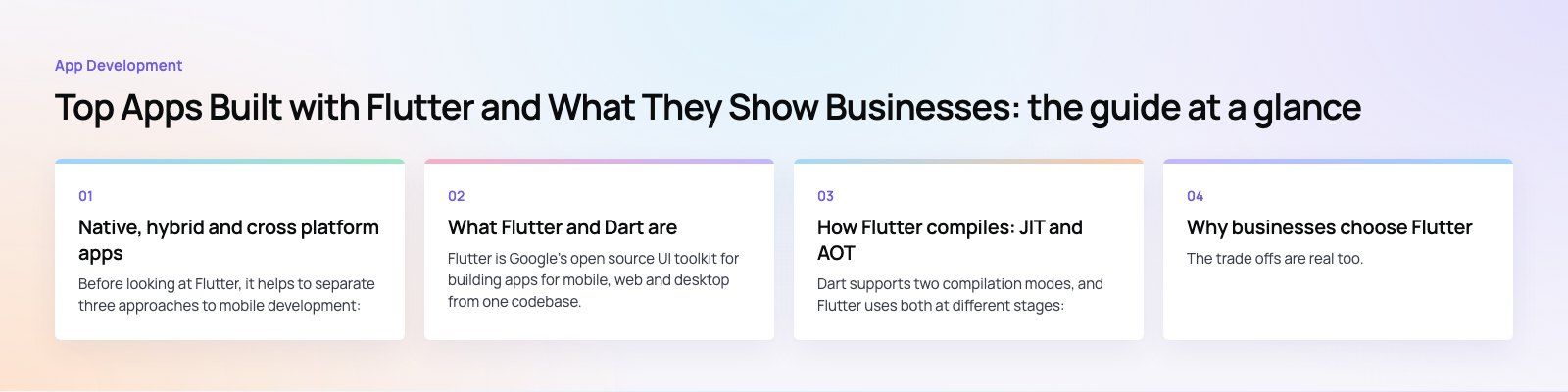
Native, hybrid and cross platform apps
Before looking at Flutter, it helps to separate three approaches to mobile development:
- Native apps are built separately for each platform, in Swift for iOS and Kotlin for Android. They get full platform access but need two codebases.
- Hybrid apps wrap a web app inside a native shell. They are quick to build but often feel less smooth and have limited device access.
- Cross platform apps share most of their code across platforms but compile to native code or render with native performance. Flutter and React Native are the leading options.
Flutter sits firmly in the third group, and it takes a distinctive approach to drawing the interface.
What Flutter and Dart are
Flutter is Google's open source UI toolkit for building apps for mobile, web and desktop from one codebase. Apps are written in Dart, a language also developed by Google, which is designed for fast UI development with features such as sound null safety and garbage collection.
Unlike frameworks that map components to the platform's own UI controls, Flutter draws every pixel itself using its own rendering engine. Its current engine, Impeller, is now the default on iOS and Android and was designed to produce smooth, predictable animation. Because Flutter controls the rendering, an app looks the same on every device, which is valuable for brands that want a precise, consistent design.
Dart can also be used for backend logic, so some teams use one language across app and server. Most businesses, however, pair a Flutter front end with an existing backend in another language.
How Flutter compiles: JIT and AOT
Dart supports two compilation modes, and Flutter uses both at different stages:
| Mode | When it is used | Benefit |
|---|---|---|
| Just in time (JIT) | During development | Hot reload: code changes appear in the running app within moments, keeping app state |
| Ahead of time (AOT) | Release builds | Compiled native machine code for fast startup and consistent performance |
This combination gives developers a fast feedback loop while building and users a compiled, efficient app in production.
Why businesses choose Flutter
- One codebase, several platforms: most features are written once for iOS and Android, and optionally web and desktop.
- Consistent design: because Flutter renders its own UI, custom brand designs look identical on every device.
- Fast development: hot reload and a rich set of ready made widgets speed up building and iterating on interfaces.
- Strong performance: AOT compilation and the Impeller engine deliver smooth animation for most app types.
- Smaller teams: one Flutter team can replace two separate native teams for many products.
- Google backing: Google uses Flutter in its own apps, which gives confidence in its long term support.
The trade offs are real too. Dart developers are fewer than JavaScript developers, app binaries are somewhat larger than minimal native apps, and brand new platform features sometimes need native code before a plugin exists.
Top apps built with Flutter
All of the companies below appear on Flutter's official showcase. The descriptions focus on why Flutter fits each type of product rather than on figures we cannot verify.
Google Ads
Google's own app for managing advertising campaigns is built with Flutter. It lets advertisers check performance, adjust budgets and respond to recommendations from a phone. For a data heavy dashboard app used on both platforms, a shared codebase keeps features in step across iOS and Android.
Google Pay
Google rebuilt parts of Google Pay with Flutter to bring its iOS and Android versions onto one codebase. It shows that Flutter is trusted for payments, where reliability and consistency between platforms matter.
My BMW
BMW uses Flutter for its My BMW app, which lets drivers check vehicle status, lock the car remotely, plan trips and manage charging. A car maker with many models and markets benefits from shipping one consistent app experience to all customers.
eBay Motors
eBay used Flutter for its eBay Motors app, a marketplace for buying and selling vehicles and parts. Marketplace apps with rich listings, search and messaging are a strong fit for Flutter's custom UI and fast iteration.
Alibaba Xianyu
Alibaba's Xianyu is a large second hand marketplace in China and one of the earliest big adopters of Flutter. It is often cited as proof that Flutter can handle very high traffic consumer apps.
Nubank
Nubank, a large digital bank in Latin America, uses Flutter for its mobile app. Banking apps need security, accessibility and consistent behavior across devices, and Nubank's adoption shows Flutter meeting those requirements at scale.
Realtor.com
Realtor.com uses Flutter for its property search app in the US. Real estate apps rely on maps, image heavy listings and saved searches, all areas where a smooth, consistent interface matters.
talabat
talabat, the food and grocery delivery platform widely used across the Middle East, is featured on Flutter's showcase. On demand delivery apps change often and must work well on many device types, which suits a shared codebase.
The New York Times
The New York Times appears on Flutter's showcase for its use of the framework in its products. Publishers value Flutter's ability to deliver polished, interactive experiences that look the same on every screen.
Toyota
Toyota is featured for using Flutter in vehicle infotainment, an example of Flutter running beyond phones on embedded screens. It shows the framework's reach into automotive and other embedded devices.
Hamilton
The official app for the Broadway musical Hamilton was built with Flutter and is listed on the showcase. Entertainment and fan apps often need distinctive branding, which Flutter's custom rendering supports well.
When Flutter is the right choice
Flutter fits well when
- You need iOS and Android, and possibly web, from one team.
- Your brand needs a highly custom interface that looks identical everywhere.
- The app is mainly screens, forms, lists, maps and API driven content.
- You want to move quickly and iterate on design after launch.
Consider another option when
- The app is iOS only and depends on the newest Apple features, where native Swift is simpler.
- Your team already has deep React and JavaScript skills, where React Native may be quicker to staff.
- The product is mainly a content website, where a responsive web app or PWA may be enough.
- You rely on niche hardware SDKs that have no maintained Flutter plugin.
Mistakes to avoid with Flutter projects
- Ignoring platform conventions. A consistent design is good, but users still expect native navigation patterns and gestures.
- Adding plugins without checking maintenance. Abandoned packages block upgrades later.
- Skipping state management decisions. Choose an approach early and use it consistently across the app.
- Testing only on one platform. Shared code still behaves differently around permissions, notifications and keyboards.
If you are deciding between Flutter, React Native and native, a product scoping session maps your features against each option. Our work on the Book My Trip and Star Cinemas apps shows the booking and checkout flows these frameworks are often chosen for, and our marketplaces and on demand page covers apps similar to several on this list.
Codeeo's team of 80+ across Dubai, Riyadh and Karachi has delivered 200+ projects across the UAE and the US. If you are planning a cross platform app, our mobile app development team can help you choose the right framework and build it.
Frequently asked questions
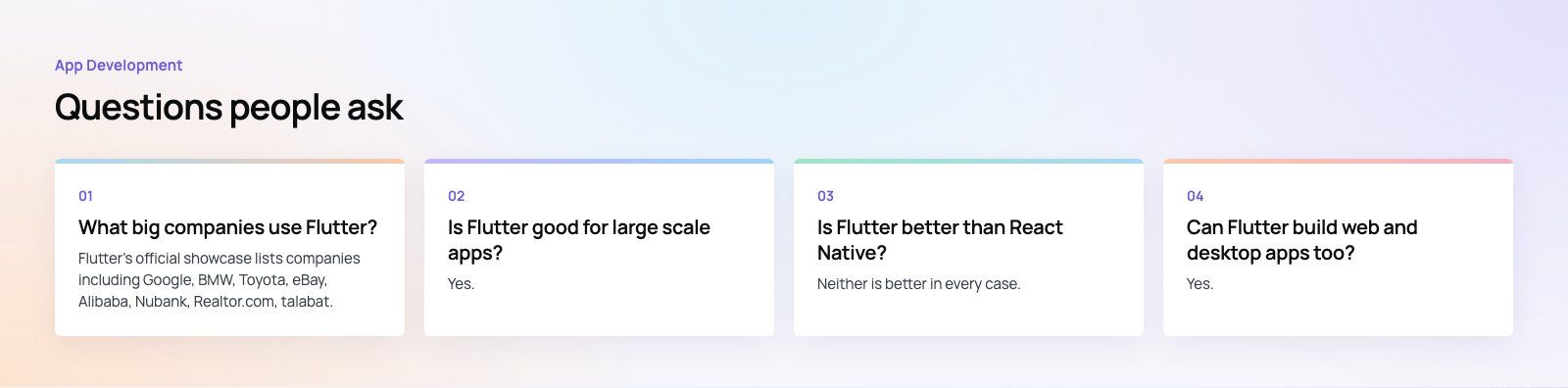
Flutter's official showcase lists companies including Google, BMW, Toyota, eBay, Alibaba, Nubank, Realtor.com, talabat, The New York Times and many others.
Google uses it in apps such as Google Ads and Google Pay. The range covers banking, automotive, marketplaces, delivery and media, which shows that Flutter is used well beyond small projects and startups.
App DevelopmentCross Platform App Development: How It Saves Time and MoneyHow shared code across iOS and Android cuts build and maintenance effort, which frameworks to consider in 2026, and when native development is still the better call. App DevelopmentHow to Plan an App Development Project From Start to FinishA step by step plan for an app project: define users and goals, scope an MVP, choose platforms, design, build the team, phase the timeline, test and launch.
 App DevelopmentMust Have Features of an HR Management AppThe features an HR management app needs, from onboarding and self service to payroll, performance and analytics, plus when to buy or build.
Tell us what the business needs. We will tell you what to build first.
Schedule a free consultation and get a written recommendation, with costs, before you commit to anything.
Get in touchPROVEN RESULTS
4.7 / 5verified reviews on Google