 App DevelopmentCross Platform App Development: How It Saves Time and MoneyHow shared code across iOS and Android cuts build and maintenance effort, which frameworks to consider in 2026, and when native development is still the better call.
How Much Does It Cost to Develop an Automotive Mobile App?
What drives the cost of an automotive mobile app: app type, features, vehicle and dealer integrations, platforms, team model and the costs after launch.
The cost to develop an automotive mobile app depends on the type of app, the features it needs, how deeply it connects to vehicles or dealer systems, the platforms it runs on and the team that builds it. A service booking app for a single workshop is a modest project; an app that reads live vehicle data, controls car functions remotely or runs on the car's own screen is a much larger one. The fastest route to a reliable estimate is to define your users, list the features and identify every system the app must talk to.
This guide covers the types of automotive apps, the features and components that drive effort, how to choose a team and the costs that continue after launch.
Types of automotive mobile apps
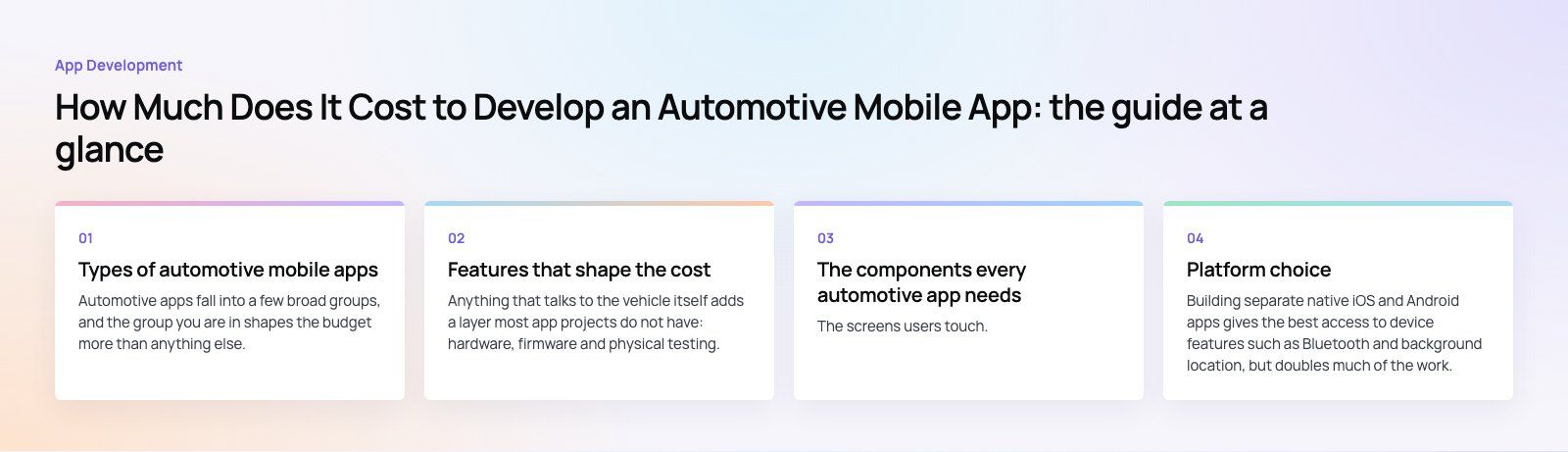
Automotive apps fall into a few broad groups, and the group you are in shapes the budget more than anything else.
Customer facing apps
These support car owners: service booking, maintenance reminders, digital service history, roadside assistance requests, loyalty programs and, for connected cars, remote locking or climate control. Dealerships, workshops and car brands build them to keep customers coming back.
Commerce and marketplace apps
Apps for buying and selling vehicles or parts, auctions, rentals and subscriptions. They need listings, search, payments and often live bidding or booking calendars. The Pioneer Auctions case study, for example, covers an auction app and website for cars and other goods with live bidding, wishlists and payments.
Fleet and operations apps
Tools for fleet managers, drivers and technicians: trip logs, vehicle inspections, fuel and maintenance tracking, dispatch and diagnostics.
In vehicle apps
Apps that run on the car's display, either through phone projection such as Apple CarPlay and Android for Cars, or natively on cars with Android Automotive. These must follow strict platform rules on what can be shown while driving, which narrows design options and adds review effort.
Features that shape the cost
| Feature level | Examples | Why effort rises |
|---|---|---|
| Basic | Sign in, profile, vehicle details, service booking, push notifications, contact options | Standard components, simple backend |
| Intermediate | Payments, service history, dealer or workshop integration, maps and location, loyalty, chat | Third party integrations, more user roles, admin tools |
| Advanced | Live diagnostics, remote vehicle control, telematics, OBD or hardware connections, in car screens, AI based predictions | Hardware testing, security, real time data, platform reviews |
Anything that talks to the vehicle itself adds a layer most app projects do not have: hardware, firmware and physical testing. The Runvse case study is a tuning and calibration product for diesel trucks made of a mobile app, an API and the microcontroller firmware that talks to the vehicle. Each of those three parts needs its own design, build and testing.
The components every automotive app needs
Front end
The screens users touch. For drivers, the interface must be simple, readable at a glance and safe to use. Accessibility, large touch targets and clear status messages matter more here than in many consumer apps.
Backend
The API, database, authentication and admin panel that store vehicles, users, bookings and transactions. Apps that handle vehicle data also need careful security, logging and data retention rules.
Integrations
Most of the effort in automotive apps sits in integrations: dealer management systems, workshop software, parts catalogs, payment gateways, mapping services, telematics providers and the manufacturer's own vehicle APIs where available. Each integration depends on the quality of the other system's documentation and access terms.
Admin and operations tools
Staff need to manage bookings, inventory, users, content and reports. A good admin panel is often as large as the customer app itself.
Platform choice
Building separate native iOS and Android apps gives the best access to device features such as Bluetooth and background location, but doubles much of the work. Cross platform frameworks such as Flutter or React Native share most of the code and suit the majority of customer and dealer apps. In car experiences follow their own platform rules and templates, so plan them as a separate piece of work.
In house team or outsourced development
| Factor | In house team | Outsourced team |
|---|---|---|
| Control | Full day to day control | Shared control through a defined process |
| Cost structure | Salaries, benefits and tools continue between projects | Pay for the project or the team you need |
| Expertise | Must recruit for mobile, backend, integration and possibly hardware skills | Access to an existing team with those skills |
| Speed to start | Hiring takes time | Can start once scope is agreed |
| Scaling | Harder to scale up or down quickly | Easier to adjust team size |
| Communication | Direct and immediate | Needs clear rituals, especially across time zones |
Many companies combine the two: an in house product owner and a few developers, with dedicated developers from a partner adding capacity and specialist skills.
Costs beyond development
- App store accounts and review. Apple and Google require developer accounts, and in car apps go through additional platform review.
- Hosting and data. Telematics and live tracking generate a lot of data, and cloud costs grow with active vehicles.
- Third party services. Maps, SMS, payment processing and vehicle data APIs often charge by usage.
- Maintenance. Operating system updates, security patches, bug fixes and changes when partner APIs change.
- Hardware support. If your app connects to devices, new vehicle models and firmware versions need testing.
- Customer support for drivers who cannot connect, book or pay.
Trends in automotive apps
- Connected car services. More vehicles expose data and remote functions, so owners expect apps to show status and control features.
- In car app platforms. CarPlay, Android Auto and Android Automotive give brands and service providers a route onto the dashboard.
- Voice and assistants. Voice commands and chat assistants reduce the need to touch the screen.
- Digital service and sales. Booking, quotes, payments and paperwork move into apps, which ties the app closely to dealer systems.
- Electric vehicle features. Charging station search, charge scheduling and battery status are now standard requests for EV focused apps.
Planning your budget
- Define your users and the main job each needs the app to do.
- List features and mark which require vehicle data, hardware or third party systems.
- Start with an MVP that proves the core value, and leave advanced features for later releases.
- Confirm access to every API you need before committing to a timeline.
- Budget for maintenance, hosting and support from the start.
Codeeo has delivered more than 200 projects across the UAE and the US with a team of 80+ across Dubai, Riyadh and Karachi. Our mobile app development team and our automotive industry work cover dealer, service and vehicle connected apps, and a product scoping session is a good first step toward an estimate.
Frequently asked questions
It depends on the app type, features, integrations, platforms and team.
A service booking app with standard features is at the lower end. Apps with payments, dealer system integrations and admin tools sit in the middle. Apps that read live vehicle data, control car functions or run on in car screens are the most expensive because they add hardware, security and platform review work.
App DevelopmentCross Platform App Development: How It Saves Time and MoneyHow shared code across iOS and Android cuts build and maintenance effort, which frameworks to consider in 2026, and when native development is still the better call. App DevelopmentHow to Plan an App Development Project From Start to FinishA step by step plan for an app project: define users and goals, scope an MVP, choose platforms, design, build the team, phase the timeline, test and launch.
 App DevelopmentMust Have Features of an HR Management AppThe features an HR management app needs, from onboarding and self service to payroll, performance and analytics, plus when to buy or build.
Tell us what the business needs. We will tell you what to build first.
Schedule a free consultation and get a written recommendation, with costs, before you commit to anything.
Get in touchPROVEN RESULTS
4.7 / 5verified reviews on Google