 Digital TransformationHow Digital Transformation Is Reshaping BusinessesFive ways digital transformation is changing operations, customer experience, data, business models and work, plus the challenges and a practical roadmap.
CodeeoInsightsDigital Transformation
Automotive Digital Transformation: How Connected Factories Work
How connected factories use IoT, analytics, automation and digital twins to improve automotive production, plus the risks and a practical way to start.
Automotive digital transformation means connecting the machines, people and systems inside a vehicle plant so that production data flows in real time instead of sitting in logbooks and spreadsheets. A connected factory uses sensors, analytics, automation and software models of the line to catch faults earlier, change models faster and plan maintenance before something breaks. The payoff is fewer surprises on the shop floor and better decisions in the office.
This guide explains what a connected factory actually is, the technologies behind it, where the value shows up, and the problems manufacturers run into when they try to build one.
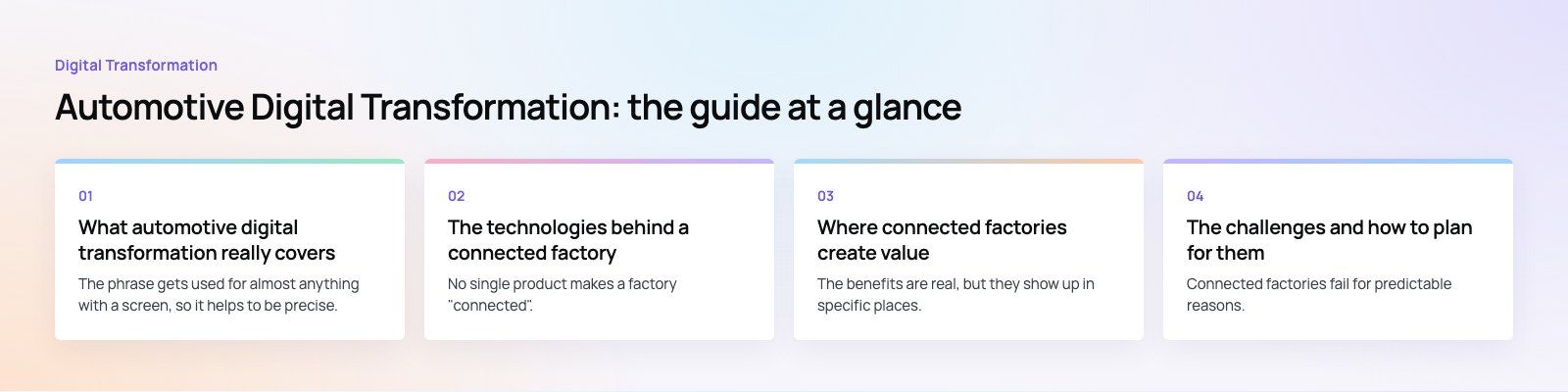
What automotive digital transformation really covers
The phrase gets used for almost anything with a screen, so it helps to be precise. In an automotive context it usually spans three areas:
- The product: software defined vehicles, connected services and over the air updates.
- The customer: online configuration, digital retail, service booking and ownership apps.
- The operation: the plants, suppliers and logistics that build and move the vehicles.
Connected factories sit in the third area. They are often the least visible part of the change, but they decide how quickly a manufacturer can respond to demand, absorb a supplier delay or launch a new variant without stopping the line.
From isolated machines to a connected plant
In a traditional plant, each press, robot cell and paint booth runs its own controller. Data stays local, and problems are found when a quality inspector or a maintenance engineer notices them. In a connected plant, those same machines report their state continuously to a shared data layer. Planning, quality and maintenance teams all read from the same picture, and software can raise an alert the moment a reading drifts out of tolerance.
The technologies behind a connected factory
No single product makes a factory "connected". It is a stack of technologies that only works when the pieces talk to each other.
Industrial Internet of Things (IIoT)
Sensors on motors, spindles, conveyors, welders and environmental systems measure temperature, vibration, torque, current draw and cycle time. Gateways collect those readings from the machine controllers and send them on to a plant or cloud platform. The sensors are cheap; the hard part is naming, timestamping and storing the data consistently so that it can be compared across lines and sites.
Data platforms and analytics
Raw sensor data is only useful once it is combined with context: which vehicle, which part number, which shift, which supplier batch. Analytics platforms join operational data with records from the manufacturing execution system (MES) and the ERP, then surface trends on dashboards. Over time, the same data trains models that predict scrap, energy use or the next likely failure.
Automation and robotics
Body shops have used robots for decades. What changes in a connected plant is that robots and automated guided vehicles report their status, receive new programs centrally and coordinate with the systems around them. Collaborative robots handle repetitive tasks next to people, and machine vision checks welds, gaps and paint finish at line speed.
Digital twins
A digital twin is a software model of a machine, a line or a whole plant that is kept in step with live data. Engineers use it to test a new model changeover, rebalance a line or simulate the effect of a slower supplier before touching the physical plant. The value depends on how accurate and current the model is, so twins are usually built in stages, starting with one bottleneck station.
Integration software
This is the layer most plans underestimate. Connecting a robot vendor's controller to an MES, the MES to the ERP and the ERP to a supplier portal takes APIs, message queues and a lot of careful mapping. Without it, every new system becomes another island. Projects such as cloud integration and custom software for plant dashboards often make the difference between a pilot and a plant wide rollout.
Where connected factories create value
The benefits are real, but they show up in specific places. Here is where manufacturers usually see them first.
| Area | What changes | Typical first step |
|---|---|---|
| Efficiency | Bottlenecks and micro stoppages become visible | Live overall equipment effectiveness (OEE) per station |
| Quality | Defects are traced to a machine, batch or setting | Linking inspection results to process data |
| Flexibility | Model changeovers are planned and tested in software | A twin of one changeover heavy line |
| Maintenance | Repairs are scheduled before failures | Vibration and temperature monitoring on critical assets |
| Sustainability | Energy and material use are measured per vehicle | Metering on paint shops and compressed air |
| Cost | Less scrap, less unplanned downtime, less overtime | Tracking downtime causes by category |
Better efficiency
Most plants already know their headline output. What they often cannot see are the short stoppages of a few seconds that add up across a shift. Connected machines record every one of them, which lets engineers fix the real cause rather than the most memorable one.
Better quality
When a defect appears at final inspection, a connected plant can trace that vehicle back through every station it passed, the torque values applied and the parts it received. That shortens root cause analysis and narrows any recall or rework to the vehicles that are actually affected.
More flexibility
Buyers expect more trims, colors and powertrain options, and plants increasingly build several models on one line. Software that knows the exact sequence of vehicles coming down the line can prepare tooling, parts and instructions for each one.
Predictive maintenance
Instead of servicing equipment on a fixed calendar or waiting for it to fail, maintenance teams watch for early warning signs such as rising vibration or current draw. Repairs move into planned downtime, and spare parts are ordered before they are needed.
Sustainable operations
Paint shops, ovens and compressed air systems are among the largest energy users in a vehicle plant. Measuring their consumption per vehicle makes it possible to set targets, spot leaks and schedule energy heavy processes more carefully.
The challenges and how to plan for them
Connected factories fail for predictable reasons. Planning for them early is cheaper than fixing them later.
Security of operational technology
Connecting machines that were designed to be isolated exposes them to network threats. Plants need segmented networks, controlled remote access and patching processes that respect production schedules. The ISA/IEC 62443 series is the widely used reference for securing industrial automation and control systems, and it is a sensible starting point for any security plan.
Data privacy and ownership
Plant data can include operator performance, supplier information and engineering details that are commercially sensitive. Agree early who owns the data, who can see it, how long it is kept and how it moves between sites, vendors and cloud providers.
Skills gap
A connected plant needs people who understand both the line and the software. Maintenance technicians need to read dashboards, and data engineers need to understand what a torque curve means. Training and mixed teams matter as much as the technology.
Integration with legacy equipment
Plants run machines of very different ages, from different vendors, speaking different protocols. Some will need retrofitted sensors or protocol converters. Map every asset and its data interface before choosing a platform, or the platform will choose your limits for you.
Regulatory compliance
Safety, environmental and data rules differ by country, and vehicles themselves face cybersecurity and software update regulations in many markets. Any change that touches production records or vehicle software should be reviewed against the rules in each market the plant serves.
Cost and return
Sensors, platforms, integration and training all cost money, and the return comes over time. The safest route is a narrow pilot with a clear measure, such as unplanned downtime on one line, that proves value before the program scales.
A practical roadmap for getting started
- Pick one problem. Choose a measurable pain point such as downtime on a bottleneck station or scrap in one process.
- Audit the assets. List the machines involved, their controllers, protocols and existing data.
- Build the data layer. Collect, name and store the readings consistently, with the context needed to make sense of them.
- Show it to the people who act on it. A dashboard that the line supervisor checks every shift beats a sophisticated model no one opens.
- Measure and expand. Once the pilot shows a result, extend it to similar stations, then to other lines and plants.
Software that connects vehicles, devices and people is something we build regularly. Our Runvse case study shows a mobile app, an API and microcontroller firmware working together for diesel truck tuning, and our automotive industry page covers the wider work.
If you are planning plant dashboards, integrations between MES and ERP or a companion app for vehicles, our team of 80+ across Dubai, Riyadh and Karachi can help you scope it. Start with a product scoping session or get in touch.
Frequently asked questions
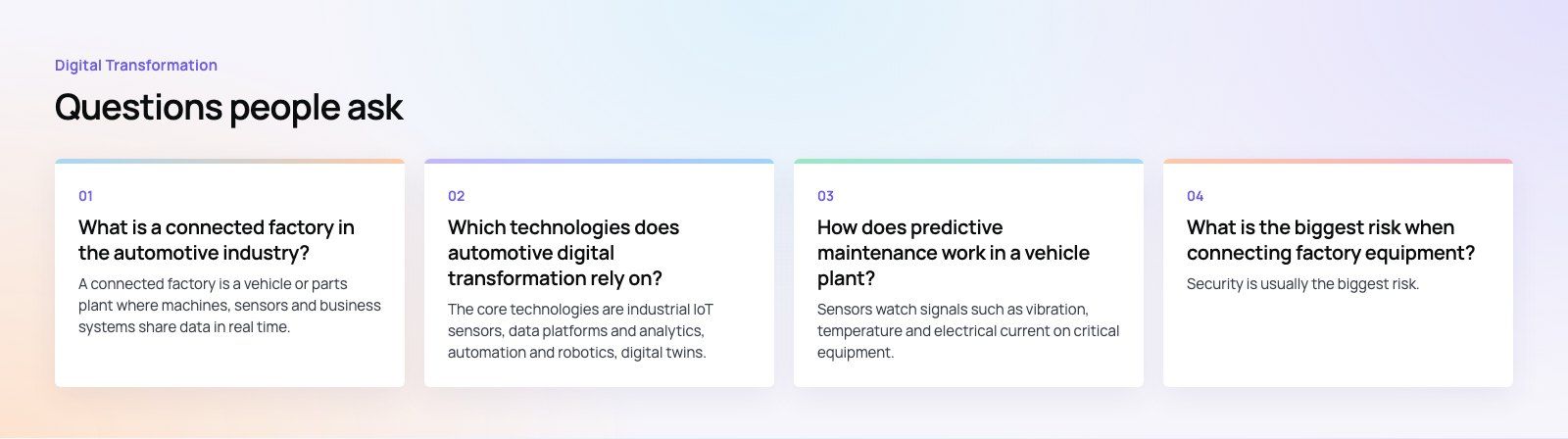
A connected factory is a vehicle or parts plant where machines, sensors and business systems share data in real time.
Instead of each robot or press keeping its information locally, readings flow into a common platform that planning, quality and maintenance teams all use. This lets the plant spot problems early, trace defects quickly and plan maintenance before equipment fails.
Digital TransformationHow Digital Transformation Is Reshaping BusinessesFive ways digital transformation is changing operations, customer experience, data, business models and work, plus the challenges and a practical roadmap. Digital TransformationStrategic Human Resource Management: Aligning HR With GoalsWhat strategic human resource management means, the components of a strategic HR model, and a six step process for aligning HR with business goals.
 Digital TransformationBest CRM for Small Businesses: 10 Options and How to ChooseTen CRM platforms that suit startups and small teams, from HubSpot and Zoho to Kommo and NetHunt, with a comparison table and a practical way to choose.
Tell us what the business needs. We will tell you what to build first.
Schedule a free consultation and get a written recommendation, with costs, before you commit to anything.
Get in touchPROVEN RESULTS
4.7 / 5verified reviews on Google