 Digital TransformationHow Digital Transformation Is Reshaping BusinessesFive ways digital transformation is changing operations, customer experience, data, business models and work, plus the challenges and a practical roadmap.
CodeeoInsightsDigital Transformation
Strategic Human Resource Management: Aligning HR With Goals
What strategic human resource management means, the components of a strategic HR model, and a six step process for aligning HR with business goals.
Strategic human resource management means designing hiring, development, performance and reward practices around what the business is trying to achieve, instead of running HR as a separate administrative function. In practice it comes down to three things: knowing the business goals in detail, turning them into a small number of people priorities, and measuring whether those priorities move the numbers the leadership team cares about.
This guide explains what makes HR strategic, the components that have to be in place, a step by step model for aligning HR with business goals, and the systems and data that make the alignment visible.
What makes HR strategic rather than administrative
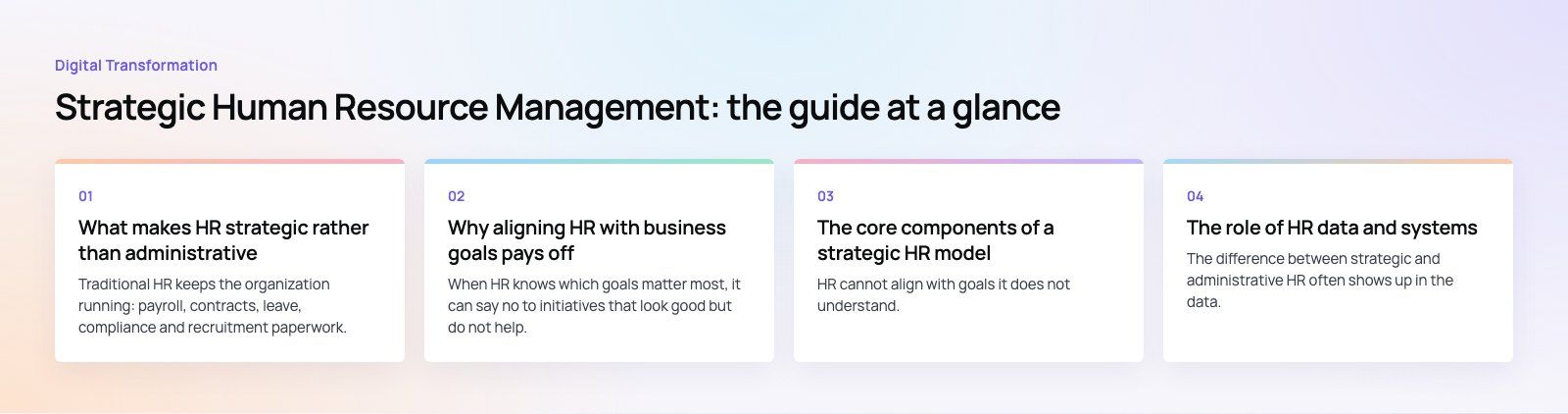
Traditional HR keeps the organization running: payroll, contracts, leave, compliance and recruitment paperwork. That work matters, but it is reactive. A request comes in and HR processes it.
Strategic HR starts from the other end. It asks what the company needs to be able to do in two or three years and works backward to the people, skills, structures and behaviors that will get it there. If the plan is to launch in a new market, strategic HR is already thinking about which roles have to exist there, who could move, and what the hiring pipeline looks like. If the plan is to grow margin, it looks at productivity, turnover in expensive roles and where management time is wasted.
| Area | Administrative HR | Strategic HR |
|---|---|---|
| Starting point | Incoming requests and policy | Business goals and the plan |
| Hiring | Fill open roles as they appear | Plan capabilities ahead of demand |
| Performance | Annual review forms | Goals linked to company objectives, reviewed often |
| Learning | A course catalog | Targeted skills the plan depends on |
| Data | Headcount and payroll reports | Measures tied to business outcomes |
| Seat at the table | Informed after decisions | Involved while decisions are made |
Why aligning HR with business goals pays off
Priorities become clear
When HR knows which goals matter most, it can say no to initiatives that look good but do not help. A team with limited time and budget will always have more ideas than capacity, and alignment is the filter.
Performance improves where it counts
People do better work when they can see how their role connects to what the company is trying to do. Gallup's 2024 Q12 meta-analysis, which covers more than 180,000 teams, found that teams in the top quartile for engagement showed a median 23% difference in profitability and 18% in sales productivity compared with the bottom quartile. Strategic HR is how you get more teams into that top group on purpose.
Spending goes to the right places
Alignment stops money being spread thinly across generic programs. Training, hiring and rewards get concentrated on the roles and skills that drive results.
Talent becomes a competitive advantage
Competitors can copy a product or a price. It is much harder to copy a team that is well hired, well developed and wants to stay. That is the long term payoff of treating people decisions as business decisions.
The core components of a strategic HR model
A clear reading of the business goals
HR cannot align with goals it does not understand. That means reading the actual plan, sitting in on planning sessions, and understanding the market pressures behind it, not just receiving a summary slide.
A people strategy with a few priorities
From the goals, HR picks a short list of priorities. Typical ones are talent acquisition for specific capabilities, performance management, learning and development, engagement and retention, and leadership development. Three to five priorities are manageable. Fifteen are a wish list.
Collaboration with leadership and managers
Strategic HR is a shared effort. Department heads know where the gaps are, and line managers are the ones who actually run performance conversations and keep people engaged. HR designs the system, but managers make it real.
Measures that connect to outcomes
Each priority needs a key performance indicator that a finance director would recognize. Time to hire for critical roles, regretted turnover, internal promotion rate, revenue per employee and engagement scores by team are all common. The point is to show cause and effect, not activity.
Room to adapt
Plans change. A people strategy that was right twelve months ago may be wrong after a new product, a funding round or a restructure. Building in a regular review is what keeps HR strategic instead of drifting back to administration.
A step by step model for aligning HR strategy
- Analyze the current state. Review the business plan, current HR practices and the outside environment, including the local labor market, competitor hiring and any regulatory changes. List where people practices help the plan and where they get in the way.
- Write the people strategy. Translate the gaps into a short list of initiatives, each with an owner, a timeline, the resources it needs and the business goal it supports.
- Communicate it and invite challenge. Share the strategy with senior leaders, managers and staff. Ask what is missing or unrealistic. Strategies built behind closed doors rarely survive contact with the people expected to run them.
- Implement in phases. Start with the initiative that has the clearest link to a business goal and a fast feedback loop. Early wins build credibility for the harder work.
- Measure and adjust. Track the agreed indicators monthly or quarterly. If a program is not moving its measure, change it or stop it.
- Review the whole strategy regularly. At least once a year, or whenever the business plan changes, repeat the analysis and update priorities.
The role of HR data and systems
The difference between strategic and administrative HR often shows up in the data. If headcount lives in one spreadsheet, performance reviews in documents, training records in a learning platform and turnover in payroll exports, nobody can see the full picture. Leaders end up arguing from anecdotes.
Strategic HR needs a single view of the workforce that answers questions like these:
- Which teams have the highest regretted turnover, and what do their engagement scores look like?
- How long does it take to fill the roles the growth plan depends on?
- Do people who complete a development program get promoted faster or stay longer?
- Where are managers carrying too many direct reports to coach well?
Sometimes an off the shelf HR platform covers this. Often the gap is in connecting it to everything else: finance, project systems, CRM and the tools staff use every day. A reporting layer built in Power BI can pull those sources together, and workflow tools on the Microsoft Power Platform can automate approvals, onboarding steps and review reminders. Where the process is unusual enough that no product fits, custom software is the more honest answer.
Common mistakes to avoid
- Copying another company's perks. Free lunches and flexible time work for some businesses because they fit their goals and culture. Copying them without that link adds cost without results.
- Too many initiatives at once. Spreading HR effort across a dozen programs means none of them gets the attention to work.
- Measuring activity instead of outcomes. Training hours delivered and surveys sent are inputs. Retention, promotion rates and productivity are outcomes.
- Leaving managers out. Most of what employees experience comes from their direct manager. If managers are not trained and supported, the strategy stays on paper.
- Treating alignment as a one time project. Business goals move, so the people strategy has to move with them.
Where to start
If HR in your business is mostly administrative today, do not try to change everything at once. Pick one business goal for the coming year, identify the single biggest people constraint on it, and design one initiative with one measure. Run it for a quarter, report the result to leadership, and use that to earn the next step.
If the blocker is that your people data sits in disconnected tools, Codeeo can help. Our team of 80+ across Dubai, Riyadh and Karachi builds reporting, workflow and custom software that gives leaders one view of the workforce. Start with a product scoping session to map what you need.
Frequently asked questions
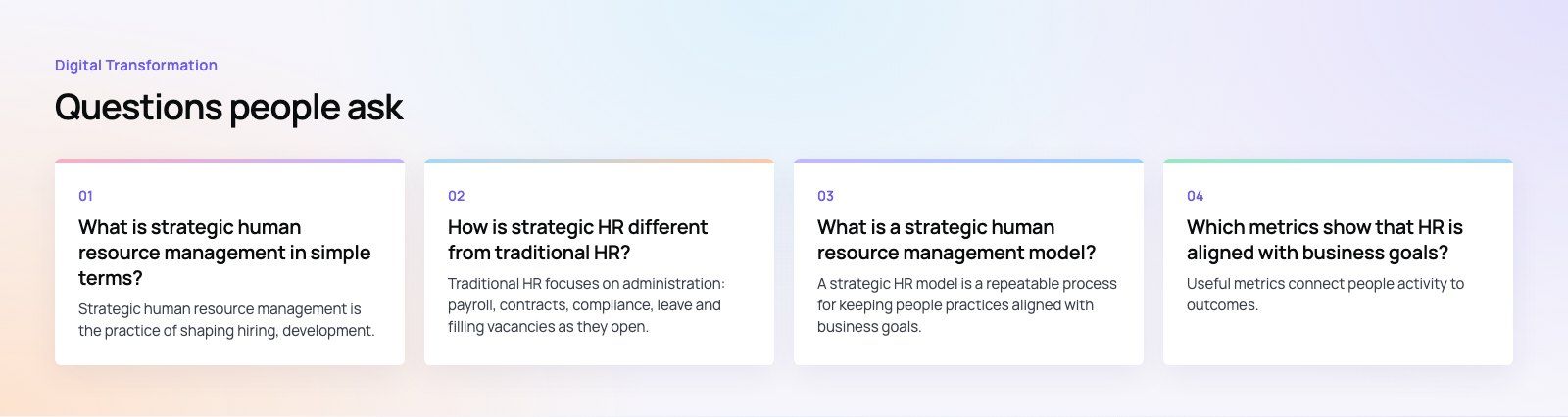
Strategic human resource management is the practice of shaping hiring, development, performance and reward decisions around the goals of the business.
Instead of only processing HR requests, the HR team works with leadership to decide which skills, roles and behaviors the company needs, then builds programs to deliver them and measures whether they improve business results such as retention, productivity and growth.
Digital TransformationHow Digital Transformation Is Reshaping BusinessesFive ways digital transformation is changing operations, customer experience, data, business models and work, plus the challenges and a practical roadmap. Digital TransformationBest CRM for Small Businesses: 10 Options and How to ChooseTen CRM platforms that suit startups and small teams, from HubSpot and Zoho to Kommo and NetHunt, with a comparison table and a practical way to choose.
 Digital TransformationDigital First Strategy: What It Is and How to Build OneWhat a digital first strategy means, how it differs from a traditional model, the benefits, a step by step roadmap and the challenges to plan for.
Tell us what the business needs. We will tell you what to build first.
Schedule a free consultation and get a written recommendation, with costs, before you commit to anything.
Get in touchPROVEN RESULTS
4.7 / 5verified reviews on Google