 Digital TransformationHow Digital Transformation Is Reshaping BusinessesFive ways digital transformation is changing operations, customer experience, data, business models and work, plus the challenges and a practical roadmap.
CodeeoInsightsDigital Transformation
Digital First Strategy: What It Is and How to Build One
What a digital first strategy means, how it differs from a traditional model, the benefits, a step by step roadmap and the challenges to plan for.
A digital first strategy means designing how your business sells, serves and operates around digital channels and data first, then fitting physical processes around them. It is not about buying more software. It is about deciding that the website, the app, the customer data and the automated workflow are the main way the business runs, and organizing teams, budgets and decisions to match.
This guide explains what the approach involves, how it differs from a traditional model, the benefits worth chasing, a practical roadmap for putting it in place and the obstacles that usually slow companies down.
What a digital first strategy actually means
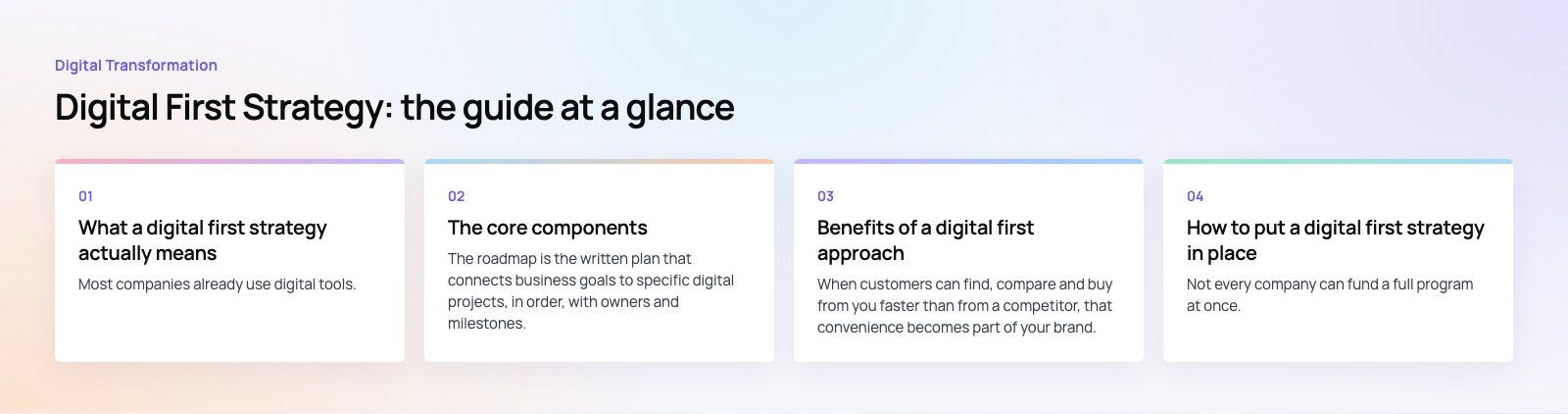
Most companies already use digital tools. The difference with a digital first company is where those tools sit. In a traditional business, technology supports a process that was designed for paper, phone calls or a shop counter. In a digital first business, the process is designed for the digital channel from the start, and the offline version is the exception.
A simple test: when a customer wants to buy, book, ask a question or complain, what is the default route? If the answer is a phone call to a person who then types it into a system, the business is still traditional. If the answer is a self-service flow that records everything and hands off to a person only when needed, it is moving toward digital first.
Digital first compared with traditional operations
| Area | Traditional business | Digital first business |
|---|---|---|
| Operations | Separate departments with their own tools | Cross-functional teams working from shared data |
| Focus | The product or service on offer | The full customer experience around it |
| Customer interaction | Mostly in person or by phone | Mostly through web, app, chat and email |
| Role of technology | A support function | A core driver of how value is delivered |
| Decision making | Experience and instinct | Data, tested against experience |
The core components
A digital strategy roadmap
The roadmap is the written plan that connects business goals to specific digital projects, in order, with owners and milestones. Without it, digital work becomes a list of disconnected purchases. A good roadmap answers three questions: what are we trying to change, which projects move that number, and what has to be true before each project can start.
Scalable, flexible technology
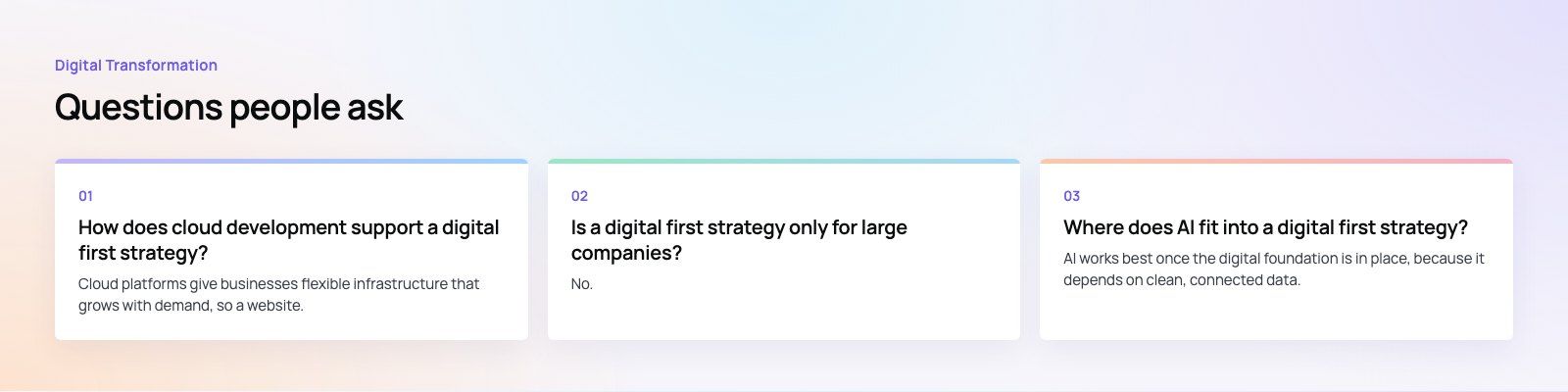
Digital first operations need systems that can grow and change without a rebuild every year. In practice that usually means cloud hosting, systems that talk to each other through APIs, and a modern website or app stack that your team can update without waiting weeks for a developer. Choosing custom software only where off the shelf tools genuinely fall short keeps the stack manageable.
Data driven decision making
Every digital interaction produces data. The point is to use it: track what customers do, measure which changes improve results, and retire the ideas that do not work. That requires clean data definitions, a single place to report from, and leaders who are willing to change course when the numbers disagree with them.
Customer experience at the center
Digital first does not mean digital only. It means the customer can do what they need, on the channel they prefer, without repeating themselves. Mapping the steps a customer takes from first visit to repeat purchase is often the most useful exercise a leadership team can do, because it shows exactly where the friction sits.
Benefits of a digital first approach
A clearer competitive position
When customers can find, compare and buy from you faster than from a competitor, that convenience becomes part of your brand. Smaller firms in particular can compete with larger ones by being easier to deal with online.
Faster reaction to change
Digital channels can be changed in days. A new offer, a new market or a new pricing model can be tested on a landing page or in an app release long before a physical rollout would be possible.
Lower operating friction
Automating routine tasks such as order confirmations, appointment reminders, invoice matching and lead routing frees staff for work that needs judgement. It also cuts the errors that come from retyping information between systems.
Stronger customer loyalty
Personalized messages, quick answers and consistent service across channels are what bring customers back. Digital first businesses can do this at scale because the data about each customer is in one place.
How to put a digital first strategy in place
- Assess your digital maturity. List the systems you use, how customers reach you, where data lives and which processes are still manual. Be honest about gaps. A short website audit is often a good first step because the website is where most customers meet the business.
- Define the vision and the measures. Pick a small number of outcomes, such as share of sales through digital channels, time to answer a customer, or cost per order, and agree how you will measure them.
- Build the roadmap. Sequence projects so early ones create the foundations later ones need. Data and integration work usually comes before personalization; a fast, reliable website usually comes before paid marketing.
- Strengthen the foundation. Invest in hosting, integrations, security and the core platforms. This is less visible than a new app but it decides whether everything else works.
- Develop a digital first culture. Give teams permission to test, measure and change. Reward people for improving the numbers, not for defending the old way.
- Deliver in phases and review. Release in small steps, review results every quarter and adjust the roadmap. A roadmap that never changes is a sign nobody is reading the data.
Where to start if resources are tight
Not every company can fund a full program at once. In that case, start where customers feel it most. For a retailer that might be the online store and checkout; for a service firm it might be online booking and follow-up; for a manufacturer it might be the order and stock system. One visible success builds the case for the next step.
Common challenges and how to handle them
Resistance to change
Staff may worry that new tools mean more work or fewer jobs. Explain clearly why the change is happening, involve the people who do the work in designing the new process, and train them properly before switching anything off. Change that is done to people tends to fail; change that is done with them tends to stick.
Budget limits
Digital programs compete with every other priority. Rank projects by their effect on revenue and efficiency, phase the work, and prefer proven platforms over building everything from scratch. Measuring results early makes the next budget conversation easier.
A shortage of digital skills
Hiring experienced product, data and engineering people is hard. Combine training for existing staff with outside help for specialist work. Many companies use dedicated developers to add capacity without building a full in-house team.
Disconnected legacy systems
Older systems often hold the most important data and are the hardest to connect. Plan integration work explicitly rather than hoping new tools will fix it. Sometimes the right answer is to replace a system; sometimes a well designed connection is enough.
Signs your strategy is working
- A growing share of customer requests are completed without a phone call or manual handoff.
- Leaders look at the same dashboard and agree on what it says.
- New ideas reach customers in weeks rather than months.
- Website and app performance is measured, for example against Google's Core Web Vitals guidance (web.dev, 2026), and improves over time.
- Staff suggest digital improvements themselves instead of waiting to be told.
Bringing it together
A digital first strategy is a series of decisions: put the customer experience at the center, make data the basis for choices, build on flexible technology and deliver in phases that prove value. Codeeo has delivered 200+ projects across the UAE and the US with a team of 80+ across Dubai, Riyadh and Karachi, from web development to mobile apps. If you want help turning your plan into a roadmap, talk to our team.
Frequently asked questions
A digital first strategy is a way of running a business where digital channels and data are the default for selling, serving customers and operating.
Processes are designed for web, app and automated workflows first, with in-person or manual steps used only where they add value. The goal is a faster, more consistent customer experience and better decisions based on real data.
Digital TransformationHow Digital Transformation Is Reshaping BusinessesFive ways digital transformation is changing operations, customer experience, data, business models and work, plus the challenges and a practical roadmap. Digital TransformationStrategic Human Resource Management: Aligning HR With GoalsWhat strategic human resource management means, the components of a strategic HR model, and a six step process for aligning HR with business goals.
 Digital TransformationBest CRM for Small Businesses: 10 Options and How to ChooseTen CRM platforms that suit startups and small teams, from HubSpot and Zoho to Kommo and NetHunt, with a comparison table and a practical way to choose.
Tell us what the business needs. We will tell you what to build first.
Schedule a free consultation and get a written recommendation, with costs, before you commit to anything.
Get in touchPROVEN RESULTS
4.7 / 5verified reviews on Google