 Digital TransformationHow Digital Transformation Is Reshaping BusinessesFive ways digital transformation is changing operations, customer experience, data, business models and work, plus the challenges and a practical roadmap.
CodeeoInsightsDigital Transformation
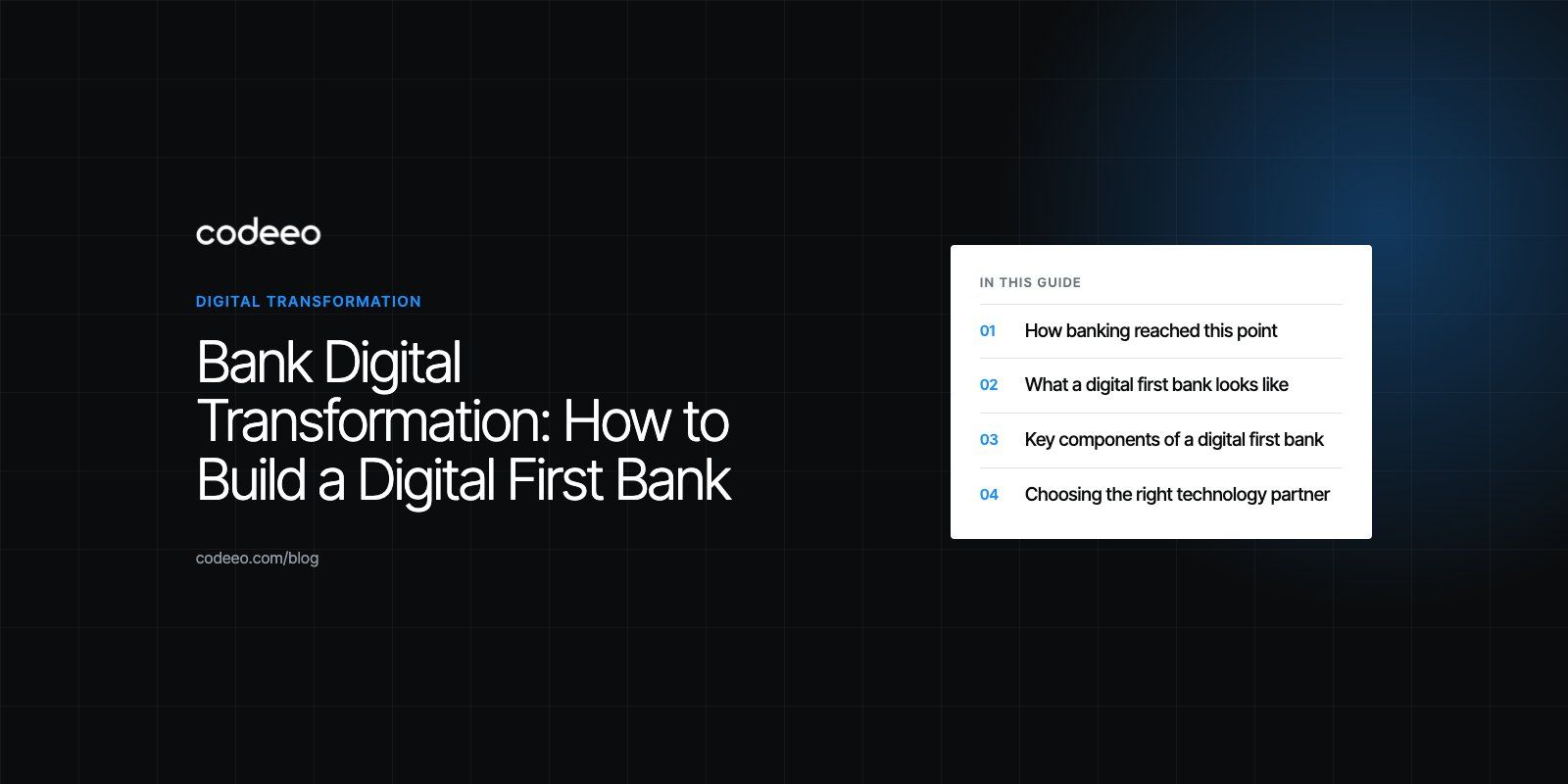
Bank Digital Transformation: How to Build a Digital First Bank
What bank digital transformation involves: the components of a digital first bank, how to choose a technology partner and practical steps to modernize in phases.
Bank digital transformation is the shift from branch led, paper heavy banking to a bank where customers can open accounts, move money, borrow and get help through digital channels first. It combines a strong mobile experience with modern core systems, open APIs, automation, data and security. The banks that do it well treat it as a change in how the whole institution works, not a new app placed on top of old processes.
This guide covers how banking got here, the components of a digital first bank, how to choose a technology partner and the practical steps that make the change manageable.
How banking reached this point
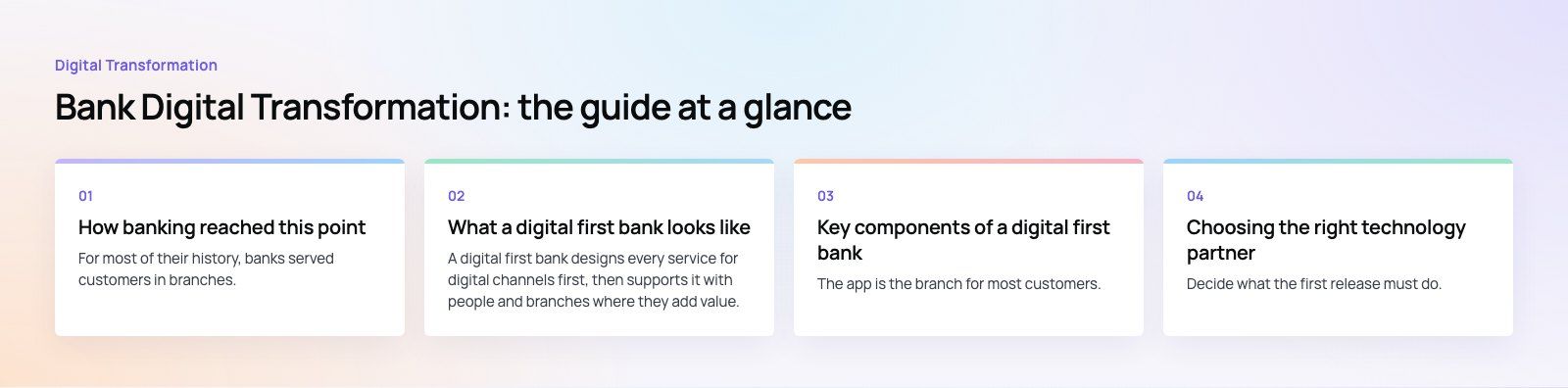
For most of their history, banks served customers in branches. ATMs brought the first self service, then internet banking moved statements and transfers online. Smartphones changed expectations again: customers now compare their bank's app with the best apps they use every day, not with other banks.
Fintech companies raised the bar further by building around the customer from day one, with fast onboarding, instant notifications and simple design. Traditional banks have the trust, licenses and balance sheets that fintechs often lack, but many still run on core systems built decades ago. Bank digital transformation is about closing that gap.
What a digital first bank looks like
A digital first bank designs every service for digital channels first, then supports it with people and branches where they add value. Customers can check balances, pay bills, transfer money, apply for products, dispute a transaction and get advice from their phone. Behind the screen, routine processes such as reconciliation are automated, and staff spend their time on complex cases rather than data entry.
Why banks cannot wait
- Customer expectations. People expect instant, mobile access around the clock, with clear information and quick resolution when something goes wrong.
- Competition from fintechs and big tech. Payments, lending and savings are increasingly offered by companies outside traditional banking.
- Cost and efficiency. Manual back office work is slow, expensive and error prone. Automation frees staff and reduces operational risk.
- Regulation. Open banking rules, data protection laws and stronger security requirements in many markets push banks to modernize how they share and protect data.
Key components of a digital first bank
| Component | What customers notice | What it needs underneath |
|---|---|---|
| Mobile first experience | An app that handles most needs quickly | Well designed APIs, reliable core integration, strong testing |
| Digital identity and onboarding | Account opening in minutes, without a branch visit | Identity verification, document checks, anti fraud controls |
| Personalization with AI | Useful insights on spending and relevant product suggestions | Clean transaction data, model governance, privacy controls |
| Open banking | Connecting their bank to apps they choose, with consent | Secure APIs, consent management, partner onboarding |
| Embedded finance | Banking services inside other services, such as paying or borrowing at checkout | Partner APIs, risk and compliance checks in real time |
| Automation | Faster approvals and fewer errors | Workflow tools, robotic process automation, exception handling |
| Cybersecurity | Confidence that money and data are safe | Encryption, fraud detection, monitoring, regular testing |
Mobile first design
The app is the branch for most customers. It should make the top tasks fast, explain fees and status clearly, and handle failures gracefully. Cross platform frameworks let banks ship to iOS and Android from one codebase, while native development remains an option for the most demanding features.
AI powered personalization
AI can categorize spending, flag unusual activity, suggest budgets and highlight relevant products. It works only as well as the data beneath it, and in a regulated industry it needs clear governance: explainable decisions, human review for credit outcomes and strict privacy controls.
Open banking and APIs
Open banking lets customers share their financial data with third party providers they trust, through secure APIs and with their explicit consent. The UK's Open Banking program is a well known example, and regulators in other markets, including the Gulf, have introduced their own open banking and open finance frameworks. For banks, the same APIs also make internal development faster.
Digital identity
Remote onboarding with document checks, biometrics and database verification removes the need for a branch visit and cuts drop off during account opening. It also strengthens security when combined with device binding and passkeys for sign in.
Blockchain and digital assets
Distributed ledgers have practical uses in cross border payments, trade finance and settlement, but adoption is uneven and depends on regulation in each market. Most banks treat this as an area to pilot carefully rather than a foundation for their core experience.
Data analytics
Banks hold rich data about how customers use money. Used responsibly, analytics improves product design, risk assessment, marketing and service. It requires a reliable data platform, a single view of each customer and clear rules on what data is used for which purpose.
Robotic process automation
Software robots can handle repetitive tasks such as data entry, reconciliation and report preparation. RPA is often a quick win while core systems are being modernized, but it should not become a permanent patch over processes that need redesigning.
Cybersecurity
Every new channel and API is a new attack surface. Encryption, fraud monitoring, regular penetration testing and a clear incident response plan are essential. Frameworks such as the NIST Cybersecurity Framework help structure this work as the bank's digital estate grows.
Choosing the right technology partner
Define your needs first
Decide what the first release must do. Basic account management and payments is a very different project from a full platform with lending, investments and budgeting tools. Know your target customers and the problems they complain about most.
What to look for
- Fintech experience. Ask for examples of payment, banking or financial apps and the problems they solved.
- Security practice. Ask how they handle secure coding, secrets, access control, testing and compliance requirements.
- Integration skills. Most of the effort in banking projects is connecting to core systems, card processors and third party services.
- Delivery method. Short iterations with regular demos reduce risk in long programs.
- Clear communication. You need a partner who explains trade offs plainly and raises problems early.
Evaluate proposals and references
Compare proposals on approach, team, timeline and how they handle risk, not only on cost. Speak to past clients. A small paid discovery phase is a good way to test a partner before committing to a full build.
Practical steps to streamline the transformation
1. Confront your technical debt
Map the current state honestly. Look for manual tasks that could be automated, compliance gaps, security weaknesses, slow systems, poor code quality and legacy frameworks that block change. An independent codebase review is a quick way to see where existing software stands.
2. Close the skills gap
Assess your team's skills in cloud, integration, data, AI and security. Train internal staff for the knowledge that should stay in house, and bring in outside specialists for focused work. Avoid outsourcing the understanding of your own systems entirely.
3. Modernize in phases
Replacing a core banking system in one step is risky. Many banks wrap legacy systems in APIs, move customer facing services first and migrate core functions gradually. Integration platforms such as Azure Integration Services are often used to connect old and new.
4. Put the customer at the center
Measure success by customer outcomes: faster onboarding, fewer failed payments, quicker dispute resolution and higher satisfaction. Test designs with real customers before building at scale.
For a sense of what a modern financial product involves, our Purpose Payment case study describes a payments app where every purchase sends a share to the customer's chosen charity, with an app, portals and an API.
Codeeo has delivered 200+ projects across the UAE and the US, with a team of 80+ across Dubai, Riyadh and Karachi. To see how we approach banking and payments work, visit our fintech page or our mobile app development service.
Frequently asked questions
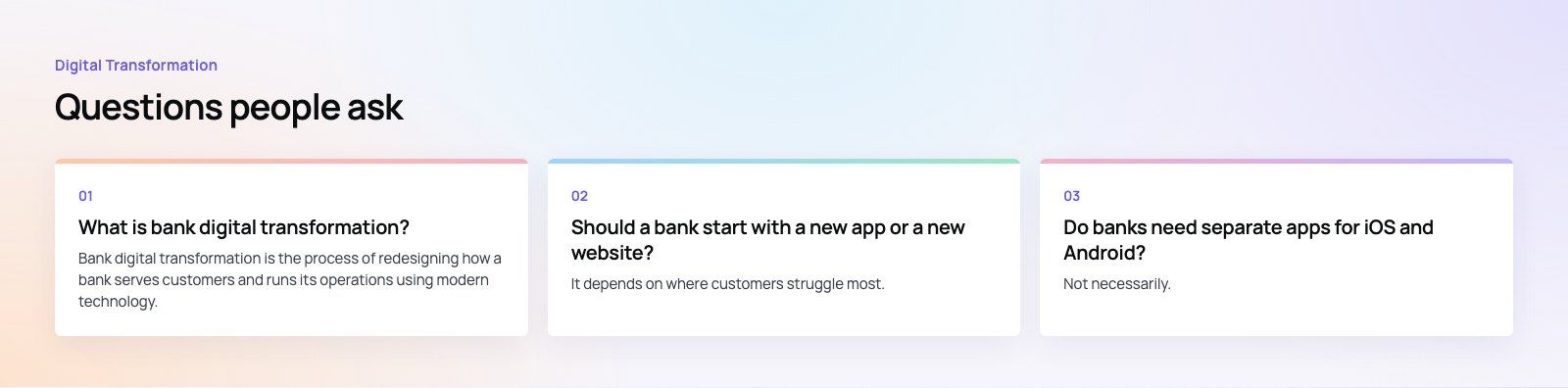
Bank digital transformation is the process of redesigning how a bank serves customers and runs its operations using modern technology.
It includes mobile banking, digital onboarding, open APIs, automation, data analytics and stronger cybersecurity. The goal is a bank where most customer needs are met quickly through digital channels, while staff focus on complex cases and advice.
Digital TransformationHow Digital Transformation Is Reshaping BusinessesFive ways digital transformation is changing operations, customer experience, data, business models and work, plus the challenges and a practical roadmap. Digital TransformationStrategic Human Resource Management: Aligning HR With GoalsWhat strategic human resource management means, the components of a strategic HR model, and a six step process for aligning HR with business goals.
 Digital TransformationBest CRM for Small Businesses: 10 Options and How to ChooseTen CRM platforms that suit startups and small teams, from HubSpot and Zoho to Kommo and NetHunt, with a comparison table and a practical way to choose.
Tell us what the business needs. We will tell you what to build first.
Schedule a free consultation and get a written recommendation, with costs, before you commit to anything.
Get in touchPROVEN RESULTS
4.7 / 5verified reviews on Google