 DevOpsPlatform Engineering vs DevOps: Differences and How They FitPlatform engineering vs DevOps explained: what each one is, where they overlap, the tools involved, and how to tell which one your organization needs next.
Benefits of DevOps for Business: What Actually Changes
The real business benefits of DevOps: faster releases, fewer failed changes, quicker recovery, and how to measure them with DORA metrics.
The main business benefits of DevOps are faster and more frequent releases, fewer failed changes, quicker recovery when something does break, and less time wasted on manual handoffs between development and operations. Those gains come from shared ownership, automation of build, test and deployment, and constant feedback from production. For a business, that means features reach customers sooner, outages are shorter and engineering time goes into the product instead of firefighting.
This guide explains what DevOps is, how it differs from Agile, the benefits it brings, how to measure them and how to start without a large reorganization.
What DevOps means
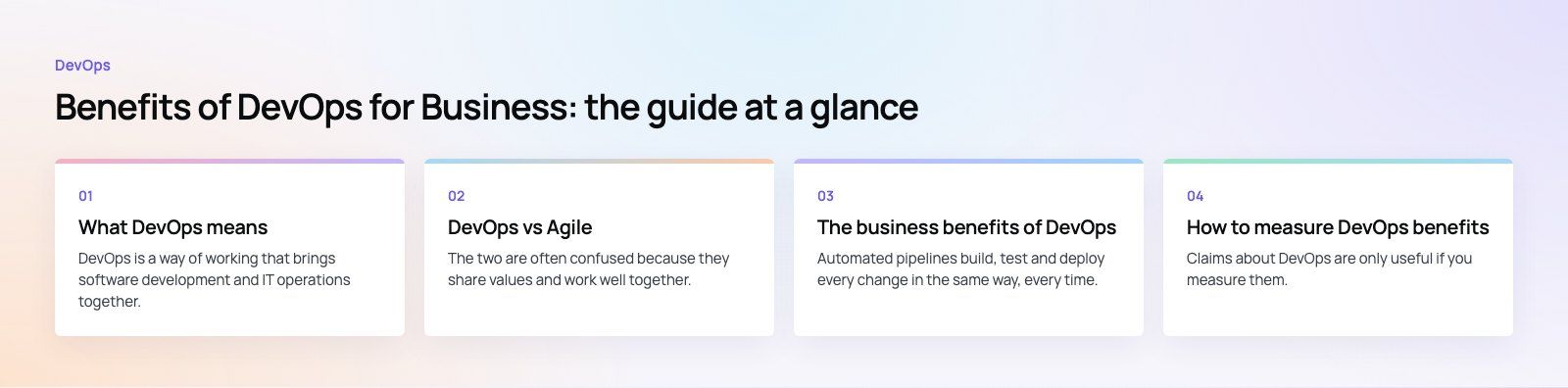
DevOps is a way of working that brings software development and IT operations together. Instead of developers writing code and passing it over a wall to an operations team that deploys and runs it, one group shares responsibility for building, releasing and running the software.
It combines three things:
- Culture: shared goals, open communication and blameless learning from incidents.
- Practices: version control for everything, continuous integration, continuous delivery, infrastructure as code and monitoring.
- Tools: pipelines, automated tests, container platforms and observability tools that make those practices routine.
Tools alone do not make a team DevOps. Buying a pipeline product without changing how people share ownership usually gives you automation around the same old bottlenecks.
DevOps vs Agile
The two are often confused because they share values and work well together. Agile is about how teams plan and build software: short iterations, close collaboration with stakeholders and responding to change. DevOps extends that thinking past development into release and operations, so working software reaches users quickly and keeps running well.
| Aspect | Agile | DevOps |
|---|---|---|
| Main focus | Planning and building software iteratively | Delivering and running software reliably |
| Who is involved | Developers, testers, product owners, stakeholders | Development and operations, often security too |
| Feedback from | Stakeholders and users at the end of each iteration | Automated tests and production monitoring, continuously |
| Typical practices | Sprints, backlogs, stand ups, retrospectives | CI/CD, infrastructure as code, monitoring, incident reviews |
| Measures of success | Working software delivered each iteration | Delivery speed and stability in production |
Most effective teams use both: Agile to decide what to build next, DevOps to get it into users' hands safely.
The business benefits of DevOps
Faster delivery and shorter time to market
Automated pipelines build, test and deploy every change in the same way, every time. That removes waiting for manual release windows and lets teams release small changes frequently. Small releases are easier to test, easier to reverse and reach customers sooner, so the business can respond to competitors, feedback and regulation without long release cycles.
Higher quality and stability
Continuous integration runs automated tests on every change, so defects are caught within minutes of being written rather than weeks later. Because each release is small, the cause of a problem is usually obvious. Combined with practices such as feature flags and gradual rollouts, this reduces the number of changes that fail in production.
Faster recovery from incidents
No team prevents every failure. DevOps focuses on spotting problems quickly through monitoring and alerts and fixing them quickly through automated rollbacks and well practiced runbooks. Shorter outages protect revenue, reputation and customer trust more than any promise of perfect uptime.
Better collaboration and less friction
When developers and operations staff share goals and tools, fewer issues get lost in handoffs. Developers understand how their code behaves in production, and operations staff are involved early enough to shape decisions about infrastructure and monitoring. Blameless incident reviews turn mistakes into fixes rather than finger pointing.
Higher productivity
Automating repetitive work such as builds, environment setup, deployments and routine checks frees engineers to work on features. Infrastructure as code means a new test environment is a command away rather than a ticket and a week's wait. Over time, teams spend less effort on the mechanics of shipping and more on the product.
Better control of infrastructure costs
Rather than promising savings, it is more honest to describe what drives them. Infrastructure defined in code is visible and reviewable, so unused servers and oversized resources are easier to spot. Cloud environments can scale up for demand and down when quiet. Fewer failed releases and shorter outages also reduce the cost of rework and lost sales. The investment is real, in tooling, training and engineering time, so the return depends on how often you release and how much downtime costs you.
Ability to adapt and scale
Continuous improvement is built into DevOps. Teams review metrics and incidents, change their process and measure again. The same automation that supports one product scales to many, which makes it easier to add services, regions or teams without multiplying manual work.
Better customer experience
Customers feel all of the above: features and fixes arrive faster, the product is more reliable and problems are resolved quickly. Monitoring real user behavior also shows teams where performance or usability needs attention, for example slow pages that hurt Core Web Vitals and conversions.
How to measure DevOps benefits
Claims about DevOps are only useful if you measure them. The research program known as DORA defines a widely used set of software delivery metrics, grouped into throughput and instability:
- Change lead time: how long a committed change takes to reach production.
- Deployment frequency: how often you deploy to production.
- Failed deployment recovery time: how quickly you recover when a deployment causes a failure.
- Change fail rate: the share of deployments that need immediate fixing or rollback.
- Deployment rework rate: how many deployments are unplanned and made to fix a user facing problem.
Record these before you change anything, then track them monthly. They give leadership a clear picture of progress without needing to understand the tooling.
How to start with DevOps
- Put everything in version control. Application code, configuration, database migrations and infrastructure definitions all belong in Git.
- Automate the build and tests. Every pull request should trigger a build and an automated test run.
- Automate deployment to one environment. Start with staging, then extend the same pipeline to production.
- Define infrastructure as code. Use a tool such as Terraform, Bicep or your cloud's own templates so environments are reproducible.
- Add monitoring and alerts. Track errors, latency and resource use, and route alerts to the people who can fix them.
- Review incidents without blame. After every significant incident, write down what happened and change the system to prevent a repeat.
- Measure and repeat. Track the delivery metrics above and pick the next bottleneck to remove.
Common mistakes
- Treating DevOps as a job title only. Hiring one "DevOps engineer" while teams stay separate rarely changes outcomes.
- Automating a broken process. Simplify the release process first, then automate it.
- Skipping tests. A fast pipeline without good tests just ships bugs faster.
- Ignoring security. Build dependency scanning, secret management and access controls into the pipeline from the start.
- Trying to change everything at once. Start with one product or team, prove the benefit and expand.
If you are not sure where your current delivery process stands, a codebase review will show the gaps in tests, pipelines and infrastructure.
Codeeo's team of 80+ across Dubai, Riyadh and Karachi has delivered 200+ projects across the UAE and the US, and we build delivery pipelines into the software we ship. If you want help setting up CI/CD and cloud infrastructure, see our custom software development and Azure integration services, or bring in dedicated developers to work inside your team.
Frequently asked questions
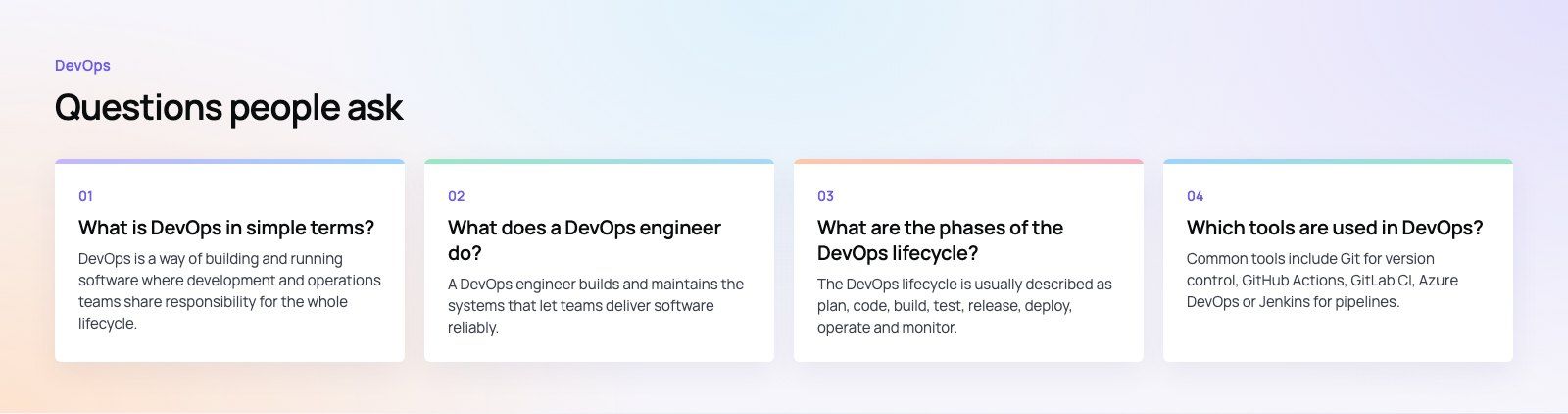
DevOps is a way of building and running software where development and operations teams share responsibility for the whole lifecycle.
They use automation to build, test and deploy every change consistently, and monitoring to see how the software behaves in production. The result is faster, smaller and safer releases, and quicker fixes when something goes wrong.
DevOpsPlatform Engineering vs DevOps: Differences and How They FitPlatform engineering vs DevOps explained: what each one is, where they overlap, the tools involved, and how to tell which one your organization needs next. DevOpsGitLab vs Jenkins: Which CI/CD Tool Fits Your Team?GitLab vs Jenkins compared on setup, features, scaling, security, integrations and total cost, with a simple checklist for choosing the right CI/CD tool.
 DevOpsConfiguration Management Tools in DevOps: How the Leaders CompareAnsible, Puppet, OpenVox, Chef, Salt, Terraform and OpenTofu compared: what configuration management does in DevOps and how to choose a tool.
Tell us what the business needs. We will tell you what to build first.
Schedule a free consultation and get a written recommendation, with costs, before you commit to anything.
Get in touchPROVEN RESULTS
4.7 / 5verified reviews on Google