 DevOpsPlatform Engineering vs DevOps: Differences and How They FitPlatform engineering vs DevOps explained: what each one is, where they overlap, the tools involved, and how to tell which one your organization needs next.
Configuration Management Tools in DevOps: How the Leaders Compare
Ansible, Puppet, OpenVox, Chef, Salt, Terraform and OpenTofu compared: what configuration management does in DevOps and how to choose a tool.
Configuration management tools in DevOps automate how servers and environments are set up and kept in a known state, so every machine is configured the same way from code rather than by hand. The main options are Ansible, Puppet (and its community fork OpenVox), Chef and Salt, with Terraform or OpenTofu usually handling infrastructure provisioning alongside them and Jenkins or another CI system running the whole pipeline. For most new teams, Ansible is the easiest starting point.
This guide explains what configuration management does, compares the main tools on architecture, language and fit, and covers how to choose and introduce one without disrupting existing systems.
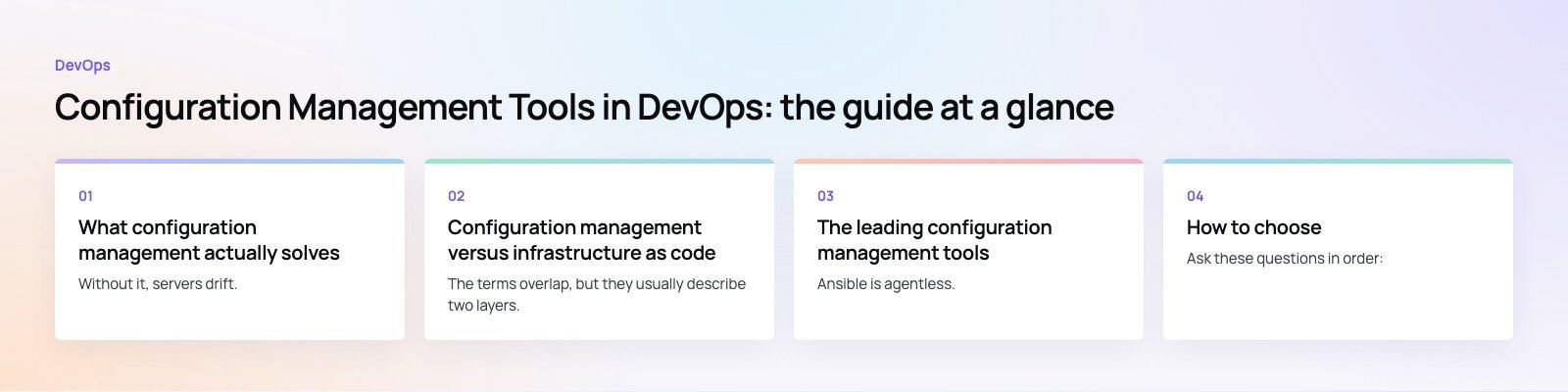
What configuration management actually solves
Without it, servers drift. One gets a security patch, another does not. Someone tweaks a config file during an incident and never writes it down. Months later, staging and production behave differently and nobody knows why.
Configuration management fixes this by describing the desired state of each system in code: which packages are installed, which services run, which users exist, what each config file contains. A tool then applies that description and corrects any drift. The benefits follow directly:
- Consistency. Every environment is built from the same definitions.
- Repeatability. A lost server can be rebuilt in minutes rather than days.
- Auditability. Changes go through version control and review like any other code.
- Speed. One change can be rolled out across hundreds of machines at once.
- Security. Hardening rules and patches are applied everywhere, not just where someone remembered.
Configuration management versus infrastructure as code
The terms overlap, but they usually describe two layers. Provisioning tools such as Terraform and OpenTofu create the infrastructure itself: networks, virtual machines, databases, load balancers and cloud services. Configuration management tools then set up what runs on those machines. Many teams use one of each. Containers shift the balance further: when applications ship as images and run on Kubernetes, much of the per server configuration moves into the image build and deployment manifests, and configuration management focuses on the hosts and any systems that are not containerized.
The leading configuration management tools
Ansible
Ansible is agentless. It connects to machines over SSH (or WinRM for Windows) and runs tasks described in YAML playbooks, so there is nothing to install on the managed nodes. Playbooks read almost like a checklist, which makes Ansible approachable for developers and system administrators alike. A large library of modules and community collections covers most common systems, cloud providers and network devices. The official Ansible documentation is a good place to start.
Best for: teams that want quick wins, mixed environments, and ad hoc automation alongside full configuration management.
Watch out for: performance on very large fleets, since it pushes changes over SSH, and playbooks that grow messy without a clear role structure.
Puppet and OpenVox
Puppet uses a declarative, model driven language. You describe the end state in manifests, and agents on each node check in with a central server and converge to that state on a regular schedule. It handles large, varied estates well and offers strong reporting on what changed and where.
The open source picture has changed. Perforce, which owns Puppet, stopped publishing public open source Puppet packages in late 2024 and now steers users to its commercial offerings. In 2025 the Vox Pupuli community released OpenVox, a community maintained fork intended as a drop in replacement. Teams on open source Puppet should decide which path they are on before planning upgrades.
Best for: large estates that need continuous enforcement and detailed compliance reporting.
Watch out for: a steeper learning curve, the overhead of running the server and agents, and the licensing decision above.
Chef
Chef treats infrastructure as code written in a Ruby based language. Configuration is organized into recipes and cookbooks, and nodes run a client that pulls and applies them. It is very flexible, because anything Ruby can express, Chef can do, and its companion tools add compliance testing and auditing.
Best for: teams with strong development skills who want maximum flexibility and testing built into their infrastructure code.
Watch out for: the need for Ruby knowledge and more moving parts than agentless tools.
Salt
Salt, often still called SaltStack, is built around a fast, event driven messaging layer between a master and its minions. Changes can be pushed to many machines very quickly, and its event system can trigger automated responses when something happens on a node. Configuration is written in YAML with Jinja templating, and the Salt Project documentation covers its architecture in detail.
Best for: large fleets where speed of execution and event driven automation matter.
Watch out for: a smaller community than Ansible and a more complex initial setup.
Terraform and OpenTofu
Strictly speaking these are provisioning tools rather than configuration management, but they sit at the heart of most DevOps toolchains. You declare infrastructure in HashiCorp Configuration Language, and the tool compares that with what exists and plans the changes. Providers cover all major clouds and many SaaS platforms.
Terraform moved from an open source license to the Business Source License in 2023, and HashiCorp is now part of IBM. In response, the community created OpenTofu, an open source fork under the Linux Foundation that remains largely compatible with Terraform configurations. Most teams can use either; the choice usually comes down to licensing preferences and which features each project adds over time.
Jenkins and other CI systems
Jenkins is a continuous integration server, not a configuration management tool, but it is often what runs the tools above. With Jenkins Pipeline, the build, test and deploy steps are written as code, and a stage can call Ansible, Terraform or any other tool. GitHub Actions, GitLab CI and Azure Pipelines fill the same role. Teams on Microsoft's stack commonly run Ansible or Terraform tasks inside Azure Pipelines to provision and configure Azure resources as part of every release.
How the tools compare
| Tool | Main role | Architecture | Language | Learning curve |
|---|---|---|---|---|
| Ansible | Configuration and orchestration | Agentless, push over SSH | YAML | Gentle |
| Puppet / OpenVox | Configuration enforcement | Agent and server, pull | Puppet DSL | Steeper |
| Chef | Configuration as code | Agent and server, pull | Ruby based DSL | Steeper |
| Salt | Configuration and remote execution | Master and minions, push and events | YAML with Jinja | Moderate |
| Terraform / OpenTofu | Infrastructure provisioning | CLI with state file | HCL | Moderate |
| Jenkins | CI/CD orchestration | Server with agents | Groovy pipelines | Moderate |
How to choose
Ask these questions in order:
- What are you managing? Mostly cloud resources points to Terraform or OpenTofu first. Long lived servers need a configuration tool as well. Mostly containers may need very little configuration management at all.
- How large is the estate? A few dozen servers suit Ansible well. Thousands of nodes with continuous enforcement lean towards Puppet, OpenVox or Salt.
- What skills does the team have? YAML is easy to pick up; Ruby or a custom DSL takes longer.
- Do you need continuous drift correction? Agent based tools enforce state on a schedule; agentless tools apply it when you run them, often from CI.
- What are your licensing constraints? Check the current license of each tool, especially Terraform and Puppet, against how you plan to use it.
Introducing configuration management safely
- Start with one low risk service and codify its current setup before changing anything.
- Keep all configuration in Git and require review for changes, exactly like application code.
- Run changes through CI and test them in staging before production.
- Keep secrets out of playbooks and manifests; use a vault or your cloud's secrets manager.
- Use dry run or check modes to preview what will change.
- Expand service by service rather than attempting a big bang migration.
Good configuration management is invisible when it works: releases are routine and environments match. Codeeo's team of 80+ across Dubai, Riyadh and Karachi builds and runs the infrastructure behind web and mobile products. See our custom software development and Azure integration services, ask for a codebase review if your pipelines need attention, or add dedicated developers with DevOps experience to your team.
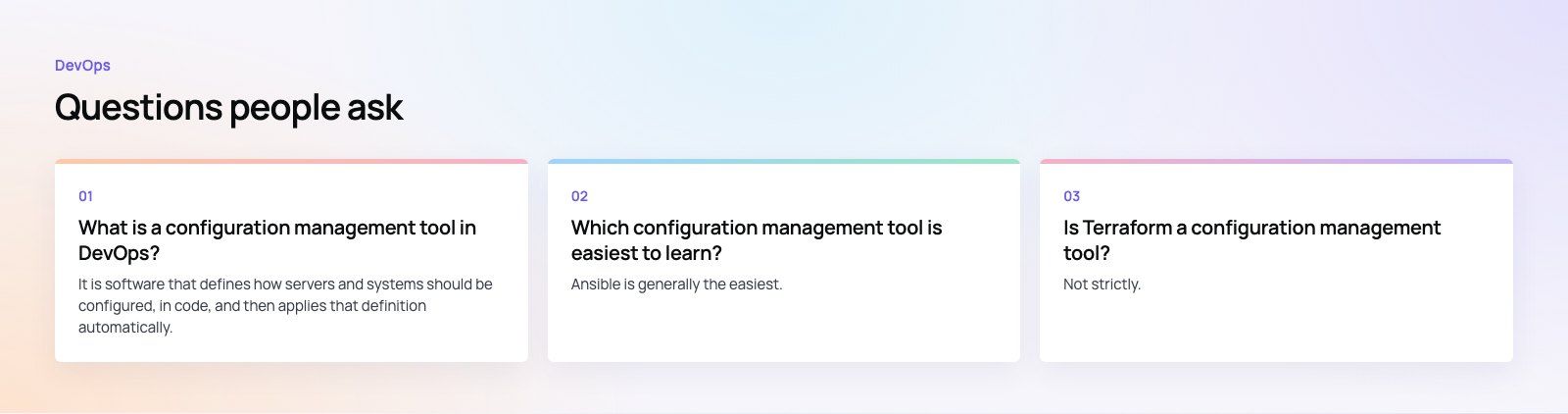
Frequently asked questions
It is software that defines how servers and systems should be configured, in code, and then applies that definition automatically.
It installs packages, manages services, writes config files and corrects drift, so every environment stays consistent. Ansible, Puppet, OpenVox, Chef and Salt are the best known examples, and they are usually run from a CI/CD pipeline alongside provisioning tools.
DevOpsPlatform Engineering vs DevOps: Differences and How They FitPlatform engineering vs DevOps explained: what each one is, where they overlap, the tools involved, and how to tell which one your organization needs next. DevOpsGitLab vs Jenkins: Which CI/CD Tool Fits Your Team?GitLab vs Jenkins compared on setup, features, scaling, security, integrations and total cost, with a simple checklist for choosing the right CI/CD tool.
 DevOpsDevOps Techniques for Scalable Web App DevelopmentCI/CD, infrastructure as code, containers, orchestration, autoscaling and monitoring: the DevOps techniques that help web apps grow, and the order to adopt them.
Tell us what the business needs. We will tell you what to build first.
Schedule a free consultation and get a written recommendation, with costs, before you commit to anything.
Get in touchPROVEN RESULTS
4.7 / 5verified reviews on Google