 DevOpsGitLab vs Jenkins: Which CI/CD Tool Fits Your Team?GitLab vs Jenkins compared on setup, features, scaling, security, integrations and total cost, with a simple checklist for choosing the right CI/CD tool.
Platform Engineering vs DevOps: Differences and How They Fit
Platform engineering vs DevOps explained: what each one is, where they overlap, the tools involved, and how to tell which one your organization needs next.
DevOps is a way of working that brings development and operations together so software is built, shipped and run by the same team with lots of automation. Platform engineering is a discipline that builds an internal platform, a set of shared tools and paved paths, so those teams can practise DevOps without each one reinventing its own infrastructure. They are not rivals: platform engineering is one way to make DevOps work at scale.
This guide explains each one, where they overlap, where they differ, and how to tell which one your organization needs to invest in next.
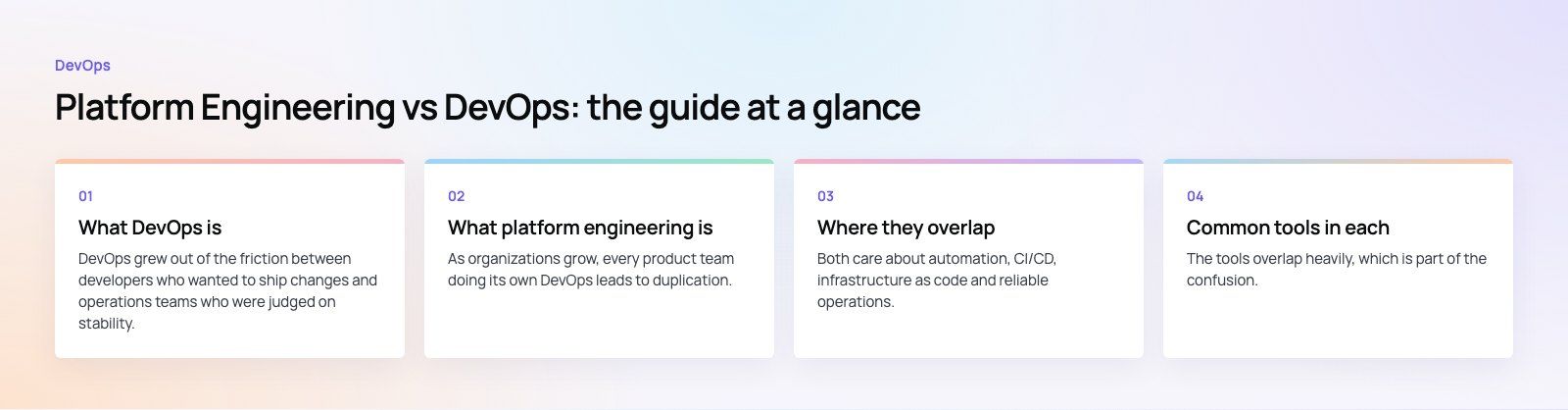
What DevOps is
DevOps grew out of the friction between developers who wanted to ship changes and operations teams who were judged on stability. It is mainly a cultural and process change: shared responsibility for the software from commit to production, supported by automation.
Core DevOps practices
- Collaboration and shared ownership. The people who build a service also care about how it runs, and operations knowledge feeds back into design.
- Automation. Builds, tests and deployments run through pipelines rather than manual steps, which cuts errors and speeds up releases.
- Continuous integration and continuous delivery (CI/CD). Small changes are merged, tested and released often, so each release carries less risk.
- Infrastructure as code. Servers, networks and cloud resources are defined in version controlled files, so environments are repeatable.
- Measurement and feedback. Teams track delivery and reliability and improve their process based on what they see. The DORA research program publishes widely used software delivery metrics for this.
What platform engineering is
As organizations grow, every product team doing its own DevOps leads to duplication. Ten teams write ten slightly different pipelines, configure monitoring ten ways and each learn Kubernetes the hard way. Platform engineering responds by treating internal infrastructure as a product.
A platform team builds and maintains an internal developer platform: self service tools, templates and golden paths that let product teams create a service, deploy it, observe it and secure it with minimal friction. The CNCF platforms white paper describes this idea in detail.
What a platform team typically owns
- Infrastructure automation using infrastructure as code tools so environments are consistent.
- Containers and orchestration, often Docker and Kubernetes, packaged so developers do not need to be cluster experts.
- Shared CI/CD pipelines and templates that new services can adopt on day one.
- Observability: logging, metrics, tracing and alerting set up by default.
- Security and compliance guardrails such as secrets management, access control, policy checks and encryption.
- A developer portal where teams find services, documentation and self service actions.
Platform engineering vs DevOps at a glance
| Aspect | DevOps | Platform engineering |
|---|---|---|
| What it is | A culture and set of practices | A discipline and a team that builds a product |
| Main focus | Collaboration, flow and shared ownership | Tools, infrastructure and self service |
| Who does it | Everyone involved in delivery | A dedicated platform team |
| Customer | End users of the software | Internal developers |
| Output | Faster, safer releases | An internal developer platform and golden paths |
| Success measures | Delivery speed, change failure rate, recovery time | Platform adoption, developer time saved, onboarding speed |
| Typical stage | Any size of team | Organizations with several product teams |
Where they overlap
Both care about automation, CI/CD, infrastructure as code and reliable operations. The difference is in who does the work and how it is packaged. In a pure DevOps model, each team builds its own pipeline. In a platform model, the platform team builds the pipeline once, and product teams use it while still owning their services in production. The DevOps culture of shared ownership stays in place; the platform removes repetitive toil.
Common tools in each
The tools overlap heavily, which is part of the confusion. Typical choices include Git based version control, pipeline tools such as GitHub Actions, GitLab CI or Jenkins, infrastructure as code with Terraform or similar, configuration management with Ansible, containers with Docker, orchestration with Kubernetes, and monitoring and tracing stacks. Platform teams add a layer on top: service templates, a developer portal such as Backstage, and policy tooling that applies guardrails automatically.
Which one does your organization need?
Start with DevOps practices if
- You have one or a few product teams.
- Releases are still manual, infrequent or stressful.
- Developers and operations people work in separate silos.
The priority here is automation, CI/CD and shared ownership. A dedicated platform team would be premature.
Invest in platform engineering if
- Several teams solve the same infrastructure problems in different ways.
- New services take weeks to set up because of environment and pipeline work.
- Developers spend a large share of their time on infrastructure rather than features.
- Security and compliance rules are applied inconsistently across teams.
Mistakes to avoid
- Renaming the ops team. Calling an operations ticket queue a "platform team" changes nothing. A platform must be self service.
- Building without asking developers. A platform is a product, and its users are your developers. Talk to them, measure adoption and iterate.
- Forcing one path for everything. Golden paths should make the common case easy, not block teams with genuinely different needs.
- Dropping DevOps culture. A platform does not remove the need for teams to own their services in production.
- Starting too big. Begin with the most painful shared problem, such as service setup or deployment, and expand from there.
Getting delivery right
Codeeo's team of 80+ across Dubai, Riyadh and Karachi builds and runs software for clients, from custom software and web platforms to Azure integrations. If your releases are slow or your infrastructure has grown messy, a codebase review is a practical way to find where automation or a shared platform would help most.
Frequently asked questions
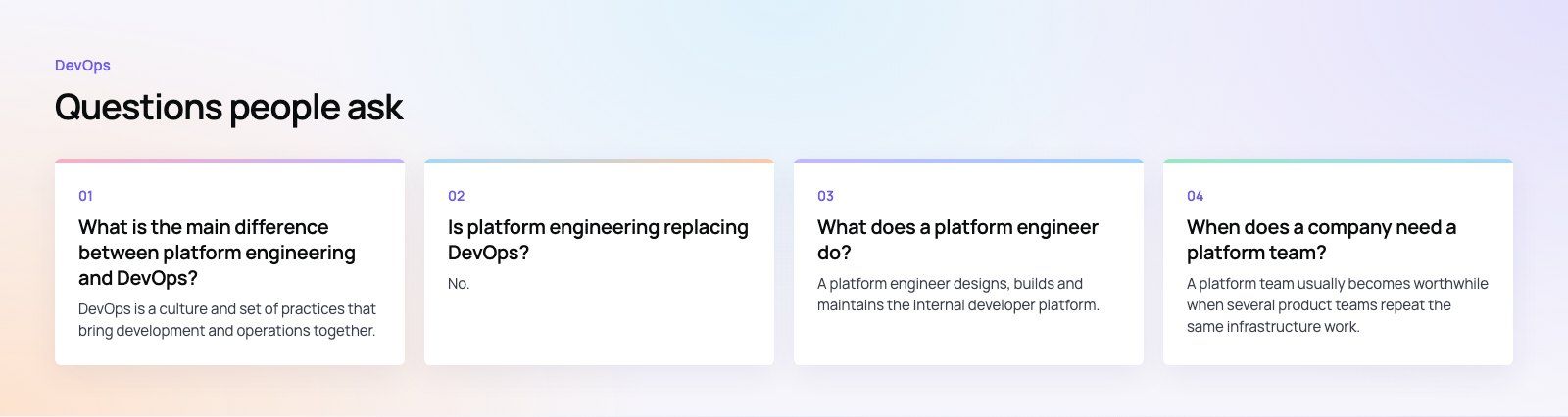
DevOps is a culture and set of practices that bring development and operations together, with automation and shared ownership of software in production.
Platform engineering is a discipline in which a dedicated team builds an internal platform of self service tools so product teams can follow those practices without each building their own infrastructure. One describes how teams work; the other provides the tooling.
DevOpsGitLab vs Jenkins: Which CI/CD Tool Fits Your Team?GitLab vs Jenkins compared on setup, features, scaling, security, integrations and total cost, with a simple checklist for choosing the right CI/CD tool. DevOpsConfiguration Management Tools in DevOps: How the Leaders CompareAnsible, Puppet, OpenVox, Chef, Salt, Terraform and OpenTofu compared: what configuration management does in DevOps and how to choose a tool.
 DevOpsDevOps Techniques for Scalable Web App DevelopmentCI/CD, infrastructure as code, containers, orchestration, autoscaling and monitoring: the DevOps techniques that help web apps grow, and the order to adopt them.
Tell us what the business needs. We will tell you what to build first.
Schedule a free consultation and get a written recommendation, with costs, before you commit to anything.
Get in touchPROVEN RESULTS
4.7 / 5verified reviews on Google