 E-Commerce10 Features of a High-Converting Ecommerce WebsiteThe ten features that turn store visitors into buyers, from product pages and checkout to speed, mobile design, social proof and ongoing testing.
Best Print on Demand Sites for Entrepreneurs Compared
Compare Printify, Printful, Gelato, SPOD and Redbubble, see how print on demand works, and learn how to choose a provider that fits your market and margin.
The best print on demand sites for most entrepreneurs are Printify, Printful, Gelato and SPOD for selling under your own brand, and Redbubble if you want a marketplace that brings its own buyers. The right one depends on where your customers live, which products you want to sell, and whether you need your own store or just a place to upload designs.
This guide compares the main options, explains the trade offs that actually matter once orders start arriving, and shows how to choose without getting stuck on surface features like the number of products in a catalog.
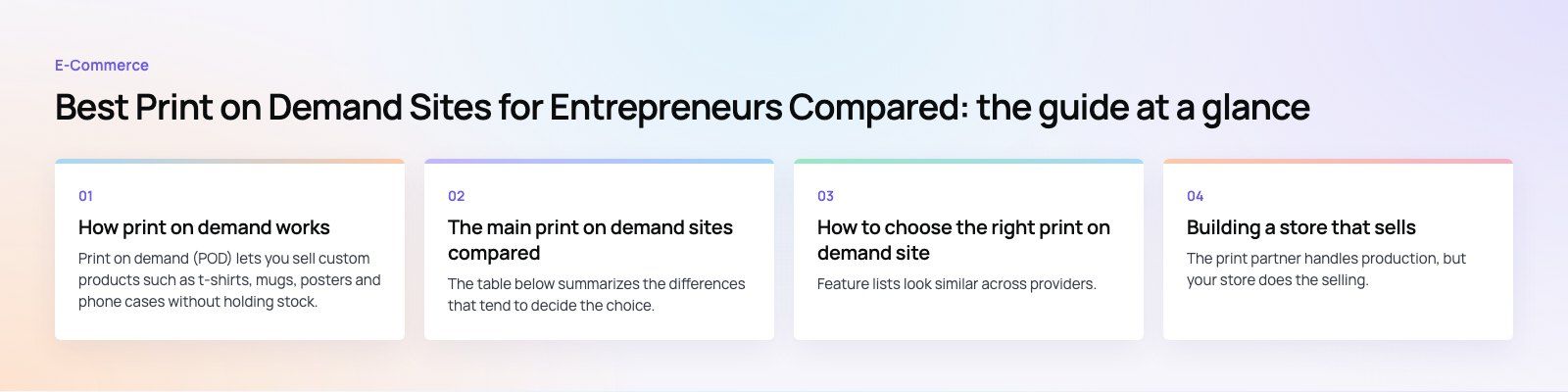
How print on demand works
Print on demand (POD) lets you sell custom products such as t-shirts, mugs, posters and phone cases without holding stock. A customer orders from your store, the order passes to a print partner, and that partner prints, packs and ships the item. You pay the production and shipping cost per order and keep the difference between that and your retail price.
There are two broad models:
- Fulfillment services such as Printify, Printful, Gelato and SPOD. They connect to your own store on Shopify, WooCommerce, Etsy or similar, and you own the brand and the customer relationship.
- Marketplaces such as Redbubble. You upload designs, the marketplace sells them to its own visitors and pays you a margin. You do not need a store, but the buyer is the marketplace's customer, not yours.
POD is close to dropshipping, but with one key difference. In dropshipping you resell a supplier's existing product. In POD every item carries your design, so you are building a brand rather than reselling a commodity.
The main print on demand sites compared
The table below summarizes the differences that tend to decide the choice. Catalogs and integrations change often, so confirm the details on each provider's own site before you commit.
| Platform | Model | Best for | Main trade off |
|---|---|---|---|
| Printify | Network of independent print providers | Sellers who want choice of printer and location | Quality can vary between providers |
| Printful | Mostly in-house production | Brands that value consistency and branded packaging | Base costs tend to be higher, so margins are thinner |
| Gelato | Global network that prints near the buyer | International sellers who want shorter shipping distances | Some features sit behind a paid plan |
| SPOD | Fast in-house production | Sellers who need quick turnaround on apparel | Smaller ecosystem than the larger players |
| Redbubble | Marketplace | Artists who want buyers without running a store | No custom branding and no customer data |
Printify
Printify does not print anything itself. It connects you to a network of independent print providers, and you choose which provider makes each product based on location, production cost, shipping cost and reviews. That choice is the main reason sellers pick it: you can route orders to a printer close to your buyers and compare providers on the same product.
It includes a free mockup generator, a design editor and integrations with the major store platforms. The flip side of a provider network is that print quality and packaging are not uniform. Order samples from any provider before you list their products, and keep a backup provider for your best sellers.
Printful
Printful runs much of its own production, which gives it tighter control over quality. It is popular with brands that want a consistent look and feel, including branded packaging, inside labels and pack-in inserts. It also offers warehousing for items you want to keep in stock alongside your printed products.
Consistency usually comes with higher base costs, which leaves less room for margin at a given retail price. Printful and Printify announced a merger in late 2024 and said they would keep both brands, so for now they remain separate services with their own catalogs and pricing.
Gelato
Gelato works through a global network of production partners and routes each order to a facility near the buyer. For sellers with customers spread across several countries, that can mean shorter delivery times and less shipping distance per order. It offers a product customization tool and a design integration with Canva.
Gelato has a free tier and a paid plan. The paid plan adds features such as premium images and extra discounts, so check which tier the features you care about sit on.
SPOD
SPOD is known for fast production on apparel and a large library of ready-made designs that sellers can use if they are not designers themselves. It connects to the main store platforms. It suits sellers who care most about turnaround speed on a focused range of clothing and accessories.
Redbubble
Redbubble is a marketplace rather than a fulfillment service. You upload artwork, set your margin, and Redbubble lists your designs on its products and sells them to its own visitors. You do not need a website, and the marketplace handles payment, production and support.
The cost is control. You cannot add your own branding, and Redbubble keeps the customer details. Buyers think of themselves as Redbubble customers, so you build little lasting relationship with them. Many artists use it as a side channel alongside their own store.
How to choose the right print on demand site
Feature lists look similar across providers. These are the questions that separate them in practice.
Where are your customers?
Shipping time and shipping cost are usually the biggest complaints in POD. If most of your buyers are in one region, choose a provider with production in that region. If they are spread across many countries, a network model like Gelato or Printify's location filters will matter more than catalog size.
Do you need your own brand?
If you want repeat customers, email lists and your own pricing, you need a fulfillment service connected to your own store. If you only want to test whether your designs sell, a marketplace is the faster start.
How much does consistency matter?
A brand selling premium apparel cannot afford a batch of shirts with faded prints. In that case, a provider with more in-house control is worth the thinner margin. For low-cost novelty items, a wider provider choice may be the better deal.
Which platform does your store run on?
Check that the provider's integration with your store platform syncs products, variants, orders and tracking numbers automatically. Manual order handling does not scale. If you are building or moving a store, our notes on Shopify development and WooCommerce development cover what to plan for.
What drives your margin?
Your margin is the retail price minus the base product cost, the print cost, shipping, payment fees, platform fees and any subscription. Base costs vary by provider, product, print method and production location. Build a simple sheet with your top five products and compare the real landed cost at each provider before choosing.
Setting up a print on demand store, step by step
- Pick a niche. A clear audience, such as runners, nurses or a local sports club, sells better than generic slogans.
- Choose your store platform. Shopify and WooCommerce are the most common. Etsy works well as a marketplace channel.
- Connect a provider and order samples. Check print quality, sizing, fabric and packaging in your own hands before you list anything.
- Create mockups and product pages. Use real photos of your samples where you can. Write clear size guides and care notes.
- Set prices. Price from your real landed cost, including shipping and fees, not from the base price alone.
- Test the whole order flow. Place a real order, track it, and confirm emails and tracking updates reach the customer.
- Market it. Organic social, paid ads and search all work for POD. Start with one channel you can measure properly.
Common mistakes to avoid
- Skipping samples. Mockups always look perfect. Physical products sometimes do not.
- Underpricing. Forgetting shipping, payment fees or returns turns a busy store into a loss.
- Listing everything. A huge catalog of untested products makes the store harder to browse. Start small and add what sells.
- Using designs you do not own. Trademarked characters, logos and lyrics lead to takedowns and account bans on every platform.
- Ignoring delivery expectations. Tell customers on the product page that items are made to order, and give a realistic delivery window.
Building a store that sells
The print partner handles production, but your store does the selling. A fast, clear storefront with honest delivery information and good product photography is what turns visitors into buyers. Codeeo has delivered 200+ projects across the UAE and the US, including stores such as the bilingual Shopify build for EGO Sustainable. If you are planning a print on demand brand, our ecommerce and web development team can help you build the store and connect it to the provider that suits your market, and digital marketing can help you find your first customers.
Frequently asked questions
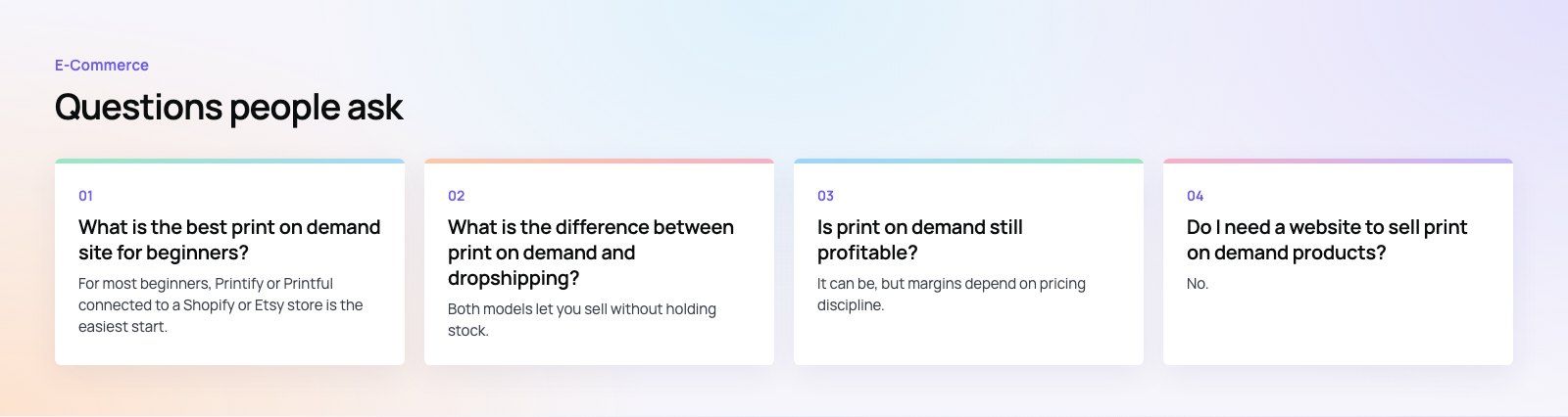
For most beginners, Printify or Printful connected to a Shopify or Etsy store is the easiest start.
Both offer free mockup tools, simple product setup and automatic order routing. Printify gives more choice of printer and cost, while Printful gives more consistent production. If you do not want to run a store at all, a marketplace like Redbubble lets you upload designs and start selling immediately.
E-Commerce10 Features of a High-Converting Ecommerce WebsiteThe ten features that turn store visitors into buyers, from product pages and checkout to speed, mobile design, social proof and ongoing testing. E-CommerceBenefits of Using a CMS for Ecommerce WebsitesHow a CMS helps online stores manage products, SEO, growth and security, how it compares with a custom build, and how to choose between WooCommerce, Shopify and headless.
 E-CommerceEcommerce Website Development: 9 Elements Every Store NeedsThe nine parts every online store needs, from catalog data and search to checkout, security, operations and analytics, with what to decide before you build.
Tell us what the business needs. We will tell you what to build first.
Schedule a free consultation and get a written recommendation, with costs, before you commit to anything.
Get in touchPROVEN RESULTS
4.7 / 5verified reviews on Google