 E-Commerce10 Features of a High-Converting Ecommerce WebsiteThe ten features that turn store visitors into buyers, from product pages and checkout to speed, mobile design, social proof and ongoing testing.
Big Cartel vs Shopify: Which Platform Fits Your Store?
Big Cartel vs Shopify compared on setup, design, apps, payments, SEO and support, with a clear guide to which platform suits small makers and which suits growth.
Choose Big Cartel if you are an artist, maker or small brand with a modest product range who wants a simple, low cost shop with no platform fees on sales. Choose Shopify if you want room to grow, need many integrations, sell across several channels or plan to run a larger catalog. Both let you build a store without code, but Shopify gives far more control over design, apps and checkout, at a higher running cost.
This comparison looks at setup, design, integrations, payments, SEO, support and plans, with facts checked against each platform's own pricing pages in 2026.
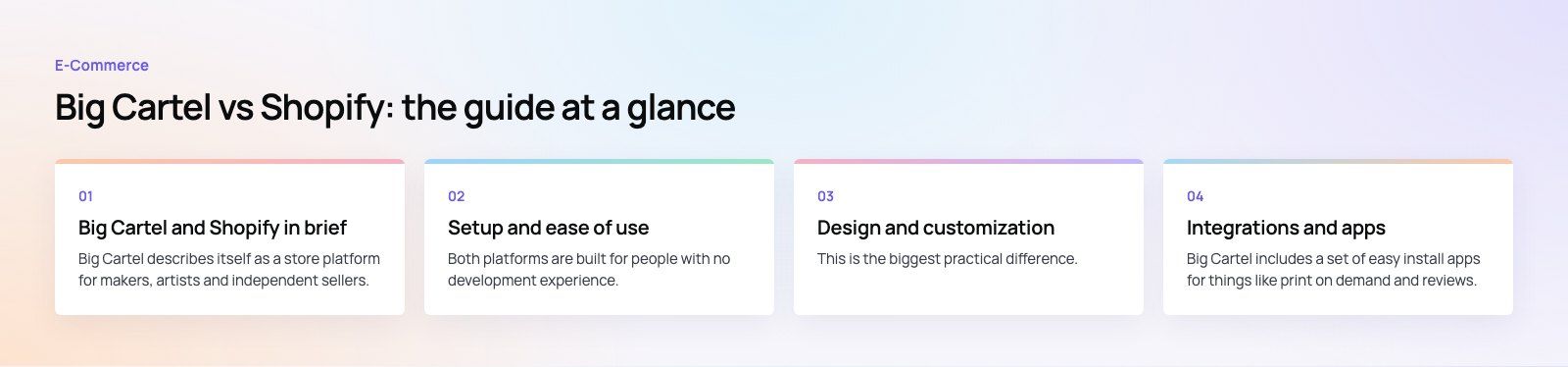
Big Cartel and Shopify in brief
Big Cartel describes itself as a store platform for makers, artists and independent sellers. Its focus is simplicity: a few setup steps, clean templates and plans built for small shops. According to Big Cartel's pricing page, there is a free Gold plan with five product listings and one template, a Platinum plan with a seven day free trial, and a Diamond plan for shops that are ready to scale. Big Cartel states that it does not charge platform or listing fees on sales.
Shopify is a full commerce platform used by everyone from first time sellers to large brands. It offers hosted stores, a large theme library, point of sale for in person selling and an app store covering almost any feature. Shopify's pricing page lists a free three day trial and plans named Basic, Grow and Advanced, with 24/7 support.
Side by side comparison
| Area | Big Cartel | Shopify |
|---|---|---|
| Best for | Artists, makers and small catalogs | Growing stores, dropshipping, multi channel brands |
| Free option | Free Gold plan with a small product limit | Short free trial, no permanent free plan |
| Platform fees on sales | None, according to Big Cartel | None with Shopify Payments; extra fee with third party gateways |
| Design control | Limited template customization | Extensive theme customization |
| Integrations | Built in apps plus Zapier connections on the top plan | Thousands of apps in the Shopify App Store |
| Payments | Cards, PayPal and other providers through connected processors | Built in Shopify Payments where available, plus third party gateways |
| SEO and content | Basic tools | Editable titles, descriptions and URLs, built in blog |
| Support | Human support, with priority support on the top plan | 24/7 support |
Setup and ease of use
Both platforms are built for people with no development experience. Big Cartel is the simpler of the two: you pick a template, add products, connect payments and launch. There are fewer settings to learn, which is exactly what many small sellers want.
Shopify takes longer to set up because it does more. You choose a theme, configure shipping, taxes, payments and notifications, and usually install a few apps. The admin is well organized, but beginners should expect a learning curve.
Design and customization
This is the biggest practical difference. Big Cartel templates are clean but offer limited room to change layouts, add custom sections or rich media to product pages. That is fine for a simple shop, but it can feel restrictive as a brand develops.
Shopify themes are far more flexible. Its editor lets you rearrange sections, add video to product pages, build custom landing pages and change most of the storefront without code. Developers can go further with custom themes when needed.
Integrations and apps
Big Cartel includes a set of easy install apps for things like print on demand and reviews, and its Diamond plan connects to thousands of other apps through Zapier. That covers common tasks such as adding customers to an email list or posting new products to social media.
Shopify's App Store is far larger and integrates directly into the store admin. Subscriptions, loyalty programs, bundles, advanced search, accounting and marketplace connections are all available, although many apps carry their own monthly fees.
Payments and fees
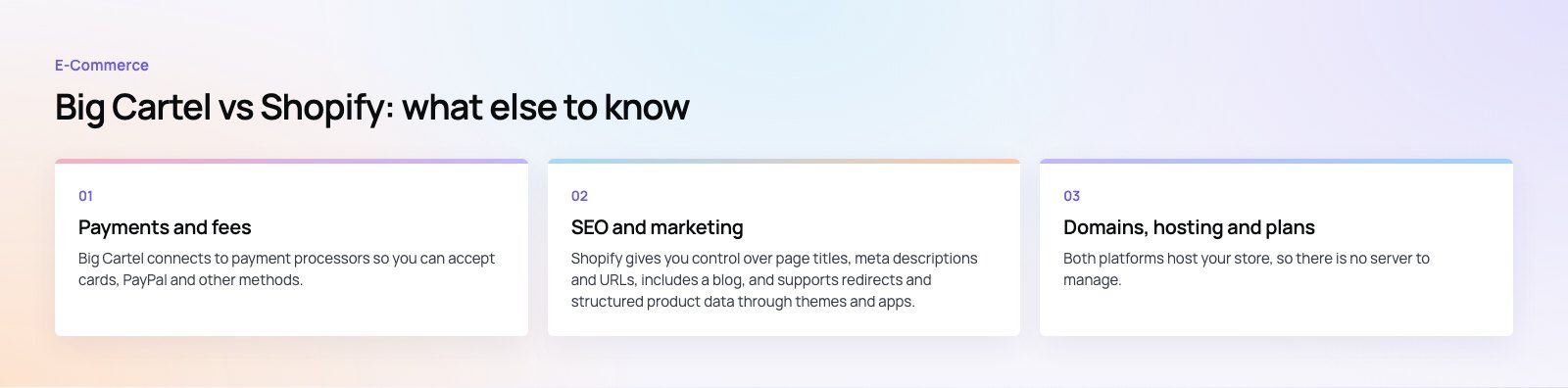
Big Cartel connects to payment processors so you can accept cards, PayPal and other methods. You pay the processor's fees, but Big Cartel says it adds no platform fee of its own.
Shopify has its own processor, Shopify Payments. Using it avoids Shopify's extra transaction fee for third party gateways. It is not available in every country, so check Shopify's supported countries list before you decide. Sellers outside those countries rely on third party gateways and should factor that fee into their margins.
SEO and marketing
Shopify gives you control over page titles, meta descriptions and URLs, includes a blog, and supports redirects and structured product data through themes and apps. That matters if search traffic is part of your growth plan.
Big Cartel's SEO tools are more basic. Big Cartel shops can rank, but sellers who rely on organic search, content marketing or detailed product pages will find Shopify easier to work with. Shopify also offers more built in marketing features, such as discounts, abandoned cart recovery and email tools, with Big Cartel reserving some of these for its top plan.
Domains, hosting and plans
Both platforms host your store, so there is no server to manage. Both let you use a custom domain instead of the default bigcartel.com or myshopify.com address. Shopify also lets you buy a domain directly in its admin.
Big Cartel offers monthly or annual billing and lets you cancel at any time. Shopify also offers monthly and annual plans, with a discount for paying annually. Check both pricing pages for current terms, since plans change regularly.
Which one should you choose?
Choose Big Cartel if
- You sell art, prints, merch or handmade goods in small runs
- Your catalog is small and unlikely to grow fast
- You want the lowest running cost and no platform fees
- You value a simple admin over advanced features
Choose Shopify if
- You plan to grow the catalog or sell in several markets
- You run dropshipping, subscriptions or wholesale
- You need specific integrations or a custom design
- Search traffic and content are part of your marketing
- You want to sell in person as well as online
Moving between the two
Big Cartel offers tools to import products from Shopify, Etsy and Squarespace, and Shopify has migration apps that bring in products, customers and orders from other platforms. Designs and apps do not transfer, so expect to rebuild those. Before switching, map every product URL to its new address with redirects so you keep any search rankings you have earned. If you need help with that, our site migration team handles redirects, data and launch checks.
If you are still unsure, a platform fit review compares your catalog, payments and growth plans against each option, and a checkout teardown shows where an existing store loses buyers. For a larger Shopify example, see the EGO Sustainable case study, a bilingual store for a GCC athleisure label selling in five markets.
Codeeo has delivered 200+ projects across the UAE and the US, with a team of 80+ across Dubai, Riyadh and Karachi. If Shopify is the right fit, our Shopify developers can set up, customize or extend your store.
Frequently asked questions
Big Cartel is usually easier for a complete beginner with a small catalog, because it has fewer settings, simple templates and a free plan for a handful of products.
Shopify is still beginner friendly but takes longer to learn because it does much more. If you expect to grow quickly, starting on Shopify can save a migration later.
E-Commerce10 Features of a High-Converting Ecommerce WebsiteThe ten features that turn store visitors into buyers, from product pages and checkout to speed, mobile design, social proof and ongoing testing. E-CommerceBenefits of Using a CMS for Ecommerce WebsitesHow a CMS helps online stores manage products, SEO, growth and security, how it compares with a custom build, and how to choose between WooCommerce, Shopify and headless.
 E-CommerceEcommerce Website Development: 9 Elements Every Store NeedsThe nine parts every online store needs, from catalog data and search to checkout, security, operations and analytics, with what to decide before you build.
Tell us what the business needs. We will tell you what to build first.
Schedule a free consultation and get a written recommendation, with costs, before you commit to anything.
Get in touchPROVEN RESULTS
4.7 / 5verified reviews on Google