 E-Commerce10 Features of a High-Converting Ecommerce WebsiteThe ten features that turn store visitors into buyers, from product pages and checkout to speed, mobile design, social proof and ongoing testing.
How to Build a B2B Marketplace Website Like Alibaba
How to build a B2B marketplace like Alibaba: choosing a niche, buyer and supplier features, escrow payments, tech stack, cost drivers and launch steps.
To build a website like Alibaba, you need a B2B marketplace that lets verified suppliers list products with bulk pricing, lets buyers search, compare and request quotes, and holds payment safely until goods ship. Start with one industry or region, launch a lean version with supplier onboarding, search, quotes and protected payments, then add logistics, financing and data tools as volume grows. What it costs depends on scope, integrations and how much you build custom, not on a fixed figure.
This guide covers what makes the Alibaba model work, the features a wholesale marketplace needs, the technical foundation, the cost drivers and the problems that sink most new B2B platforms.
What makes the Alibaba model work
Alibaba.com connects manufacturers, wholesalers and trading companies with business buyers around the world. Unlike a consumer store, most orders are large, negotiated and repeated. The marketplace earns money mainly from the supplier side through memberships, promoted listings and value added services, while buyers browse for free. Its parent, Alibaba Group, also runs consumer marketplaces, logistics and cloud businesses, which is why the brand feels like a whole ecosystem rather than a single website.
You do not need that ecosystem to compete. What you can copy is the logic underneath it:
- Trust between strangers. Supplier verification, trade history, reviews and payment protection make it safe for a buyer to send a large order to a factory they have never visited.
- Depth of catalog. Buyers come back because they can find many suppliers for the same product and compare them.
- Negotiation built in. Requests for quotation, tiered pricing and minimum order quantities match how wholesale actually works.
- Data. Search behavior and order history tell the platform which categories to grow and which suppliers to promote.
Choose a niche before you choose a stack
A general marketplace for everything is the hardest possible starting point, because you need thousands of suppliers and buyers on day one. The platforms that grow today usually pick a vertical where buyers are badly served: industrial spare parts, packaging, medical consumables, construction materials, food ingredients or a specific trade corridor. A narrow focus lets you write category specific attributes, vet suppliers properly and market to a defined group of buyers.
Answer three questions before writing a line of code:
- Which buyers struggle to source this category today, and why?
- Where will your first fifty suppliers come from?
- Will you earn from supplier subscriptions, commission on orders, paid placement, or a mix?
Your answers shape the feature list, the payment flow and the legal setup, so settle them first. A short product scoping exercise is a cheap way to test the idea before committing a development budget.
Core features of a B2B marketplace
A wholesale marketplace serves three groups: buyers, suppliers and your own operations team. Each needs its own set of tools.
For buyers
- Search with filters for specification, certification, minimum order quantity, lead time and supplier location.
- Product pages with technical data sheets, tiered price breaks and sample ordering.
- Request for quotation forms that reach several suppliers at once.
- Messaging with file sharing, so specs and drawings stay attached to the conversation.
- Company accounts with several users, approval rules and order history.
For suppliers
- Onboarding with document upload and verification status.
- Bulk product upload by spreadsheet or API, with variants and price tiers.
- A dashboard for quotes, orders, inventory, payouts and buyer messages.
- Storefront pages that show capabilities, certifications and factory details.
- Paid options such as membership tiers or promoted listings, if that is your revenue model.
For your operations team
- An admin panel to approve suppliers, moderate listings and manage categories.
- Dispute handling with a clear record of messages, documents and payments.
- Reporting on search terms with no results, quote conversion and supplier response times.
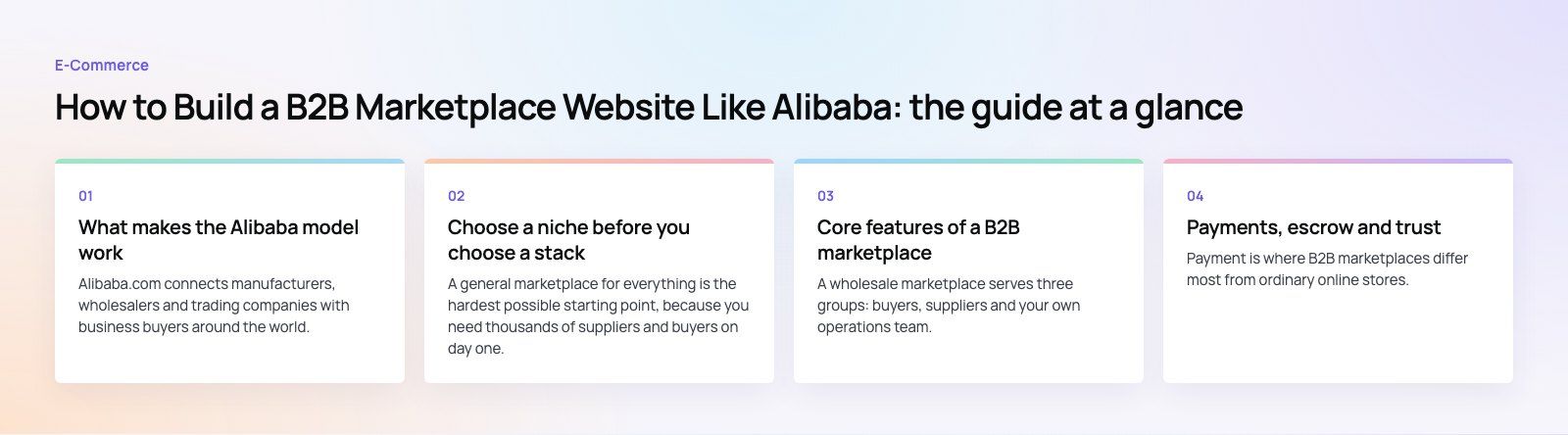
Payments, escrow and trust
Payment is where B2B marketplaces differ most from ordinary online stores. Orders are large, buyers often expect to pay part up front and the rest on shipment, and suppliers need to be paid out in their own currency. Most new platforms use a marketplace payments product, such as Stripe Connect or a regional provider, to collect from buyers, hold funds, take a commission and pay suppliers. That keeps you out of the business of holding client money directly, which carries heavy licensing obligations in most countries.
Trust tools matter as much as the payment flow:
- Supplier verification with trade licence, certificates and, for higher tiers, an on site or video audit.
- Reviews tied to completed orders only.
- Protection rules that say exactly when funds release and what happens if goods arrive late or wrong.
- Support for bank transfer and trade terms, since many businesses will not pay large invoices by card.
Payment design is worth getting right early, because changing it after suppliers are live is painful. Our payment integration team works on exactly this kind of split and delayed payout flow.
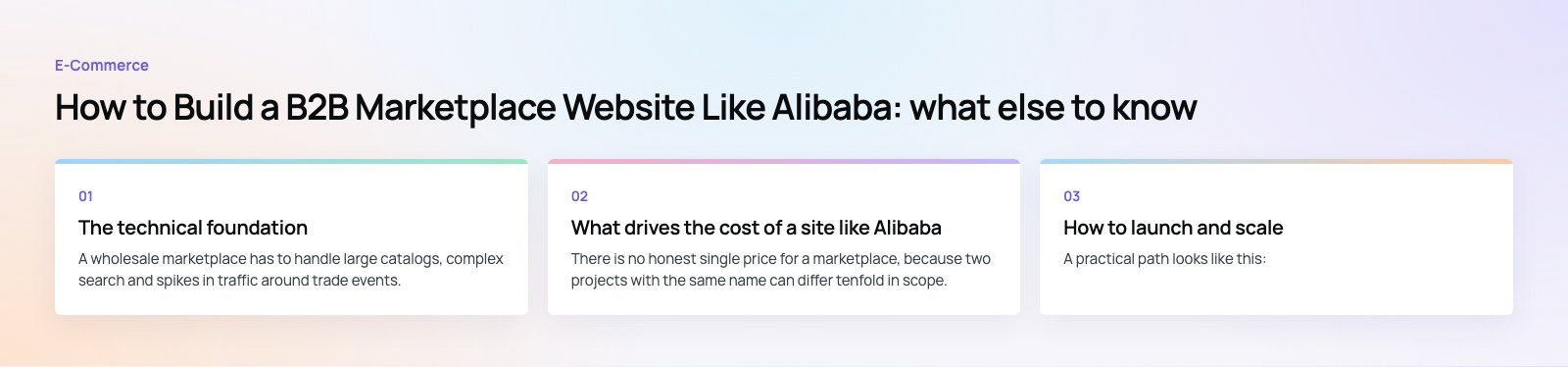
The technical foundation
A wholesale marketplace has to handle large catalogs, complex search and spikes in traffic around trade events. A sensible foundation looks like this:
- Cloud hosting on AWS, Azure or Google Cloud, so you add capacity when traffic grows rather than buying servers up front.
- A relational database such as PostgreSQL or MySQL for orders, accounts and payments, where consistency matters.
- A search engine such as Elasticsearch, OpenSearch or a hosted service, because database queries alone cannot handle faceted search across large catalogs.
- A content delivery network to serve images and pages quickly to buyers in other countries.
- An API layer so large suppliers can sync stock and prices from their own ERP instead of updating listings by hand.
Platform options compared
| Approach | Best for | Trade offs |
|---|---|---|
| Multi vendor plugin on an ecommerce platform | Testing demand with a small number of suppliers | Struggles with quotes, tiered pricing and company accounts |
| Marketplace software as a service | Launching quickly with standard features | Limited control over B2B workflows and data; recurring platform fees |
| Headless commerce with custom marketplace logic | Growing platforms that need flexible front ends | More engineering effort, but you own the buyer experience |
| Fully custom build | Specialized verticals with unusual workflows | Longest timeline and highest upfront effort, maximum control |
Many teams start with software as a service or a plugin to prove demand, then move to headless commerce or a custom software build once they know which workflows matter.
What drives the cost of a site like Alibaba
There is no honest single price for a marketplace, because two projects with the same name can differ tenfold in scope. These are the factors that move the budget:
| Cost driver | What raises it |
|---|---|
| Scope of features | Requests for quotation, negotiation, company accounts with approvals, multi currency |
| Integrations | Supplier ERP sync, shipping carriers, tax engines, credit or trade finance providers |
| Payments | Escrow, split payouts, partial payments and payouts in many countries |
| Search | Large catalogs, many attributes per category, multilingual search |
| Design | Custom interface, separate buyer and supplier apps, accessibility work |
| Security and compliance | Supplier verification, data protection rules, payment card requirements |
| Running costs | Hosting, search service, support staff, moderation and ongoing development |
| Growth | Supplier acquisition, buyer marketing and content |
Two points are often missed. First, the budget to recruit suppliers and buyers is usually as large as the build budget. Second, a marketplace is never finished: you will keep paying for development as you learn how people use it. Plan for a launch budget and a running budget, not one lump sum.
How to launch and scale
A practical path looks like this:
- Concierge test. Match a few buyers and suppliers by hand, using forms and email, to prove the demand exists.
- Minimum viable marketplace. Supplier onboarding, listings, search, quotes, messaging and protected payments. Nothing else.
- Liquidity. Seed one category deeply rather than many categories thinly, so the first buyers find real choice.
- Operations tools. Add dispute handling, analytics and supplier scoring once order volume makes manual work slow.
- Scale. Add logistics partners, financing, more regions and supplier APIs as demand proves itself.
Common mistakes to avoid
- Copying every feature. Alibaba built its ecosystem over many years. Launch with the handful of features your niche actually uses.
- Ignoring supplier quality. One bad supplier can lose you a buyer for good. Verification and scoring are product features, not admin chores.
- Letting deals leave the platform. If messaging and payments are clumsy, buyers and suppliers swap contact details and transact elsewhere. Make the platform the easiest way to trade.
- Underestimating search. If buyers cannot find a product in two searches, they leave. Invest in category attributes and synonyms early.
- Treating it as a website project. A marketplace is a business with two sets of customers. Budget for support, moderation and marketing from the start.
Where to start
A B2B marketplace succeeds when it solves sourcing for one group of buyers better than email, trade shows and general platforms do. Pick the niche, prove demand by hand, then build only what that niche needs. Codeeo has delivered 200+ projects across the UAE and the US, including multi sided platforms such as JobIQ, and our marketplace and on demand team can help you scope and build yours.
Frequently asked questions
The cost depends on scope rather than the name.
A focused marketplace with supplier onboarding, search, quotes and protected payments costs far less than a platform with logistics, financing, multilingual search and supplier APIs. Integrations, payment complexity and design are the biggest drivers. Budget separately for running costs and for recruiting suppliers and buyers, which often match the build cost.
E-Commerce10 Features of a High-Converting Ecommerce WebsiteThe ten features that turn store visitors into buyers, from product pages and checkout to speed, mobile design, social proof and ongoing testing. E-CommerceBenefits of Using a CMS for Ecommerce WebsitesHow a CMS helps online stores manage products, SEO, growth and security, how it compares with a custom build, and how to choose between WooCommerce, Shopify and headless.
 E-CommerceEcommerce Website Development: 9 Elements Every Store NeedsThe nine parts every online store needs, from catalog data and search to checkout, security, operations and analytics, with what to decide before you build.
Tell us what the business needs. We will tell you what to build first.
Schedule a free consultation and get a written recommendation, with costs, before you commit to anything.
Get in touchPROVEN RESULTS
4.7 / 5verified reviews on Google