 E-Commerce10 Features of a High-Converting Ecommerce WebsiteThe ten features that turn store visitors into buyers, from product pages and checkout to speed, mobile design, social proof and ongoing testing.
How to Build a Fashion Ecommerce Website Like Zara
How to build a fashion ecommerce website like Zara: editorial design, variant stock, fast mobile checkout, platform choice, cost drivers and retention.
To build a fashion website like Zara, you need an ecommerce store that puts large, editorial product imagery first, makes new arrivals easy to find, handles sizes and stock per variant accurately, and checks out quickly on a phone. Behind the storefront you need a catalog and inventory system that can publish new collections often and stay in sync with stores and warehouses. Cost depends on platform choice, design depth, integrations and catalog size, not on a fixed figure.
This guide explains what makes the Zara model work online, the features a fashion store needs, the platform options, the cost drivers and the marketing that keeps shoppers coming back.
What makes Zara's online store work
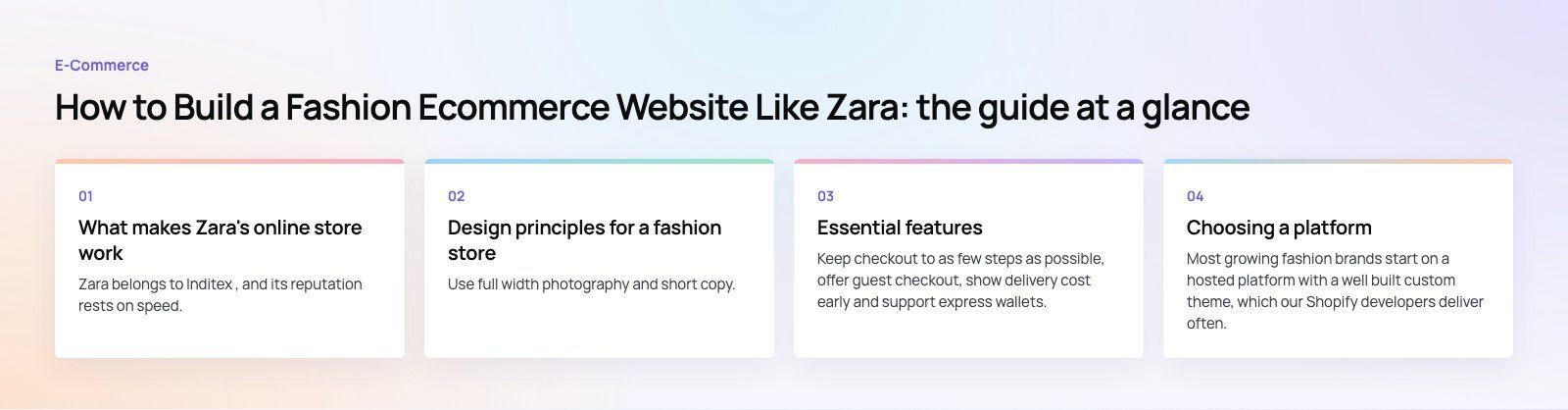
Zara belongs to Inditex, and its reputation rests on speed. The business is known for taking designs to market quickly, releasing new pieces often, and keeping much of design and logistics under its own control so it can react to what customers buy. The website is built around that model.
- Newness on display. New arrivals sit at the front of every category, giving regular shoppers a reason to check back often.
- Scarcity. Limited runs and visible low stock create urgency without heavy discounting.
- Editorial presentation. Large photography, minimal text and lots of white space make the site feel like a magazine rather than a catalog.
- Connected stock. Online stock, store stock and delivery options work together, so shoppers can see availability and choose how to receive an order.
- Data in the loop. What sells online and in stores feeds back into what gets designed and reordered.
A new brand will not copy Zara's supply chain, but it can copy the principles: release often, present products beautifully, keep stock data accurate and make buying fast.
Design principles for a fashion store
Let the product lead
Use full width photography and short copy. Show several angles, a close up of the fabric and the product on a model, with the model's height and size worn. Video of the garment moving answers fit questions that photos cannot.
Keep navigation simple
Shoppers browse by gender or department, then category, then new arrivals. Keep menus shallow, and give every listing page filters for size, color, price, fit and fabric. Persistent filters that remember the shopper's size save frustration.
Design for phones first
Most fashion browsing happens on mobile. Design the product listing grid, the product page and the checkout for a small screen first, with large tap targets and sticky add to bag buttons.
Stay fast
Heavy imagery slows pages down. Serve modern image formats at the right size for each screen, lazy load images below the fold and keep scripts lean. Google's Core Web Vitals measure loading, responsiveness and layout stability, and our Core Web Vitals service focuses on getting image heavy stores to pass them.
Essential features
| Feature | Why it matters for fashion |
|---|---|
| Variant level stock | Every size and color needs its own stock, so shoppers never order something that is gone |
| Size guides and fit notes | Fit is the main reason for returns; clear guidance reduces them |
| Fast search | Typo tolerant search with suggestions and filters by size and color |
| Wishlists and back in stock alerts | Bring shoppers back when items return or drop in price |
| Customer accounts | Order history, saved addresses, easy reorders and returns |
| Flexible delivery | Home delivery, store pickup and clear delivery dates |
| Simple returns | Self service returns from the account page, with status tracking |
| Local payment options | Cards, wallets and buy now pay later methods your market expects |
| Reviews and ratings | Fit and quality feedback from real buyers builds trust |
| Multiple languages and currencies | Needed if you sell across borders |
Checkout
Keep checkout to as few steps as possible, offer guest checkout, show delivery cost early and support express wallets. A checkout teardown is a quick way to find where an existing store loses buyers.
Back office
Behind the store you need a catalog that handles collections, launch dates and variants, an order management system that routes orders to the right warehouse or store, and integrations with your ERP or inventory system, shipping carriers and accounting tools. This is where a store that feels simple to shoppers gets complex to build.
Choosing a platform
| Option | Strengths | Limits |
|---|---|---|
| Hosted platform such as Shopify | Fast launch, reliable checkout, large app ecosystem | Theme limits on highly editorial layouts; app fees add up |
| Open source such as WooCommerce or Magento | Full control of code and data | You handle hosting, security and performance |
| Headless commerce | Editorial front end with a proven commerce engine behind it | More engineering effort and a larger team to maintain |
| Fully custom | No platform limits at all | Highest effort; rarely needed for a growing brand |
Most growing fashion brands start on a hosted platform with a well built custom theme, which our Shopify developers deliver often. Brands that want a truly editorial, Zara style front end with very fast pages usually move to headless commerce, keeping the platform for checkout and catalog while building the storefront in a modern framework.
What drives the cost
- Platform. A hosted platform with a theme costs least upfront; headless and custom cost more but remove design limits.
- Design depth. A fully custom, editorial design system takes longer than adapting a theme.
- Catalog size and complexity. Many variants, frequent drops and multiple markets need more setup and better tooling.
- Integrations. ERP, warehouse, store stock, carriers, payments, reviews and marketing tools.
- Languages and markets. Each extra language, currency or region adds content, testing and tax setup.
- Photography and content. Professional product shoots are a recurring cost with every collection.
- Running costs. Hosting, platform and app subscriptions, maintenance and ongoing improvements.
- Marketing. Paid social, search, email and influencer work to bring traffic.
Marketing and retention
A fashion site lives on repeat visits. The tactics that work best:
- Email and SMS. New arrival drops, back in stock alerts and abandoned bag reminders.
- Social commerce. Shoppable posts and short videos that link straight to product pages.
- Search optimization. Unique category copy, clean product data and structured data so products appear in search results.
- Personalization. Recommendations based on browsing and the shopper's size.
- User generated content. Customer photos and reviews that show fit on real people.
- Loyalty. Early access to drops is often more valuable to fashion shoppers than points.
Our digital marketing team runs these programs for retail brands.
Common mistakes
- Beautiful but slow. Oversized images and heavy scripts lose mobile shoppers before the page loads.
- Inaccurate stock. Selling sizes you do not have destroys trust faster than any design can build it.
- Weak size guidance. Without fit notes and measurements, return rates climb.
- Too many apps. Each plugin adds script weight and cost; choose carefully.
- No testing. Run A/B tests on product pages and checkout instead of guessing.
Bringing it together
A website like Zara combines editorial design, fast pages, accurate stock and a short checkout, backed by systems that let you release new products often. Codeeo has delivered 200+ projects across the UAE and the US, including EGO Sustainable, a bilingual Shopify store for a GCC athleisure label. Our retail and ecommerce team can help you plan and build your fashion store.
Frequently asked questions
Cost depends on platform, design depth, catalog size and integrations.
A hosted platform with a custom theme costs least to launch. A headless storefront with an editorial design, multiple markets and ERP integration costs considerably more. Plan for recurring costs too: platform fees, apps, hosting, photography for each collection, maintenance and marketing.
E-Commerce10 Features of a High-Converting Ecommerce WebsiteThe ten features that turn store visitors into buyers, from product pages and checkout to speed, mobile design, social proof and ongoing testing. E-CommerceBenefits of Using a CMS for Ecommerce WebsitesHow a CMS helps online stores manage products, SEO, growth and security, how it compares with a custom build, and how to choose between WooCommerce, Shopify and headless.
 E-CommerceEcommerce Website Development: 9 Elements Every Store NeedsThe nine parts every online store needs, from catalog data and search to checkout, security, operations and analytics, with what to decide before you build.
Tell us what the business needs. We will tell you what to build first.
Schedule a free consultation and get a written recommendation, with costs, before you commit to anything.
Get in touchPROVEN RESULTS
4.7 / 5verified reviews on Google