 E-Commerce10 Features of a High-Converting Ecommerce WebsiteThe ten features that turn store visitors into buyers, from product pages and checkout to speed, mobile design, social proof and ongoing testing.
ClickFunnels vs Shopify: Which Is Better for Online Sales?
ClickFunnels vs Shopify compared on catalog, conversion tools, courses, ecosystem and use cases, plus when to use both together and how to decide.
Shopify is the better choice if you sell physical products, manage a sizeable catalog or want to grow a full online store. ClickFunnels is the better choice if you sell courses, coaching, digital products or a small number of offers through guided sales funnels. Many businesses end up using both: ClickFunnels to capture and convert leads, Shopify to run the store.
The two platforms overlap more than they used to, since ClickFunnels now includes a store and Shopify supports landing pages and upsells through apps. But each is still built around a different idea of how online selling works, and that difference is what should drive your decision.
What Shopify is built for
Shopify is a hosted ecommerce platform for building and running online stores. Its core is product and order management: products with variants such as size and color, collections, inventory across locations, shipping rules, taxes, discounts, customer accounts and a checkout that handles many payment methods.
Around that core sits a large ecosystem. Themes control the storefront design, the Shopify App Store adds features from reviews to subscriptions to loyalty, and sales channels connect the same catalog to social platforms, marketplaces and in person point of sale. For brands that expect to grow, this ecosystem is the main attraction: most things a store needs already exist as an app or an integration.
What ClickFunnels is built for
ClickFunnels is built around sales funnels: a sequence of pages that move a visitor from first interest to purchase, then offer related products along the way. You build opt in pages, sales pages, order forms, upsell and downsell pages and thank you pages with a drag and drop editor and templates.
Its current version bundles more than funnels. ClickFunnels advertises A/B testing, a checkout, an online store, courses and membership areas, community groups, email marketing and automations, a CRM with pipelines, appointment booking and an affiliate center for managing people who promote your products. The aim is to give a coach, educator or info product seller one place for marketing, selling and delivering.
Key differences
| Area | Shopify | ClickFunnels |
|---|---|---|
| Core purpose | Full online store | Sales funnels and lead conversion |
| Product catalog | Large catalogs, variants, collections, inventory by location | Basic store, better suited to a few offers |
| Shipping and fulfillment | Built in shipping rules, carrier rates and fulfillment apps | Limited compared with a dedicated store platform |
| Upsells and order bumps | Through apps and theme customization | Built into funnel steps |
| Courses and memberships | Through third party apps | Built in |
| Email and CRM | Shopify's own email tools plus many integrations | Built in email, automations and CRM |
| Affiliate management | Through apps and Shopify's own tools | Built in affiliate center |
| Extensions | Very large app store and theme marketplace | Smaller set of integrations, plus API and webhooks |
| Best for | Physical product brands and growing ecommerce businesses | Coaches, course creators, digital products, lead generation |
Product management
This is where Shopify pulls clearly ahead. If you sell many products with variants, need inventory tracking across warehouses or want customers to filter by attributes, Shopify is designed for it. ClickFunnels can sell physical products, but it is not built for large catalogs.
Conversion tools
ClickFunnels is designed to maximize the value of each visitor. One click upsells after purchase, order bumps on the checkout and step by step funnels are native. Shopify can do similar things through apps, but you assemble them yourself.
Ecosystem and flexibility
Shopify's app store and developer platform make it easy to extend the store or connect it to ERP, accounting and marketing tools. ClickFunnels offers API access and webhooks and covers many needs inside its own product, which suits sellers who want fewer tools rather than more.
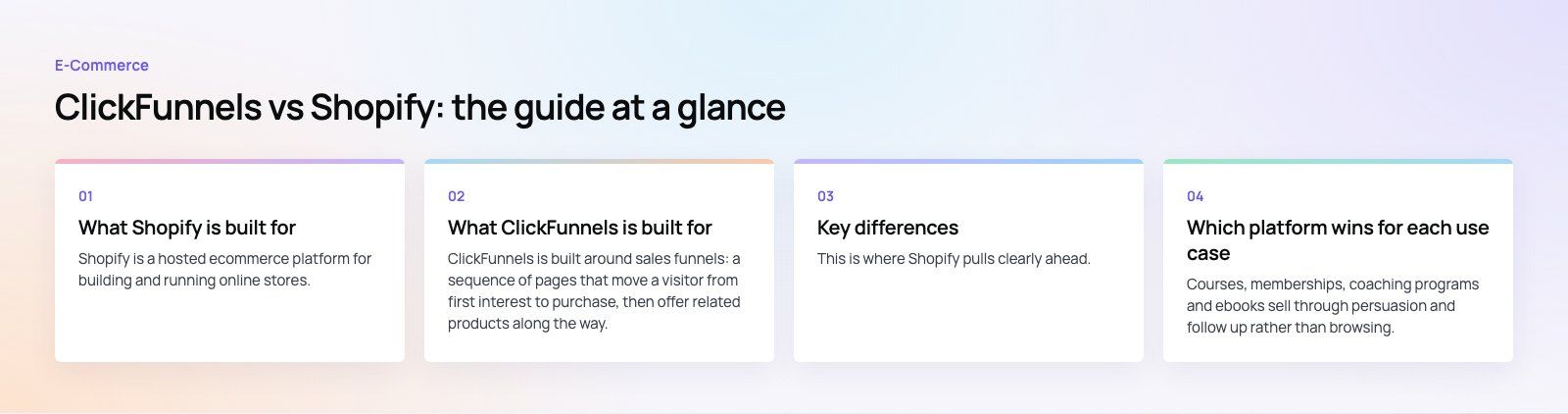
Which platform wins for each use case
Selling courses, coaching and info products: ClickFunnels
Courses, memberships, coaching programs and ebooks sell through persuasion and follow up rather than browsing. ClickFunnels combines the sales funnel, the checkout, the email sequence and the course delivery area, so a solo educator can run the whole business from one account.
Selling physical products: Shopify
Clothing, furniture, electronics, beauty and food brands need product pages, stock control, shipping and returns. Shopify handles these natively and scales from a handful of products to thousands.
Lead generation: ClickFunnels
If the goal is to capture emails or book calls, such as for a webinar, consultation or free guide, ClickFunnels' opt in pages and automations are built for exactly this.
Large catalogs and complex operations: Shopify
High order volumes, many variants, multiple sales channels and warehouse integrations point firmly to Shopify, and to Shopify Plus for larger brands.
Single product launches: either
For one hero product with upsells, both can work. ClickFunnels makes the funnel easier; Shopify makes fulfillment and future catalog growth easier. Choose based on where you expect the business to be in two years.
Drawbacks both share
- Neither brings traffic by itself. You still need search, paid ads, social or email to send people to your pages. Our digital marketing team works on exactly that side.
- Platform dependence. Both are hosted services, so outages, policy changes and pricing changes are outside your control.
- Ongoing subscription costs. Both charge monthly, and apps or higher plans add up. Budget for the full stack, not only the base plan.
- Templates are not a strategy. A good offer, clear copy and real proof matter more than the platform.
Using ClickFunnels and Shopify together
A common setup is to run top of funnel pages in ClickFunnels, such as a lead magnet, webinar sign up or quiz, then send buyers to Shopify product pages or the Shopify checkout to complete the order. Customer and order data can be passed between them with the platforms' APIs, webhooks or an automation service. This gives you ClickFunnels' conversion tools and Shopify's store operations, at the cost of two subscriptions and more moving parts to maintain.
Alternatives worth considering
- WooCommerce: an open source ecommerce plugin for WordPress, a good fit if content and SEO lead your strategy and you want full control of hosting. See our WooCommerce developers.
- Wix and Squarespace: website builders with store features, suitable for small catalogs and service businesses that sell a few products.
- Headless commerce: a commerce engine behind a custom front end, for brands that have outgrown themes and need full design control.
How to decide
- Write down what you sell today and what you expect to sell in two years.
- Count products and variants. More than a few dozen points to Shopify.
- Decide whether buyers browse or are guided. Browsing favors Shopify; guided persuasion favors ClickFunnels.
- List the tools you already pay for, such as email, CRM and course hosting, and see which platform replaces or connects to them.
- Test both on their free trials with a real product and a real checkout before you commit.
If you would like a second opinion, a platform fit review compares your plans against each option. Codeeo has delivered 200+ projects across the UAE and the US, including EGO Sustainable, a bilingual Shopify store for a GCC athleisure label. Our Shopify developers can build or improve your store.
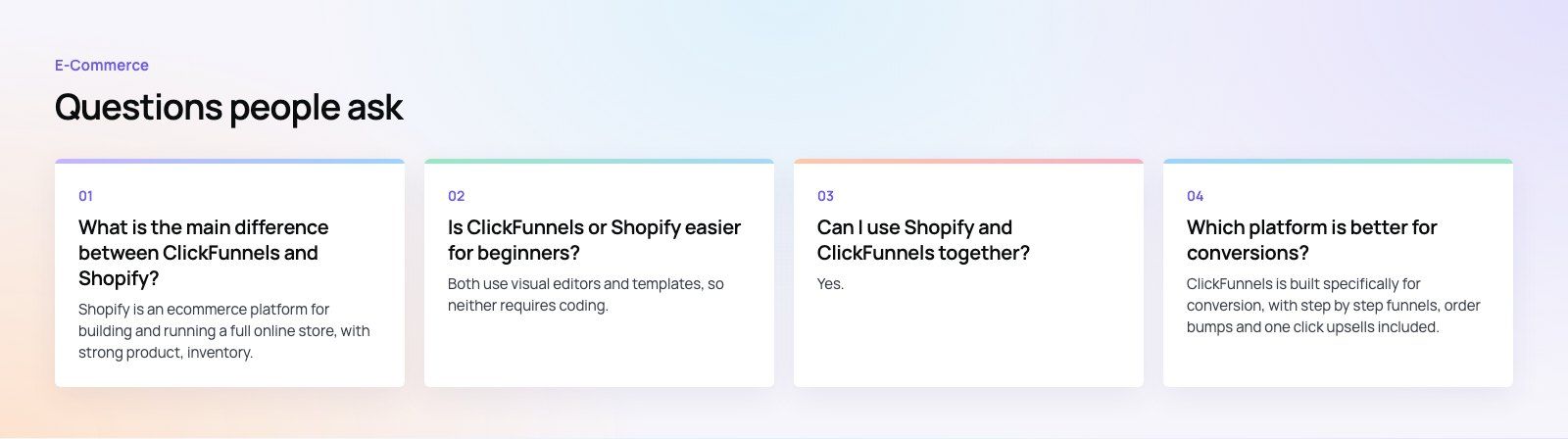
Frequently asked questions
Shopify is an ecommerce platform for building and running a full online store, with strong product, inventory, shipping and app ecosystem features.
ClickFunnels is a sales funnel builder that guides visitors through a series of pages toward a purchase, with built in upsells, email, courses and affiliate tools. Shopify suits product brands; ClickFunnels suits coaches, creators and digital offers.
E-Commerce10 Features of a High-Converting Ecommerce WebsiteThe ten features that turn store visitors into buyers, from product pages and checkout to speed, mobile design, social proof and ongoing testing. E-CommerceBenefits of Using a CMS for Ecommerce WebsitesHow a CMS helps online stores manage products, SEO, growth and security, how it compares with a custom build, and how to choose between WooCommerce, Shopify and headless.
 E-CommerceEcommerce Website Development: 9 Elements Every Store NeedsThe nine parts every online store needs, from catalog data and search to checkout, security, operations and analytics, with what to decide before you build.
Tell us what the business needs. We will tell you what to build first.
Schedule a free consultation and get a written recommendation, with costs, before you commit to anything.
Get in touchPROVEN RESULTS
4.7 / 5verified reviews on Google