 App DevelopmentCross Platform App Development: How It Saves Time and MoneyHow shared code across iOS and Android cuts build and maintenance effort, which frameworks to consider in 2026, and when native development is still the better call.
Dart Programming Language: Why It Suits Efficient, Scalable Apps
What the Dart programming language is, how its compilers, null safety and Flutter make apps fast and scalable, how it compares, and real products using it.
Dart is an open source, strongly typed programming language from Google, and it is the language behind Flutter, the framework for building iOS, Android, web and desktop apps from one codebase. It suits efficient, scalable apps because it compiles ahead of time to fast native code for release, supports hot reload during development, and has sound null safety that catches a whole class of bugs before they ship.
This guide explains where Dart came from, how its syntax and compilation work, how it compares with Swift, Kotlin and JavaScript, the practices that keep Dart projects maintainable, and real products built with it.
A short history of Dart
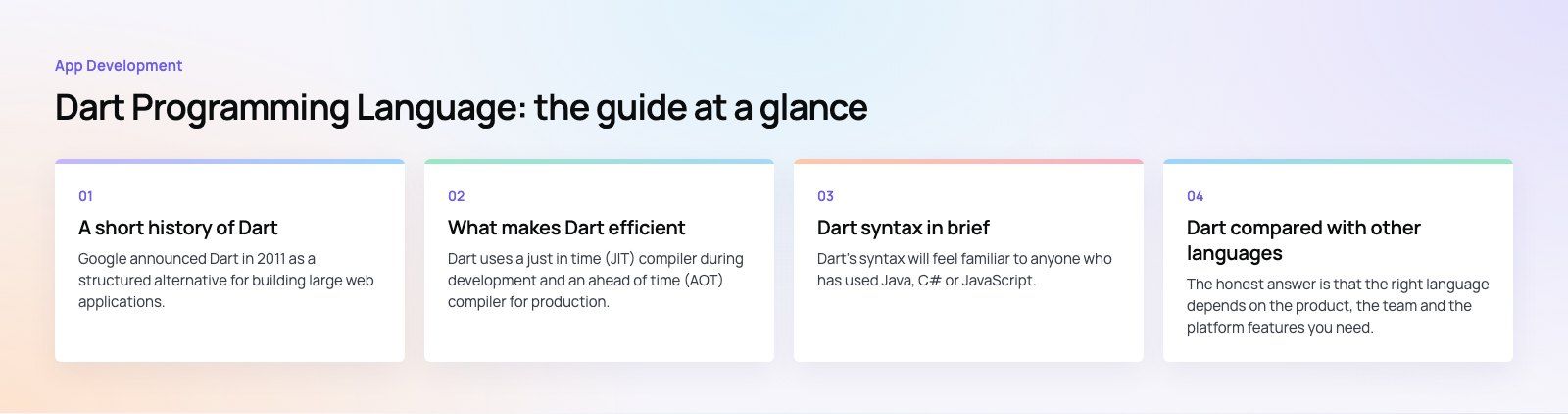
Google announced Dart in 2011 as a structured alternative for building large web applications. Early on it was aimed mainly at the browser, and adoption was modest. That changed when Google chose Dart as the language for Flutter, its UI toolkit for building natively compiled apps across platforms.
Flutter gave Dart a clear purpose, and the language evolved to serve it. Today Dart compiles to native ARM and x64 machine code for mobile and desktop, and to JavaScript or WebAssembly for the web, according to the official Dart overview. It also added sound null safety, which is now built into the language rather than optional.
What makes Dart efficient
Two compilers for two jobs
Dart uses a just in time (JIT) compiler during development and an ahead of time (AOT) compiler for production. JIT enables stateful hot reload: a developer changes code and sees the result in the running app in under a second, without losing the current screen or data. AOT turns the finished app into native machine code, which gives fast startup and smooth, predictable performance on devices.
Most languages force a choice between quick iteration and fast releases. Dart gives you both, which is a large part of why Flutter teams ship quickly.
Sound null safety
In Dart, a variable cannot hold null unless you explicitly declare that it can. The compiler enforces this, and non nullable values stay non nullable while the app runs. Null reference errors are among the most common crashes in mobile apps, so removing them at compile time noticeably improves stability.
Asynchronous code that reads like normal code
Apps spend much of their time waiting: for network calls, file reads or database queries. Dart's Future and Stream types, together with the async and await keywords, let developers write that waiting logic in a straight line that is easy to follow. For heavy computation, isolates run work in parallel without shared memory, which avoids many concurrency bugs.
Dart syntax in brief
Dart's syntax will feel familiar to anyone who has used Java, C# or JavaScript. A few examples show the style.
Variables. Use var for a value that can change, final for a value set once, and const for a compile time constant. For example, var name = 'Cafe Java'; declares a mutable string, while final location = 'Downtown'; cannot be reassigned. Types are inferred, but you can write them explicitly, as in String name.
Functions. A function declares its return type and parameters: int add(int a, int b) { return a + b; }. Short functions can use arrow syntax: int add(int a, int b) => a + b;.
Classes. Dart is object oriented, and constructors can assign fields directly: class Coffee { final String name; final double size; Coffee(this.name, this.size); }. Dart also supports mixins, extension methods, records and pattern matching, which keep larger codebases tidy.
Nullable types. Adding a question mark makes a type nullable: String? nickname; can be null, while String nickname; cannot.
Why Dart works for scalable apps
- One codebase, many platforms. With Flutter, the same Dart code runs on iOS, Android, web, Windows, macOS and Linux. Features and fixes ship to every platform together.
- Predictable performance. AOT compilation and Flutter's own rendering engine mean the UI does not depend on platform widgets, so it looks and behaves consistently.
- Static typing at scale. As a codebase grows, types make refactoring safer and help editors catch mistakes early.
- Strong tooling. The built in formatter, analyzer, test runner and package manager (pub) are part of the standard SDK, so teams spend less time assembling a toolchain.
- Backend options. Dart can also run on servers, with frameworks such as Dart Frog and Serverpod, which lets a small team share models and logic between app and API.
Dart compared with other languages
| Language | Main platforms | Strengths | When to choose it over Dart |
|---|---|---|---|
| Dart with Flutter | iOS, Android, web, desktop | One codebase, hot reload, consistent UI, AOT performance | Default choice for cross platform apps with custom UI |
| Swift | Apple platforms | Deepest access to iOS features, native look and feel | iOS only apps, or apps relying heavily on new Apple APIs |
| Kotlin | Android, plus shared logic via Kotlin Multiplatform | Native Android, strong JVM ecosystem | Android first products, or teams wanting native UI per platform with shared logic |
| JavaScript or TypeScript with React Native | iOS, Android, web | Huge ecosystem, web developers can contribute | Teams already deep in React who want to share skills with the web |
The honest answer is that the right language depends on the product, the team and the platform features you need. If your team is unsure, a platform fit review compares the options against your actual feature list.
Best practices for Dart projects
- Use the formatter and analyzer. Run dart format and dart analyze in continuous integration, and adopt a lint set so the whole team writes code the same way.
- Choose a state management approach early. Provider, Riverpod and Bloc are common options. Pick one, document it, and apply it consistently rather than mixing patterns.
- Lean on the type system. Avoid dynamic where you can, model data with classes or records, and use nullable types only where null is a real possibility.
- Write tests at three levels. Unit tests for logic, widget tests for UI components and integration tests for key flows such as sign in and checkout.
- Keep heavy work off the UI thread. Use async and await for I/O, and isolates for expensive computation such as parsing large files.
- Keep dependencies current. Review packages regularly for maintenance and security updates, and avoid packages with no recent activity.
- Understand the widget tree. Split large widgets, use const constructors where possible, and avoid rebuilding more of the tree than needed.
Real products built with Dart and Flutter
The official Flutter showcase lists many companies using the framework. A few well known examples:
- Google Ads. Google's own advertising app is listed among Flutter apps built at Google.
- Alibaba Group. Alibaba used Flutter for a large second hand marketplace app in China.
- Reflectly. A journaling app known for its animated, custom interface.
- Hamilton. The official app for the musical, built to extend the experience beyond the theater.
The showcase also includes banks, retailers, carmakers and delivery apps, which shows Dart is used well beyond small projects.
Is Dart right for your app?
Dart and Flutter are a strong fit when you need iOS and Android at the same time, want a custom branded interface, and prefer one team and one codebase. They are a weaker fit when an app depends heavily on brand new platform features on day one, or when your team is already invested in another stack. A short product scoping session helps settle that choice before development starts.
Codeeo has delivered 200+ projects across the UAE and the US, with a team of 80+ across Dubai, Riyadh and Karachi. If you are planning a cross platform app, our mobile app development team can help you choose the stack and build it, or you can add dedicated developers to your own team.
Frequently asked questions
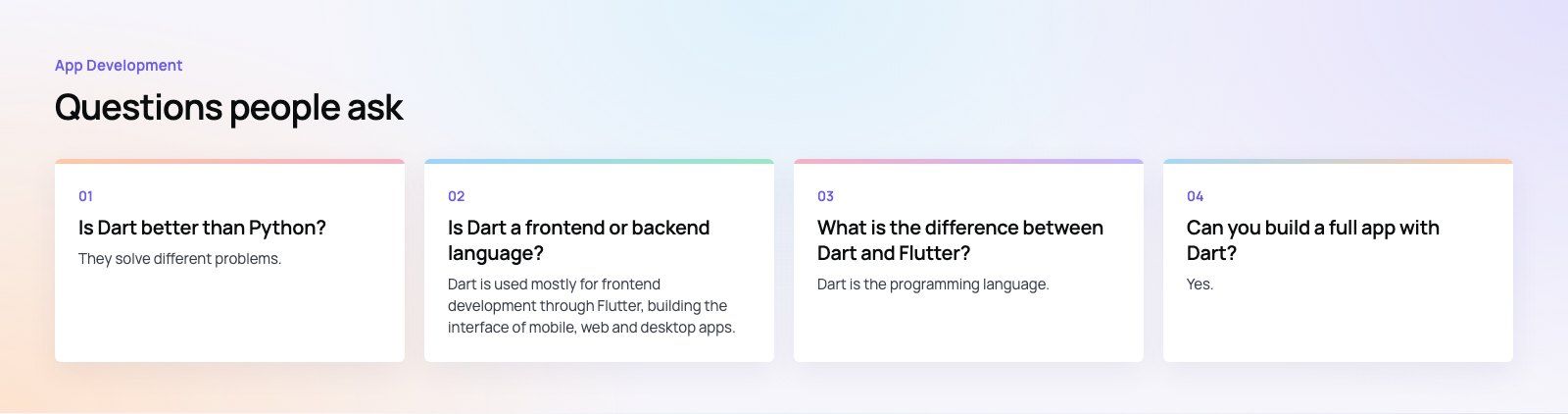
They solve different problems.
Dart is designed for building client apps, especially with Flutter on mobile, web and desktop, and compiles to fast native code. Python is the leading language for data science, machine learning, scripting and many backend services. Many products use both: a Flutter app written in Dart talking to an API or data pipeline written in Python.
App DevelopmentCross Platform App Development: How It Saves Time and MoneyHow shared code across iOS and Android cuts build and maintenance effort, which frameworks to consider in 2026, and when native development is still the better call. App DevelopmentHow to Plan an App Development Project From Start to FinishA step by step plan for an app project: define users and goals, scope an MVP, choose platforms, design, build the team, phase the timeline, test and launch.
 App DevelopmentMust Have Features of an HR Management AppThe features an HR management app needs, from onboarding and self service to payroll, performance and analytics, plus when to buy or build.
Tell us what the business needs. We will tell you what to build first.
Schedule a free consultation and get a written recommendation, with costs, before you commit to anything.
Get in touchPROVEN RESULTS
4.7 / 5verified reviews on Google