 DevOpsPlatform Engineering vs DevOps: Differences and How They FitPlatform engineering vs DevOps explained: what each one is, where they overlap, the tools involved, and how to tell which one your organization needs next.
DevOps Tools and Techniques Every Team Should Know
The DevOps tools that matter, from Git and CI servers to Terraform, Kubernetes and monitoring, plus the techniques that make them pay off and how to choose.
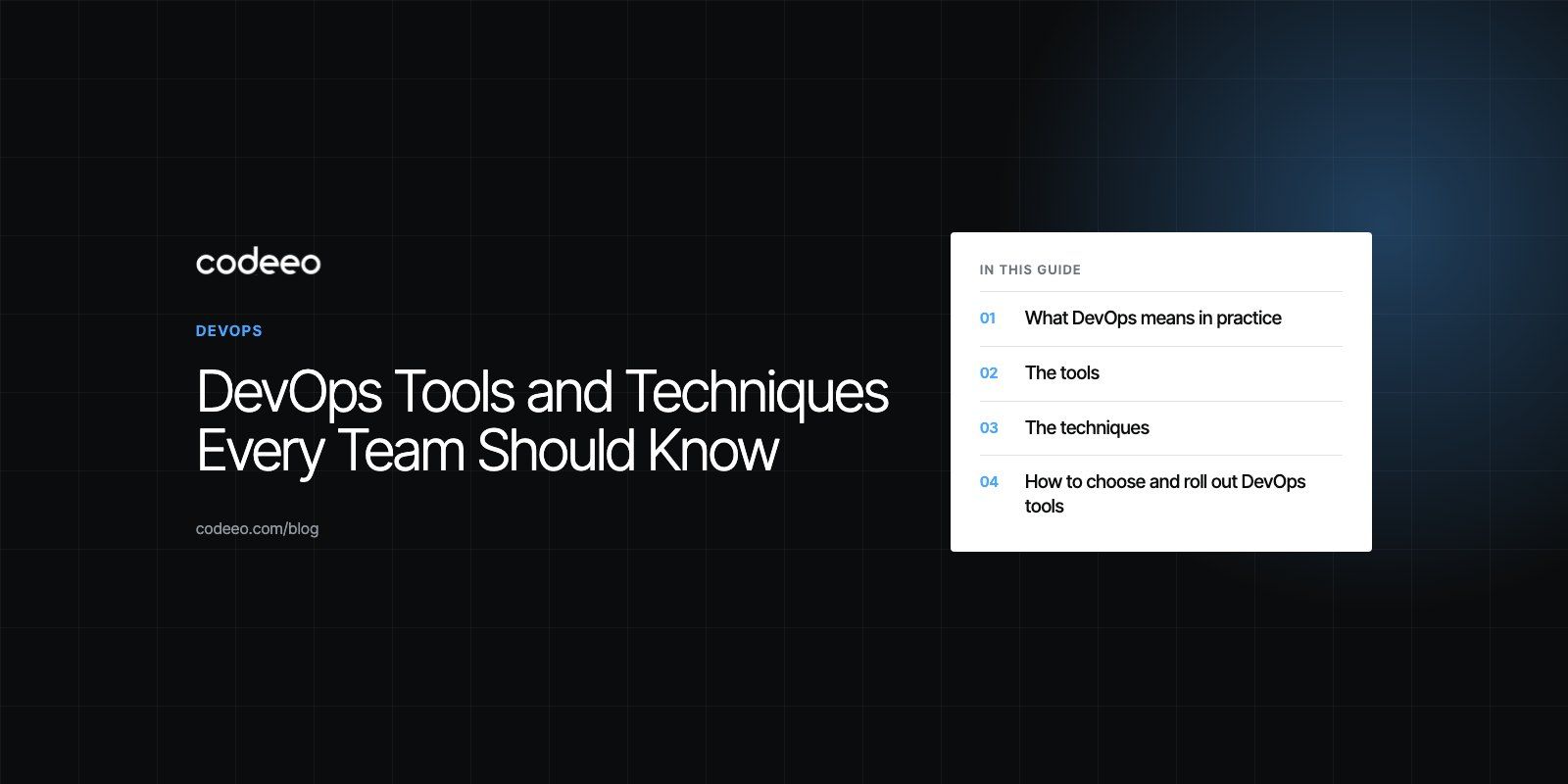
The core DevOps toolkit covers five jobs: version control (Git), automated build and test pipelines (Jenkins, GitHub Actions, GitLab CI), build tooling such as Maven, infrastructure and configuration as code (Terraform or OpenTofu, Ansible, Puppet, Chef), and containers with monitoring (Docker, Kubernetes, Prometheus, Grafana). The tools only pay off when paired with the techniques that make them useful: small changes merged often, automated testing, continuous delivery and services that can be deployed independently. This guide walks through both and helps you choose what your team actually needs.
What DevOps means in practice
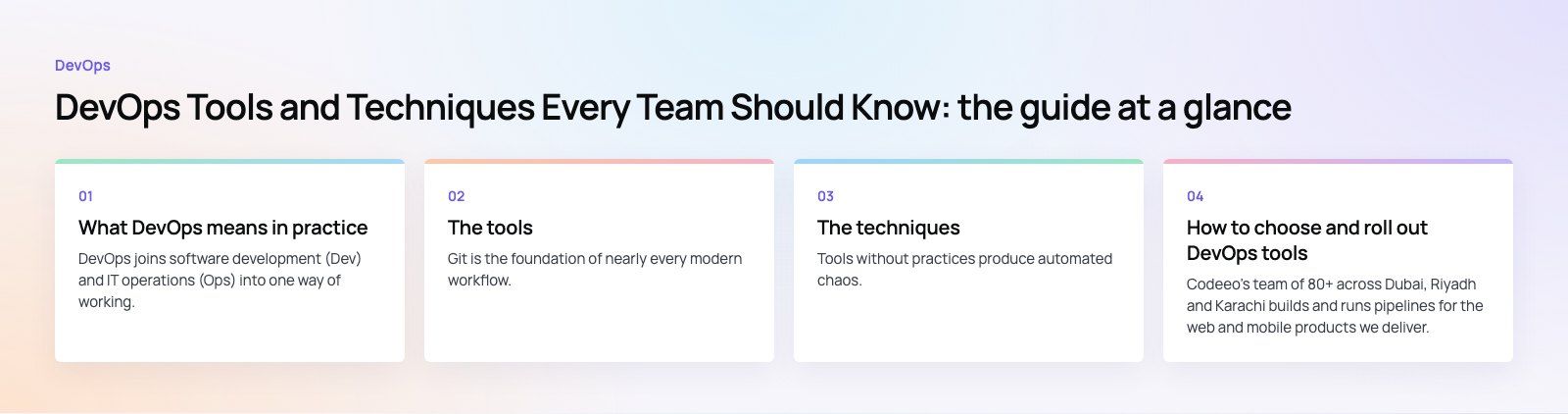
DevOps joins software development (Dev) and IT operations (Ops) into one way of working. Instead of developers handing finished code over a wall to an operations team, the same group owns the code from commit to production. Tools make that possible by automating the repetitive steps, but the change is mostly about habits: shorter feedback loops, shared responsibility and fewer manual handoffs.
A useful way to judge any DevOps setup is the set of delivery measures popularized by the DORA research program: how often you deploy, how long a change takes to reach production, how often a deployment causes a failure, and how quickly you recover when it does. Every tool below should improve at least one of those.
The tools
Git: version control
Git is the foundation of nearly every modern workflow. It tracks every change to the codebase, lets developers work on branches without blocking each other, and records who changed what and why. Hosted platforms such as GitHub, GitLab and Bitbucket add pull requests, code review and built in pipelines on top.
Because Git is distributed, each developer has a full copy of the history, which suits remote and multi office teams. The practical win is traceability: when something breaks, you can find the exact change that caused it and roll it back.
Jenkins and hosted CI: automation servers
Jenkins is an open source automation server that runs builds, tests and deployments every time code changes. Its strength is its plugin ecosystem, which connects it to almost any language, tool or cloud. Its weakness is upkeep: someone has to patch the server, manage plugins and keep pipelines tidy.
Many teams now use the CI built into their Git host, such as GitHub Actions or GitLab CI, because pipelines live next to the code and there is no server to maintain. Jenkins still makes sense when you need full control, run on premises, or already have a large investment in it.
Maven: build and dependency management
Maven standardizes how Java projects are compiled, tested, packaged and released. It declares dependencies in one file and pulls the right versions, which makes builds reproducible on any machine or pipeline. Gradle is the common alternative for teams who want more flexibility. For JavaScript, Python or .NET projects, the equivalents are npm or pnpm, pip or Poetry, and dotnet with NuGet.
Puppet and Chef: configuration management
Puppet and Chef let administrators describe how servers should be configured in code, then apply that configuration consistently across many machines. If a server drifts from the desired state, the tool brings it back. Both use agents installed on each server and suit large, long lived fleets with strict compliance needs.
Ansible is the lighter alternative. It is agentless and connects over SSH, so it is often easier to start with for smaller teams.
Terraform and OpenTofu: infrastructure as code
Where configuration tools manage what runs on a server, Terraform creates the servers, networks, databases and cloud services themselves from declarative files. You review infrastructure changes in a pull request exactly like application code. After HashiCorp changed Terraform's license in 2023, the community created OpenTofu, an open source fork under the Linux Foundation. Both use the same language, so the choice is mostly about licensing and vendor support.
Docker and Kubernetes: containers and orchestration
Docker packages an application and its dependencies into a container that runs the same way on a laptop, a test server and production. Kubernetes then schedules and scales those containers across a cluster, restarts failed ones and rolls out new versions gradually. Kubernetes is powerful but carries real operational weight. Smaller products often do better with a managed container service until they need that control.
Prometheus and Grafana: monitoring
Prometheus collects metrics from applications and infrastructure, and Grafana turns them into dashboards and alerts. Together they tell you whether a release made things faster or slower and warn you before customers notice a problem. Add centralized logs and distributed tracing as the system grows.
| Job | Common tools | Good fit when |
|---|---|---|
| Version control | Git with GitHub, GitLab or Bitbucket | Always. Every project needs it |
| CI and CD | GitHub Actions, GitLab CI, Jenkins | Hosted CI for most teams, Jenkins for full control or on premises |
| Build | Maven, Gradle, npm, pip | Matched to your language |
| Configuration | Ansible, Puppet, Chef | Ansible for simplicity, Puppet or Chef for large managed fleets |
| Infrastructure | Terraform, OpenTofu | Any cloud setup you want to reproduce and review |
| Containers | Docker, Kubernetes, managed container services | Kubernetes once you run many services at scale |
| Monitoring | Prometheus, Grafana | From the first production release |
The techniques
Tools without practices produce automated chaos. These techniques are what turn a pipeline into faster, safer delivery.
Agile delivery
Agile breaks work into small increments shaped by regular customer feedback. DevOps then makes it possible to ship those increments quickly and reliably. Combined, they mean a feature can go from idea to users in days rather than months, and a wrong turn is caught early.
Continuous integration
Developers merge small changes into the main branch often, and every merge triggers an automated build and test run. Problems surface within minutes, while the change is still fresh in the developer's mind. The discipline matters more than the tool: short lived branches, a fast test suite and a rule that a broken build gets fixed before anything else.
Continuous delivery and deployment
Continuous delivery keeps the main branch always ready to release, with automated tests and checks at every stage. Continuous deployment goes one step further and releases every passing change to production automatically. Feature flags, blue green releases and canary rollouts let you ship code without exposing unfinished features or risking every user at once.
Microservices
A microservices architecture splits an application into small services, each owning one business capability, deployable on its own and talking to others through APIs or events. Teams can release their service without coordinating a big bang deployment, and a failure in one service is less likely to take down the rest. The trade off is operational complexity: more pipelines, more monitoring and more network calls to secure. For many products a well structured monolith is the better start.
Security in the pipeline
Security checks belong inside the pipeline, not at the end of the project. Dependency scanning, secret detection, static analysis and container image scanning run on every change, so issues are fixed when they are cheapest to fix. Least privilege access for pipeline credentials matters just as much.
How to choose and roll out DevOps tools
- Start with the bottleneck. If releases take a week of manual testing, automated tests come first. If environments differ, infrastructure as code comes first.
- Prefer managed services early. Hosted CI and managed databases reduce the number of systems your team must patch.
- Standardize one pipeline template. Every repository should build, test and deploy the same way.
- Measure before and after. Track deployment frequency, lead time, change failure rate and recovery time so you know whether a change helped.
- Invest in people. Resistance to new practices is common. Pair experienced engineers with newer ones and document the why, not just the how.
Mistakes we often see
- Adopting Kubernetes before there is anything that needs orchestrating.
- Pipelines so slow that developers stop waiting for them.
- Infrastructure changed by hand in the cloud console, so code and reality drift apart.
- Monitoring added only after the first major outage.
Codeeo's team of 80+ across Dubai, Riyadh and Karachi builds and runs pipelines for the web and mobile products we deliver. If you want an outside view of your build and release setup, start with a codebase review, or speak to us about custom software development, Azure integration or dedicated developers who work inside your existing workflow.
Frequently asked questions
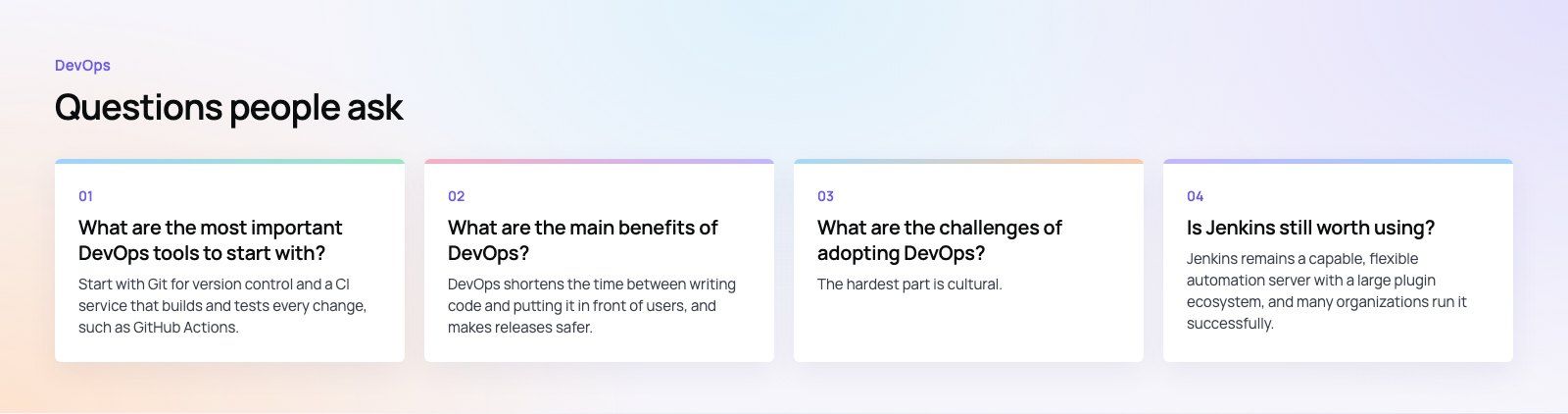
Start with Git for version control and a CI service that builds and tests every change, such as GitHub Actions, GitLab CI or Jenkins.
Next, add infrastructure as code with Terraform or OpenTofu so environments are reproducible, and basic monitoring with Prometheus and Grafana or your cloud provider's tools. Containers and Kubernetes can come later, once you run enough services to justify them.
DevOpsPlatform Engineering vs DevOps: Differences and How They FitPlatform engineering vs DevOps explained: what each one is, where they overlap, the tools involved, and how to tell which one your organization needs next. DevOpsGitLab vs Jenkins: Which CI/CD Tool Fits Your Team?GitLab vs Jenkins compared on setup, features, scaling, security, integrations and total cost, with a simple checklist for choosing the right CI/CD tool.
 DevOpsConfiguration Management Tools in DevOps: How the Leaders CompareAnsible, Puppet, OpenVox, Chef, Salt, Terraform and OpenTofu compared: what configuration management does in DevOps and how to choose a tool.
Tell us what the business needs. We will tell you what to build first.
Schedule a free consultation and get a written recommendation, with costs, before you commit to anything.
Get in touchPROVEN RESULTS
4.7 / 5verified reviews on Google