 Digital TransformationHow Digital Transformation Is Reshaping BusinessesFive ways digital transformation is changing operations, customer experience, data, business models and work, plus the challenges and a practical roadmap.
CodeeoInsightsDigital Transformation
How Digital Transformation Improves Customer Experience
How connected systems, self-service and customer data turn satisfied customers into delighted ones, with a practical rollout plan and the metrics that prove it worked.
Digital transformation improves customer experience when it removes effort from the things customers already try to do: finding information, buying, getting help and coming back. The technology matters less than the order you apply it in. Start with where customers struggle today, fix those moments with connected systems and better data, then measure whether effort actually went down.
This guide covers why delight matters more than satisfaction, the four digital levers that move customer experience, a practical rollout plan, and the metrics that tell you whether any of it worked.
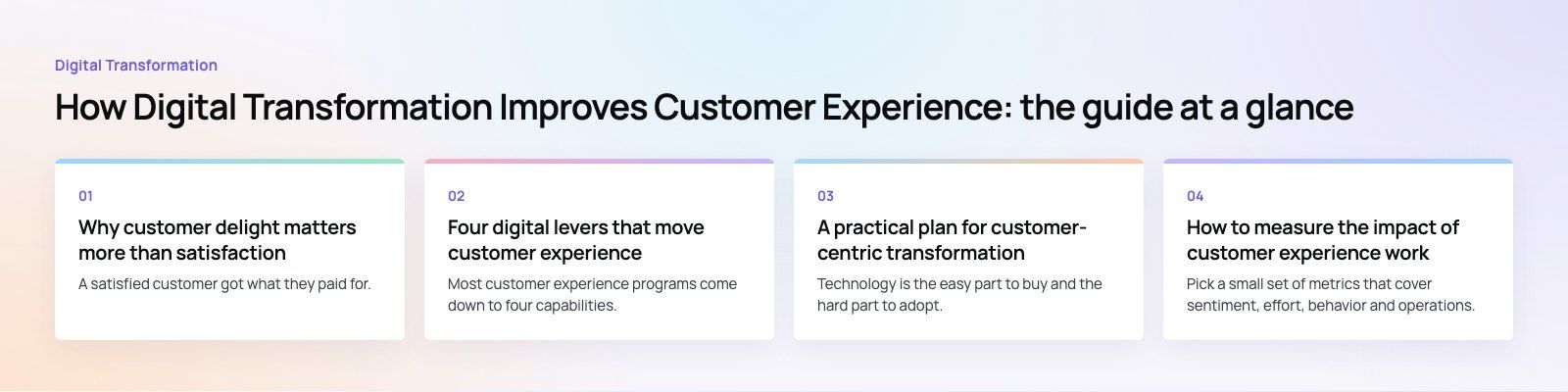
Why customer delight matters more than satisfaction
A satisfied customer got what they paid for. A delighted customer got it with less effort than they expected, and tells other people about it. That difference is commercial, not sentimental. Word of mouth is still the cheapest way to win a new customer, and delighted customers are the ones who generate it.
Loyalty and retention
Customers who have a consistently easy experience have fewer reasons to shop around. They repeat purchases, renew subscriptions and forgive the occasional mistake because the overall relationship is positive.
Brand perception and reviews
Public reviews now shape buying decisions before a prospect ever speaks to you. An experience that feels personal and quick produces the kind of reviews that do your selling for you. A slow or confusing one produces the opposite, in public.
Differentiation when products look alike
In many categories, features and prices converge. Experience is often the only thing left that a competitor cannot copy quickly, because it depends on how your systems, data and people work together.
Higher lifetime value and lower churn
Customers who stay longer spend more over time and cost less to serve. Reducing churn by even a small amount usually beats spending more on acquisition, especially in subscription and repeat purchase businesses.
A steady flow of insight
Engaged customers give feedback. That feedback, combined with behavioral data, tells you what to fix next. Disengaged customers simply leave, and you learn nothing.
Four digital levers that move customer experience
Most customer experience programs come down to four capabilities. You do not need all of them at once, but you should know which one addresses your biggest problem.
Connected omnichannel experiences
Customers move between your website, app, social channels, phone and physical locations without thinking about it. They expect you to remember who they are and what they did last. That only works when every channel reads from and writes to the same customer record, usually a CRM connected to your commerce, support and marketing tools through APIs.
The most common failure is not missing channels but disconnected ones: a support agent who cannot see a recent order, or a marketing email promoting a product the customer returned yesterday.
Self-service that actually resolves things
Many customers would rather solve a problem themselves than wait for an agent. Self-service portals, order tracking, searchable help centers and well scoped chatbots handle routine requests around the clock. The test is resolution, not deflection. A chatbot that cannot complete a refund or reschedule a booking just adds a step before the customer reaches a human.
Good self-service is built on the same back office systems your staff use, so customers can change an address, download an invoice or rebook an appointment without anyone touching it.
Data and analytics for personalization
Personalization works when it is based on what customers have actually done: browsing, purchases, support history and stated preferences. Analytics tools and machine learning models can segment customers, predict churn risk and recommend next best actions.
Two cautions apply. First, personalization on bad data feels creepy or wrong, so clean data comes before clever models. Second, privacy rules in most markets require clear consent and a lawful basis for using personal data, so design consent into the system from the start.
Mapping the customer lifecycle
A lifecycle map lays out every stage from first awareness to purchase, onboarding, support and renewal. For each stage, you note what the customer is trying to do, which systems are involved, and where friction appears. This is where most quick wins come from, because it exposes handoffs nobody owns.
Website speed is a frequent friction point that teams overlook. Google's Core Web Vitals guidance (web.dev, 2026) describes the loading, responsiveness and visual stability measures that shape how a page feels to use.
A practical plan for customer-centric transformation
Technology is the easy part to buy and the hard part to adopt. These steps keep the program anchored to customers rather than to a software list.
- Understand your customers. Combine interviews, support tickets, reviews and analytics. Build a small number of personas based on real behavior, not assumptions.
- Pick the moments that matter. Choose two or three high friction points from your lifecycle map, such as checkout, onboarding or complaint handling, and fix those first.
- Build a customer-first culture. Everyone from frontline staff to leadership should see customer metrics regularly. Give teams the authority to fix problems, not just log them.
- Choose technology that connects. Prefer platforms with open APIs and good integration options over isolated tools with long feature lists. A CRM, an analytics stack, a marketing automation platform and a feedback tool are the usual core.
- Improve every touchpoint. Your website and app are often the first and most frequent touchpoints. Fast, accessible, mobile friendly pages remove friction before support is ever needed.
- Train and equip employees. New tools fail when staff work around them. Train people on the why as well as the how.
- Collect and act on feedback. Ask for feedback at natural points, close the loop with customers who complain, and publish internally what changed as a result.
- Measure, then iterate. Set targets for a few metrics before you start, review them monthly and adjust.
How to measure the impact of customer experience work
Pick a small set of metrics that cover sentiment, effort, behavior and operations. Tracking everything usually means acting on nothing.
| Metric | What it tells you | When to use it |
|---|---|---|
| Customer Satisfaction (CSAT) | How happy customers were with a specific interaction | After support tickets, deliveries or purchases |
| Net Promoter Score (NPS) | How likely customers are to recommend you | Periodic relationship surveys |
| Customer Effort Score (CES) | How easy it was to get something done | After self-service or support interactions |
| Retention and churn rate | Whether customers stay or leave over time | Monthly or quarterly reviews |
| Customer lifetime value (CLV) | Expected revenue across the whole relationship | Budgeting and segmentation decisions |
| Repeat purchase rate | Whether buyers come back | Ecommerce and retail |
| First contact resolution | Whether issues are solved without follow-ups | Contact center and support teams |
NPS has a standard method: customers answer on a zero to ten scale, and you subtract the share of detractors from the share of promoters. The Net Promoter System site from Bain (2026) explains the calculation in full.
Alongside scores, use sentiment analysis on reviews and open text feedback to find recurring themes, and customer analytics to see where people drop out of key flows. Operational measures such as average handling time and service level compliance show whether improvements are also making your team more efficient.
Common mistakes to avoid
- Buying tools before defining problems. A new CRM will not fix a broken returns policy.
- Automating bad processes. If a process frustrates customers manually, automating it frustrates them faster.
- Measuring without acting. Surveys that never lead to visible change train customers to stop answering.
- Ignoring the website. Slow, inaccessible pages quietly undo investment elsewhere.
- Treating it as a one-off project. Customer expectations keep moving, so the work has to continue.
Customer experience improves when systems, data and people point in the same direction. Codeeo has delivered 200+ projects across the UAE and the US, from fast websites to connected CRMs, with a team of 80+ across Dubai, Riyadh and Karachi. If you want to fix the touchpoints customers use most, start with our web development and sales automation services, see how we approach custom software, or talk to the team.
Frequently asked questions
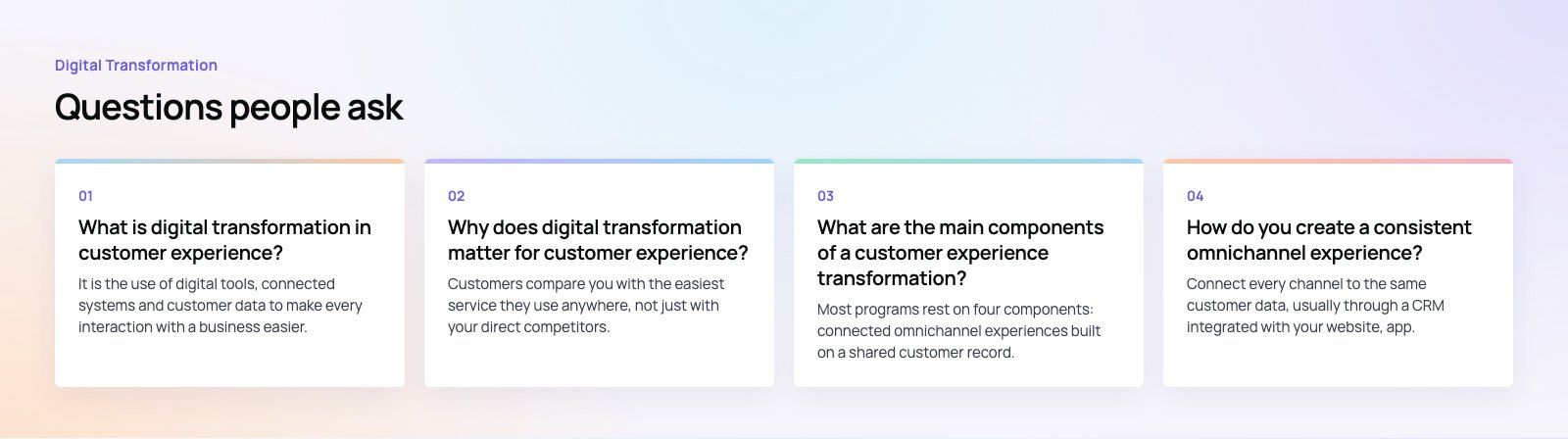
It is the use of digital tools, connected systems and customer data to make every interaction with a business easier, faster and more personal.
That includes websites, apps, CRMs, self-service portals and analytics. The goal is not new technology for its own sake but less effort for customers at each stage, from first visit to purchase, support and renewal.
Digital TransformationHow Digital Transformation Is Reshaping BusinessesFive ways digital transformation is changing operations, customer experience, data, business models and work, plus the challenges and a practical roadmap. Digital TransformationStrategic Human Resource Management: Aligning HR With GoalsWhat strategic human resource management means, the components of a strategic HR model, and a six step process for aligning HR with business goals.
 Digital TransformationBest CRM for Small Businesses: 10 Options and How to ChooseTen CRM platforms that suit startups and small teams, from HubSpot and Zoho to Kommo and NetHunt, with a comparison table and a practical way to choose.
Tell us what the business needs. We will tell you what to build first.
Schedule a free consultation and get a written recommendation, with costs, before you commit to anything.
Get in touchPROVEN RESULTS
4.7 / 5verified reviews on Google