 Digital TransformationHow Digital Transformation Is Reshaping BusinessesFive ways digital transformation is changing operations, customer experience, data, business models and work, plus the challenges and a practical roadmap.
CodeeoInsightsDigital Transformation
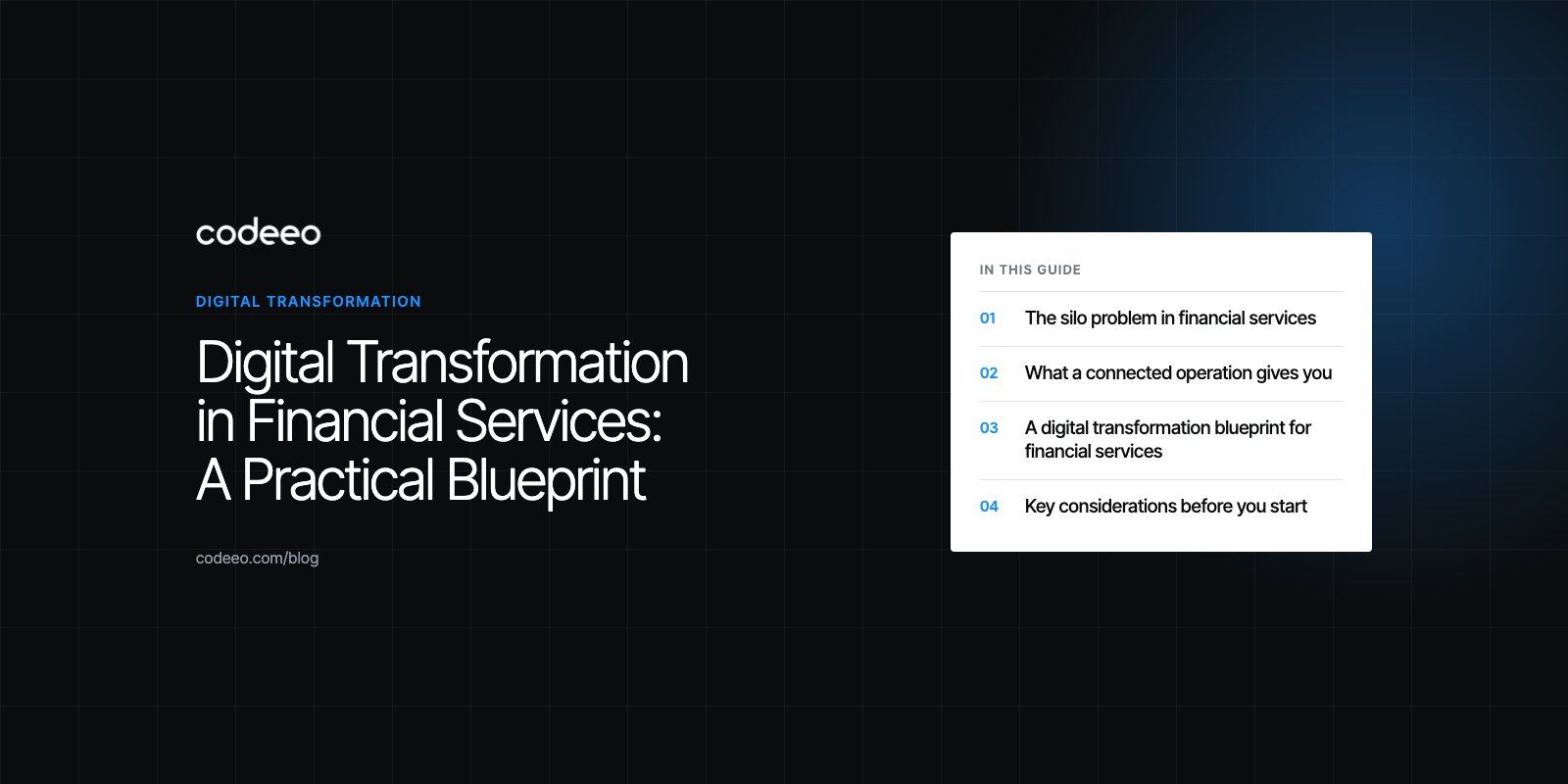
Digital Transformation in Financial Services: A Practical Blueprint
How banks, lenders and payment firms can break down data silos, with a seven step digital transformation blueprint and the risks to plan for.
Digital transformation in financial services means replacing disconnected systems, paper steps and manual handoffs with connected platforms that share one view of the customer. A practical blueprint agrees the outcomes first, assesses where you are, fixes the data silos before adding new apps, delivers in small funded phases with trained teams, and measures every phase against the outcomes. Banks, lenders, insurers and payment firms that follow that order get faster service and lower risk without betting the business on one giant project.
This guide explains why silos hold financial firms back, what a connected operation gives you, and a step by step plan you can adapt to your own organization.
The silo problem in financial services
Financial firms hold a great deal of customer information: identity documents, income, assets, credit history, transactions and every conversation with support. The trouble is that this information usually lives in separate systems. Lending has one database, cards another, the call center a third, and compliance keeps its own records in spreadsheets.
What silos cost you
- Duplicate and conflicting records. When each department keeps its own copy, an address change in one system never reaches the others.
- Slow service. Staff jump between screens to answer one question, and customers repeat the same details at every step.
- Weak risk control. Fraud patterns are hard to spot when transactions, logins and device data sit in different places.
- Painful reporting. Regulatory and management reports take days of manual reconciliation instead of minutes.
- Missed opportunities. Without a joined up view, you cannot tell which customers would benefit from a savings product, a credit line or a better plan.
One issue we often see is a modern mobile app sitting on top of old back office systems that do not talk to each other. The app looks new, but every request still waits on a manual step behind the scenes.
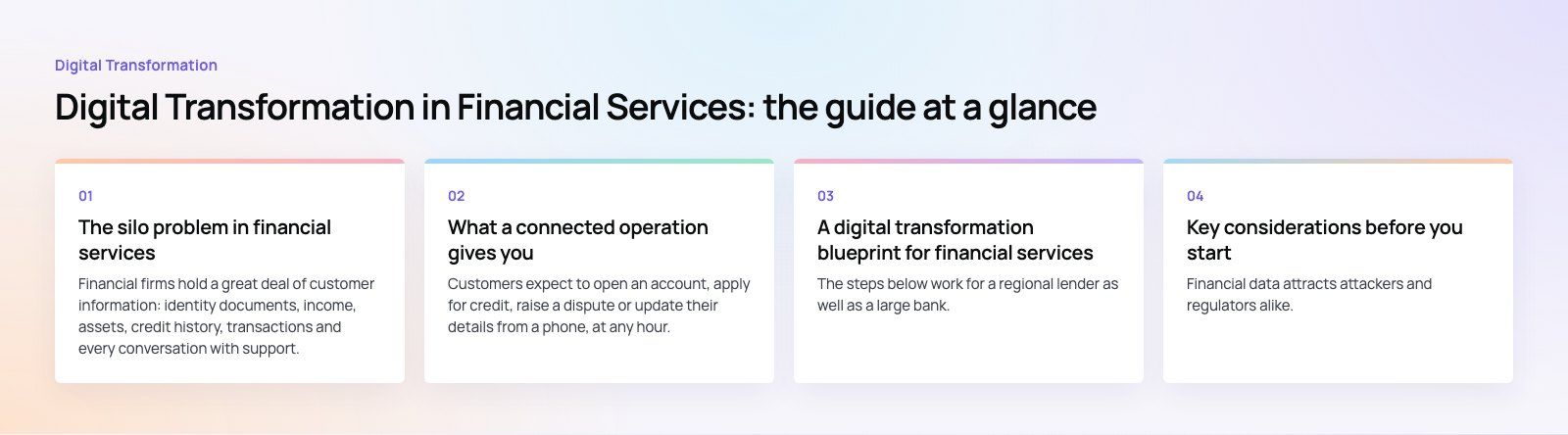
What a connected operation gives you
Better customer experience
Customers expect to open an account, apply for credit, raise a dispute or update their details from a phone, at any hour. When systems share data, those tasks can finish in one sitting instead of turning into a chain of emails and branch visits.
Lower operating effort
Automating document checks, approvals and reconciliations frees staff for work that needs judgment. Cloud infrastructure removes much of the effort of running and patching servers in house.
Stronger risk and compliance
Real time monitoring across all channels makes suspicious patterns easier to catch. Audit trails become a by product of the system rather than a separate task, which helps when regulators ask questions.
Faster product launches
With an API layer in place, a new product, partner or channel connects to existing services instead of needing its own copy of everything. Teams can test an idea with a small group and scale it if it works.
Decisions based on data
Dashboards built on a single source of truth show which products, branches and channels perform, so leaders stop arguing about whose numbers are right.
A digital transformation blueprint for financial services
The steps below work for a regional lender as well as a large bank. The scale changes, the order does not.
1. Agree the outcomes
Start with business results, not technology. Examples are shorter onboarding, faster loan decisions, fewer manual reconciliations or fewer support calls per customer. Write each outcome down with a way to measure it.
2. Assess your current state
Map your systems, data flows, integrations and manual workarounds. Rate your team's skills and your vendors' limits honestly. This assessment shows which legacy systems can be wrapped with APIs and which need replacing.
3. Fix the data foundation first
Decide which system owns each piece of customer data, clean the duplicates and connect the core systems. Without this step, every new app simply creates another silo.
4. Prioritize by value and risk
Rank initiatives by the outcome they move, the effort they need and the regulatory risk they carry. Early projects should be visible, valuable and low risk, such as digital onboarding or automated statements.
5. Build a phased roadmap
Break the program into phases of a few months each, with a clear owner, budget and success measure for every phase. Shorter phases let you learn and change course before costs pile up.
6. Train people and manage change
New systems fail when staff keep their old workarounds. Train teams early, involve them in testing and remove the old process once the new one is live.
7. Measure and adjust
Track the outcomes from step one after every release. Keep what moves the numbers and drop what does not.
Key considerations before you start
Security and regulation
Financial data attracts attackers and regulators alike. Card data falls under the PCI Security Standards Council rules, and customer data from the EU falls under the General Data Protection Regulation. Your local central bank or financial regulator will add its own rules on data residency, outsourcing and cloud use. Bring compliance into design reviews from day one rather than at the end.
Legacy systems
Core banking and policy systems are rarely replaced in one go. A common pattern is to wrap them with an API layer, move new features onto modern services, and retire old modules one at a time.
Build, buy or partner
Not every capability needs custom code. Use proven platforms for commodity functions such as CRM, accounting and identity checks, and spend custom effort where you compete, such as pricing, customer experience and risk models.
User experience
Clear, accessible screens reduce support calls and abandoned applications. Test with real customers, including older users and people on low end phones.
| Area | Typical silo symptom | Connected approach |
|---|---|---|
| Onboarding | Paper forms and repeated document requests | Digital identity checks and one shared customer profile |
| Lending | Manual data gathering for each application | Automated data pulls and rules based decisions with human review |
| Fraud | Each channel monitored separately | Real time monitoring across cards, logins and transfers |
| Reporting | Spreadsheets reconciled by hand | Dashboards on a single source of truth |
| Service | Agents switch between several screens | One view of the customer with full history |
Where financial services is heading
Embedded and partner finance
More financial products now reach customers through other businesses, such as payments inside a shopping app or credit at checkout. Open APIs let banks and fintechs plug into those partners instead of relying only on their own channels.
Cloud and service based platforms
Firms increasingly rent software and infrastructure as a service rather than running everything in house. The benefit is speed and scale. The cost is vendor dependence, so contracts and exit plans matter.
AI in daily operations
Machine learning already supports fraud scoring, document reading and customer service. The firms that gain most are the ones whose data is clean and connected enough for those models to work.
Privacy as a trust issue
Customers now judge financial brands on how they handle data. Clear consent, minimal data collection and fast breach response are as much about reputation as compliance.
Codeeo has built payment and fintech products, including the Purpose Payment app, portals and API. Our team of 80+ across Dubai, Riyadh and Karachi works on custom software, mobile apps, system integration and reporting dashboards. See how we approach fintech projects if you are planning your own roadmap.
Frequently asked questions
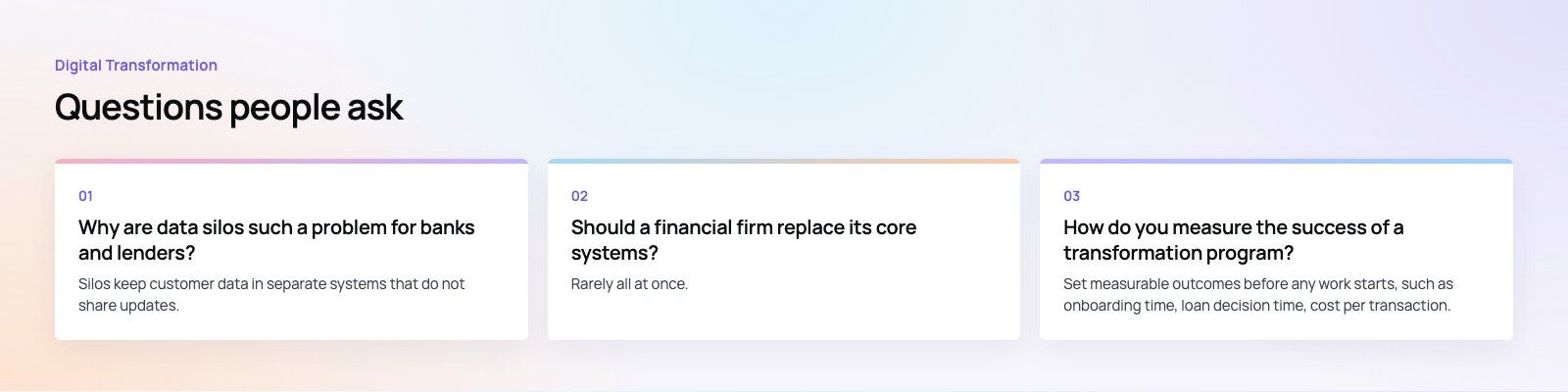
It is the move from disconnected systems and manual processes to connected digital platforms that share one view of the customer.
In practice it covers digital onboarding, mobile banking and payments, automated back office work, real time fraud monitoring and reporting from a single source of truth. The aim is faster service, lower operating effort and better control of risk.
Digital TransformationHow Digital Transformation Is Reshaping BusinessesFive ways digital transformation is changing operations, customer experience, data, business models and work, plus the challenges and a practical roadmap. Digital TransformationStrategic Human Resource Management: Aligning HR With GoalsWhat strategic human resource management means, the components of a strategic HR model, and a six step process for aligning HR with business goals.
 Digital TransformationBest CRM for Small Businesses: 10 Options and How to ChooseTen CRM platforms that suit startups and small teams, from HubSpot and Zoho to Kommo and NetHunt, with a comparison table and a practical way to choose.
Tell us what the business needs. We will tell you what to build first.
Schedule a free consultation and get a written recommendation, with costs, before you commit to anything.
Get in touchPROVEN RESULTS
4.7 / 5verified reviews on Google