 Digital TransformationHow Digital Transformation Is Reshaping BusinessesFive ways digital transformation is changing operations, customer experience, data, business models and work, plus the challenges and a practical roadmap.
CodeeoInsightsDigital Transformation
Trends Shaping Digital Transformation in Education
The trends reshaping education technology, from AI adaptive learning and VR to cloud platforms and learning analytics, plus how schools can adopt them well.
The trends shaping digital transformation in education are AI-driven adaptive learning, gamification, immersive VR and AR, cloud-based learning platforms, AI tutors, collaborative tools, learning analytics and skills-based assessment. Each one aims to make learning more personal, more engaging or more accessible. The schools that benefit most pick the trends that solve a real teaching problem and roll them out with proper training and support.
This guide explains each trend, what it is good for, the pitfalls to watch, and a practical way for schools and universities to adopt them.
Why education is changing
Technology in education is no longer about adding devices to classrooms. It changes how content is delivered, how progress is measured and how students, teachers and parents communicate. It also raises real questions about equity, privacy and evidence. UNESCO's Global Education Monitoring Report on technology in education (UNESCO, 2023) is a useful, balanced read on where technology helps learning and where it does not.
Nine trends shaping digital learning
1. AI for adaptive learning paths
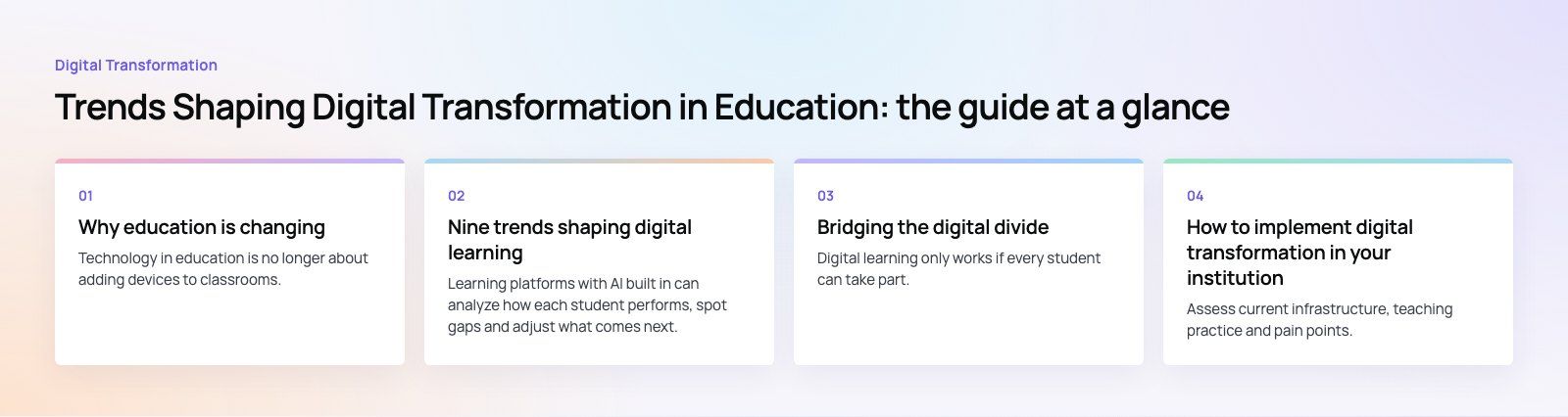
Learning platforms with AI built in can analyze how each student performs, spot gaps and adjust what comes next. A student who masters fractions quickly moves on; one who struggles gets more practice and a different explanation. Teachers get a clearer picture of who needs help without marking every exercise by hand.
The caution is transparency. Teachers should be able to see why the system recommends something and override it.
2. Gamification
Points, badges, levels and leaderboards bring game mechanics into lessons. Used well, they reward effort and progress, encourage practice and support teamwork through shared goals. Used badly, they reward speed over understanding or demotivate students who rank low. Private progress tracking often works better than public leaderboards.
3. Virtual field trips and simulations
Virtual reality lets students visit historic sites, explore the ocean floor or walk through a cell without leaving the classroom. Simulations let science and vocational students practice experiments or procedures safely and repeatedly. These experiences make abstract ideas concrete, but headsets and content take budget and planning, so they work best for specific units rather than every lesson.
4. Augmented reality in textbooks and lessons
AR overlays digital content on the real world through a phone or tablet. Point a device at a diagram of the heart and a 3D model appears that students can rotate and explore. AR usually needs less hardware than VR, which makes it easier to try first.
5. Cloud-based learning
Learning management systems in the cloud make lesson notes, videos, assignments and discussions available anywhere, on any device. Students can learn at their own pace, catch up after absences and revisit material before exams. For institutions, cloud platforms reduce on-site server maintenance and make it easier to scale during peak periods.
6. AI chatbots and virtual tutors
AI assistants can answer common questions, explain concepts in different ways and give instant feedback on practice work at any time of day. They also take routine admin questions off staff, such as timetables, fees processes and admissions steps. Schools need clear rules on acceptable use, accuracy checks and how student data is handled.
7. Collaborative learning platforms
Shared documents, discussion forums, group chat and project spaces let students work together inside and outside class. Teachers can follow group progress, give feedback in context and encourage peer learning. A single platform used consistently beats several tools used inconsistently.
8. Big data and learning analytics
Analytics bring together attendance, assessment and engagement data to show which students are at risk, which resources work and where teaching time should go. At institution level, the same data supports planning and resource allocation. The prerequisites are clean data, clear purpose and strong privacy safeguards.
9. Skills-based assessment
Rather than testing recall alone, skills-based assessment asks students to apply knowledge through projects, presentations, portfolios and simulations. Digital tools make it easier to collect evidence, use rubrics consistently and share feedback. This prepares students for the kind of work they will do after school.
Comparing the main education technologies
| Technology | Main benefit | Key consideration |
|---|---|---|
| Adaptive learning (AI) | Personalized pace and content | Transparency and teacher control |
| Gamification | Motivation and practice | Avoid rewarding speed over understanding |
| VR field trips | Immersive, memorable experiences | Hardware, content and supervision |
| AR | Interactive 3D models on common devices | Quality of available content |
| Cloud LMS | Access anywhere, any time | Connectivity and device access at home |
| AI tutors and chatbots | Instant help and fewer admin queries | Accuracy, acceptable use and privacy |
| Learning analytics | Early warning and better planning | Data quality and consent |
Bridging the digital divide
Digital learning only works if every student can take part. Many families lack reliable internet, a suitable device or a quiet place to study. Schools and governments respond with device loan schemes, subsidized connectivity, low-bandwidth versions of materials and offline access to key resources.
Accessibility matters just as much. Learning platforms and school websites should meet WCAG accessibility guidelines (W3C, 2026) so students with disabilities can use them, and bilingual institutions need proper right-to-left support where Arabic or other RTL languages are used.
How to implement digital transformation in your institution
Identify needs and goals
Assess current infrastructure, teaching practice and pain points. Talk to teachers, students, parents and IT staff. Set a small number of clear goals tied to your mission, such as improving reading outcomes, cutting admin time or supporting hybrid learning.
Choose the right EdTech
Evaluate tools on how well they serve those goals, ease of use, integration with your existing student information and finance systems, accessibility, data protection and total cost of ownership. Involve teachers and students in pilots before committing.
Plan the rollout
Set timelines, budgets and owners. Pilot with a few classes, gather feedback, fix problems, then expand. Phased rollouts are cheaper to correct than school-wide launches.
Train and support staff
Professional development should be ongoing, practical and tied to real lessons. Identify teacher champions who can help colleagues and share what works.
Encourage a culture of experimentation
Give teachers room to try new methods, share results openly and drop what does not work. Measure impact on learning, not just usage.
Common mistakes to avoid
- Buying technology before agreeing what problem it solves.
- Running too many disconnected tools that teachers must learn separately.
- Skipping training and expecting adoption to happen on its own.
- Ignoring students who lack devices or connectivity at home.
- Collecting student data without a clear purpose and consent.
Education platforms have to serve teachers, students, parents and administrators at once. Our Edsidera case study covers a school platform with classes, tasks, preset feedback and payments across mobile and web, and Diyafah shows a bilingual school website built right to left from the start. Codeeo has delivered 200+ projects across the UAE and the US with a team of 80+ across Dubai, Riyadh and Karachi. See our work for education, our mobile app development service, or contact us.
Frequently asked questions
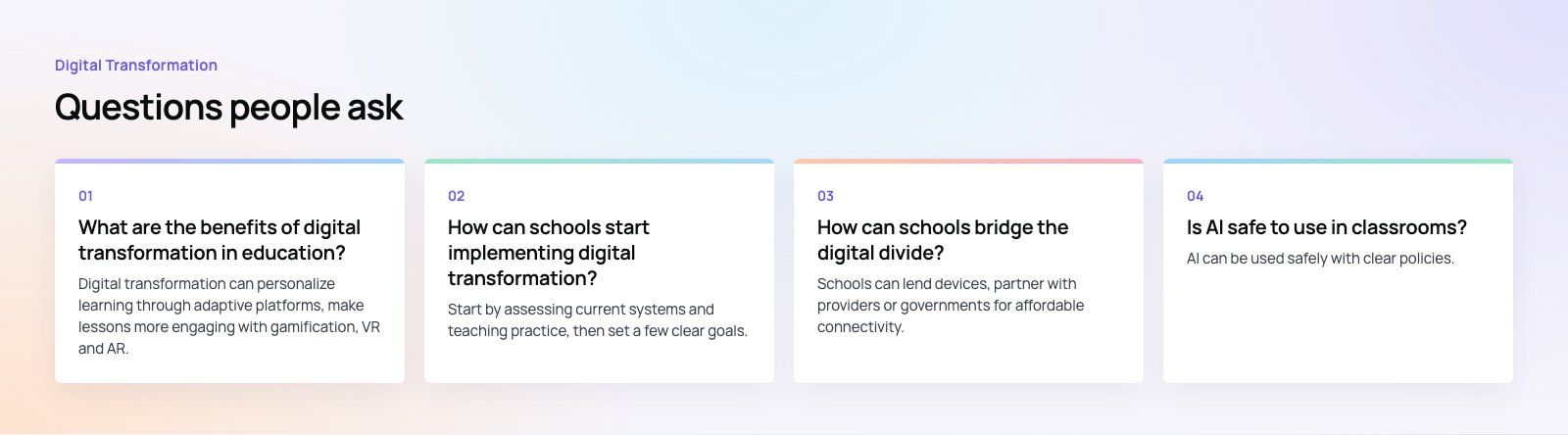
Digital transformation can personalize learning through adaptive platforms, make lessons more engaging with gamification, VR and AR, give students access to materials anywhere through cloud systems, and improve collaboration between students and teachers. Learning analytics help staff spot students who need support earlier. Institutions also save administrative time when admissions, fees and communication move onto connected systems.
Digital TransformationHow Digital Transformation Is Reshaping BusinessesFive ways digital transformation is changing operations, customer experience, data, business models and work, plus the challenges and a practical roadmap. Digital TransformationStrategic Human Resource Management: Aligning HR With GoalsWhat strategic human resource management means, the components of a strategic HR model, and a six step process for aligning HR with business goals.
 Digital TransformationBest CRM for Small Businesses: 10 Options and How to ChooseTen CRM platforms that suit startups and small teams, from HubSpot and Zoho to Kommo and NetHunt, with a comparison table and a practical way to choose.
Tell us what the business needs. We will tell you what to build first.
Schedule a free consultation and get a written recommendation, with costs, before you commit to anything.
Get in touchPROVEN RESULTS
4.7 / 5verified reviews on Google