 Digital TransformationHow Digital Transformation Is Reshaping BusinessesFive ways digital transformation is changing operations, customer experience, data, business models and work, plus the challenges and a practical roadmap.
CodeeoInsightsDigital Transformation
Digital Transformation in Pharma: The Key Drivers
How AI, cloud data platforms and wearables are changing drug discovery, clinical trials, manufacturing and patient care, plus what pharmatech startups need to get right.
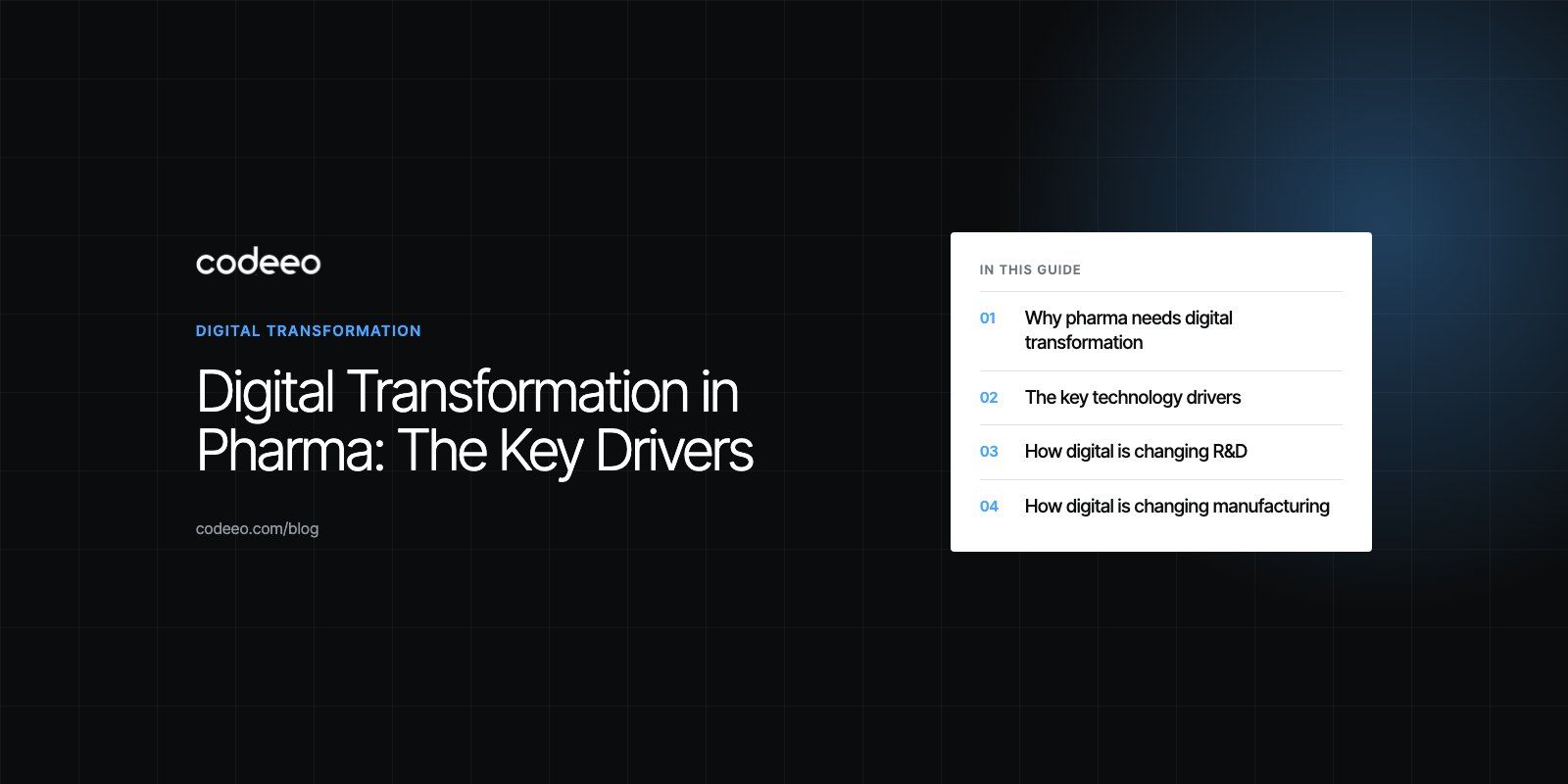
The key drivers of digital transformation in pharma are artificial intelligence and machine learning, cloud data platforms, and connected devices that capture real-world patient data. Together they shorten drug discovery, make clinical trials more efficient, tighten manufacturing quality and support patients between appointments. The pressure behind them is familiar: development is slow and expensive, regulators expect more evidence, and patients expect treatment that fits them.
This guide explains why the industry is changing, the technologies doing the work, how they affect R&D, manufacturing and patient care, and what pharmatech startups need to get right.
Why pharma needs digital transformation
Drug development is long and costly
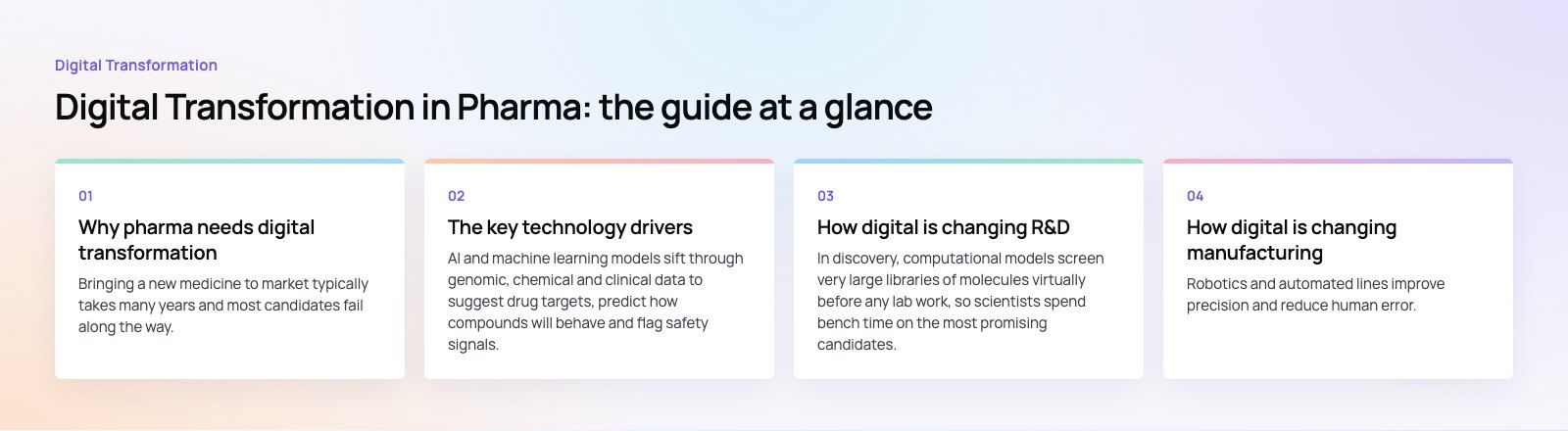
Bringing a new medicine to market typically takes many years and most candidates fail along the way. Any tool that identifies weak candidates earlier, or speeds up trials, has an outsized effect on cost and time.
Regulators expect more data
Regulators ask for detailed evidence on safety, efficacy and manufacturing quality, and increasingly accept digital data sources. That raises the bar for how data is captured, validated and audited.
Patients expect personalized care
Patients living with several conditions do not fit one-size-fits-all treatment. Digital tools make it possible to tailor dosing, monitor responses and adjust plans based on individual data.
The key technology drivers
Artificial intelligence and machine learning
AI and machine learning models sift through genomic, chemical and clinical data to suggest drug targets, predict how compounds will behave and flag safety signals. They are also used to design trials, select sites and match patients to studies. The US Food and Drug Administration maintains a dedicated page on AI and machine learning in drug development (FDA, 2026) covering its current thinking and guidance.
Cloud computing and big data
Research, trials and manufacturing generate huge volumes of data. Cloud platforms provide scalable storage and compute, so teams can run analyses that would overwhelm on-premises servers. Serverless and managed services let smaller companies process large datasets without running their own infrastructure, provided they meet validation and data protection requirements.
Wearables and the Internet of Things
Wearable sensors and connected devices record heart rate, activity, sleep and other measures continuously. In trials, they can reduce site visits and capture data closer to real life. The FDA describes how these tools are used in clinical investigations on its digital health technologies page (FDA, 2026).
How digital is changing R&D
In discovery, computational models screen very large libraries of molecules virtually before any lab work, so scientists spend bench time on the most promising candidates. AI tools that predict protein structures help researchers understand targets faster.
In development, digital tools support:
- Smarter trial design using historical data to choose endpoints, sample sizes and sites.
- Faster recruitment by matching eligible patients from health records and patient communities.
- Decentralized trials where patients use apps, e-consent and wearables at home.
- Real-time data review so safety issues surface earlier.
Trial conduct still has to follow international standards for good clinical practice, published by the ICH efficacy guidelines (ICH, 2026). Digital tools must be validated to the same standard as paper processes.
How digital is changing manufacturing
Automation and continuous manufacturing
Robotics and automated lines improve precision and reduce human error. Continuous manufacturing, where materials flow through the process without stopping between batches, can shorten production times and give tighter quality control.
Analytics and predictive maintenance
Sensors on equipment feed models that predict failures before they happen and spot quality drift early. The same data supports batch records and regulatory reporting.
Personalized medicine and 3D printing
Additive manufacturing makes it possible to produce doses and formulations tailored to small groups of patients. It is still an emerging area, but it points toward more flexible production.
Supply chain visibility
Serialization, track and trace systems and connected inventory tools help fight counterfeit medicines and keep cold chain products within safe conditions. Inventory systems that count stock continuously reduce shortages and waste.
Greener operations
Manufacturers are using energy monitoring and process data to cut waste, solvent use and energy consumption, both for cost and to meet sustainability commitments.
How digital is changing patient care
- Telehealth and remote monitoring help clinicians track patients between visits and intervene sooner.
- Personalized treatment plans use individual data to adjust dosing and therapy.
- Adherence apps remind patients to take medicines and record side effects.
- Education and support platforms give patients trusted information and access to their own data.
Where pharma software makes the biggest difference
| Area | Typical software | Main benefit |
|---|---|---|
| Sales and distribution | Order, inventory and delivery tracking apps | Fewer stockouts and faster fulfillment |
| Clinical trials | Recruitment, e-consent and remote data capture | Quicker enrollment and cleaner data |
| Patient engagement | Reminders, education and appointment apps | Better adherence and outcomes |
| Field teams | CRM and field force automation | Consistent, compliant engagement with healthcare professionals |
| Manufacturing | ERP, quality and maintenance systems | Traceability and fewer deviations |
What makes a strong pharmatech startup
- A clear, specific problem that pharma companies, clinicians or patients will pay to solve.
- Technology that fits the regulation, with data protection, validation and audit trails designed in.
- A team that spans pharma and software, because neither discipline alone can handle the domain.
- A credible funding plan that accounts for long sales cycles and regulatory milestones.
Questions investors will ask
Expect investors to probe four areas. Market opportunity: what unmet need you address and how large it is. Differentiation: why your approach beats existing tools and what stops others copying it. Regulatory pathway: which approvals you need and how you will get them. Financial viability: your route to revenue, cost structure and milestones. A working prototype built to production standards answers the technical feasibility question better than any slide.
Trends to watch
- Digital therapeutics: software that delivers evidence-based treatment, sometimes cleared by regulators as a medical device.
- Blockchain and serialization for tamper-evident supply chain records.
- Precision medicine that combines genetic profiles, medical history and real-world data to tailor therapy.
- Generative AI for drafting regulatory documents and summarizing literature, with human review.
Pharma and healthcare software must be accurate, secure and easy for busy people to use. Our Distinct and HMS case studies show healthcare platforms Codeeo has built. With 200+ projects delivered across the UAE and the US and a team of 80+ across Dubai, Riyadh and Karachi, we build mobile apps and custom software for healthcare teams. Get in touch to discuss your project.
Frequently asked questions
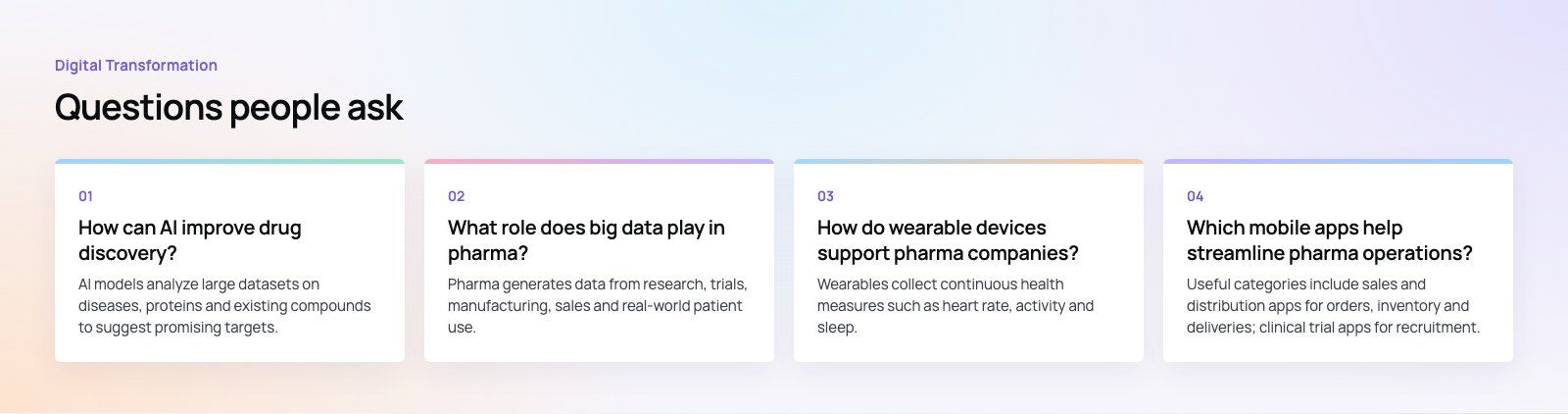
AI models analyze large datasets on diseases, proteins and existing compounds to suggest promising targets, predict how molecules will behave and screen candidates virtually before lab testing.
That helps researchers drop weak candidates earlier and focus lab time where it counts. AI is also used to design clinical trials and find suitable patients, though results still need scientific validation and regulatory review.
Digital TransformationHow Digital Transformation Is Reshaping BusinessesFive ways digital transformation is changing operations, customer experience, data, business models and work, plus the challenges and a practical roadmap. Digital TransformationStrategic Human Resource Management: Aligning HR With GoalsWhat strategic human resource management means, the components of a strategic HR model, and a six step process for aligning HR with business goals.
 Digital TransformationBest CRM for Small Businesses: 10 Options and How to ChooseTen CRM platforms that suit startups and small teams, from HubSpot and Zoho to Kommo and NetHunt, with a comparison table and a practical way to choose.
Tell us what the business needs. We will tell you what to build first.
Schedule a free consultation and get a written recommendation, with costs, before you commit to anything.
Get in touchPROVEN RESULTS
4.7 / 5verified reviews on Google