 Digital TransformationHow Digital Transformation Is Reshaping BusinessesFive ways digital transformation is changing operations, customer experience, data, business models and work, plus the challenges and a practical roadmap.
CodeeoInsightsDigital Transformation
Digital Transformation Management: A Practical Guide
What digital transformation management means, the components of a well run program, the metrics worth tracking and how to keep people on board through change.
Digital transformation management is the planning, governance and day to day oversight of changes that use technology to reshape how an organization works and serves its customers. It covers far more than choosing software: it decides which problems to solve first, who owns each change, how people are trained and how results are measured. Done well, it turns a long list of technology projects into a sequence of improvements that people actually adopt.
This guide explains the terms, the components of a well run program, the metrics worth tracking and the mistakes that most often stall progress.
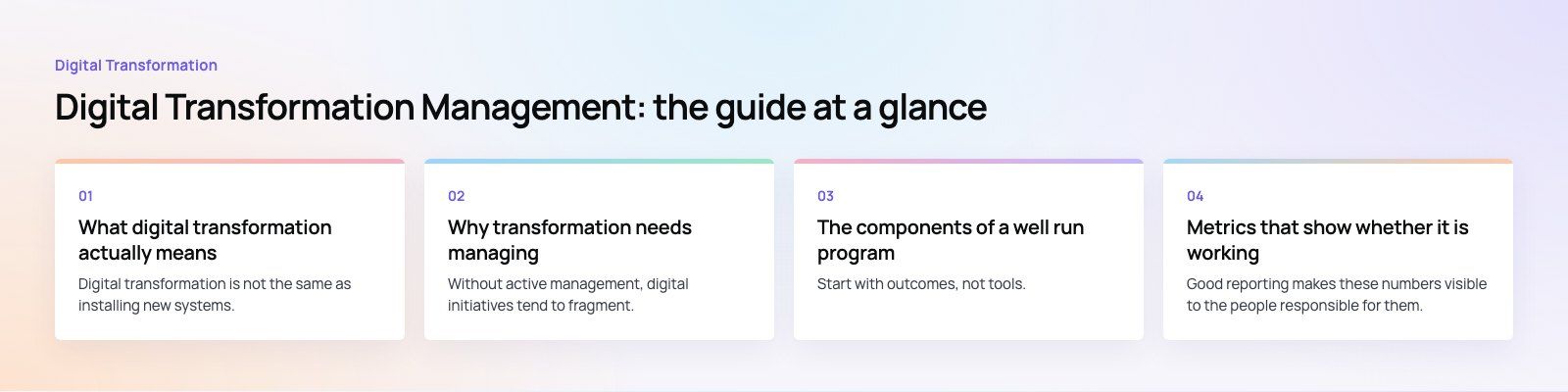
What digital transformation actually means
Digital transformation is not the same as installing new systems. It means rethinking how the business creates value, using technology as the means rather than the goal. A new CRM is a project. Changing how sales, service and finance share one view of the customer, and changing the work of the people involved, is transformation.
Three terms are often confused:
| Term | What it means | Example |
|---|---|---|
| Digitization | Converting analog information into digital form | Scanning paper contracts into a document system |
| Digitalization | Using digital tools to improve an existing process | Moving contract approvals into an automated workflow |
| Digital transformation | Rethinking the business model and operating model with technology | Letting customers sign, renew and change contracts themselves online, with sales and finance working from the same record |
Most organizations need all three. Digitization and digitalization are the building blocks. Transformation is what happens when they are joined up around a clear business goal.
Why transformation needs managing
Without active management, digital initiatives tend to fragment. Each department buys its own tools, data ends up in separate silos, and staff juggle several systems that do not talk to each other. Projects finish on time but the business does not change, because nobody owned the outcome rather than the delivery.
Digital transformation management fixes this by connecting every initiative to a business objective, sequencing work so each step builds on the last, and treating adoption as part of delivery rather than an afterthought. The value it can bring includes:
- Faster, more reliable operations through automation of repetitive work
- Better customer experiences, because service teams see the full picture
- Quicker responses to market changes and customer demand
- Lower costs from retiring duplicate systems and manual effort
- Clearer collaboration between departments that share data
The components of a well run program
A clear vision tied to business goals
Start with outcomes, not tools. "Reduce order to cash time", "let customers self serve the top five requests" or "give managers daily rather than monthly reporting" are goals people can understand and measure. Every project should trace back to one of them.
Governance and ownership
Someone senior must sponsor the program and settle trade offs between departments. Each initiative also needs a business owner who is accountable for adoption and results, not only an IT project manager accountable for delivery. In larger organizations this role often sits with a chief digital officer or a transformation office.
A sequenced roadmap
Break the program into phases that each deliver something useful within a few months. Early phases should fix foundations, such as a single customer record or clean product data, because later automation and analytics depend on them.
Data and integration
Transformation usually fails at the joins between systems. Plan how data moves between your CRM, ERP, ecommerce, finance and reporting tools, which system owns each record, and how quality is kept high. Integration work on platforms such as Azure or a move to a single platform like Microsoft Dynamics 365 are common parts of this step.
Security and risk
Every new system, integration and automated workflow changes your risk profile. A framework such as the NIST Cybersecurity Framework gives a structured way to identify, protect, detect, respond and recover as the program grows.
People and change management
This is where most programs succeed or fail. People need to understand why the change is happening, what it means for their role, and how they will be supported. That means honest communication, training before go live, champions inside each team and a way to raise problems that gets a real answer.
The human side: principles that keep people on board
- Treat change as an opportunity. Show staff how new tools remove tedious work rather than threaten their role.
- Encourage ideas from the front line. The people doing the work usually know where the friction is.
- Practice empathy. Transitions are stressful. Plan for learning time and expect productivity to dip briefly after launch.
- Communicate clearly and often. Keep staff and stakeholders aligned on the vision, the timeline and what is changing next.
- Give ownership. People who own part of the change commit to it. People who have change done to them resist it.
Metrics that show whether it is working
| Metric | What it tells you |
|---|---|
| Return on investment | Whether spending on technology, staff and training is producing measurable business value |
| Time to market | How quickly the organization can deliver a new digital service or change an existing one |
| Effort to a working prototype | How efficiently teams move from idea to something users can test |
| Adoption and usage | Whether people actually use the new tools, and which teams need more support |
| Process cycle times | Whether key processes, such as quote to order or ticket to resolution, are getting faster |
| Customer satisfaction | Whether customers notice and value the change |
| Employee capability | Whether training and support are giving staff the skills the new ways of working need |
Good reporting makes these numbers visible to the people responsible for them. Dashboards built with tools such as Power BI are a practical way to share progress with leadership and teams alike.
Common challenges and how to handle them
Resistance to change
Involve affected teams early, explain the reasons, and show quick wins. Resistance often signals a real problem with the new process that is worth listening to.
Legacy systems
Old systems rarely disappear in one step. Plan a phased migration, use integrations to bridge old and new, and retire systems only when data and processes have moved. A CRM migration is a typical example that needs careful data mapping.
Skills gaps
Combine training for existing staff with targeted outside help for specialist work. Avoid relying entirely on external teams for knowledge that should stay inside the business.
Data quality
Automation and analytics built on poor data produce poor results faster. Clean and standardize key records before you build on them.
A simple way to get started
- Pick two or three business outcomes that matter most this year.
- Map the current process for each, including the systems and handoffs involved.
- Identify the biggest point of friction and the data it depends on.
- Run a small, well scoped first project with a named business owner.
- Measure adoption and results, share them, and use what you learn to plan the next phase.
If you are unsure whether your current platforms can support the plan, a platform fit review is a quick way to find out before committing to a larger program.
Codeeo has delivered 200+ projects across the UAE and the US, with a team of 80+ across Dubai, Riyadh and Karachi. If you need help turning a transformation plan into working systems, see our custom software service.
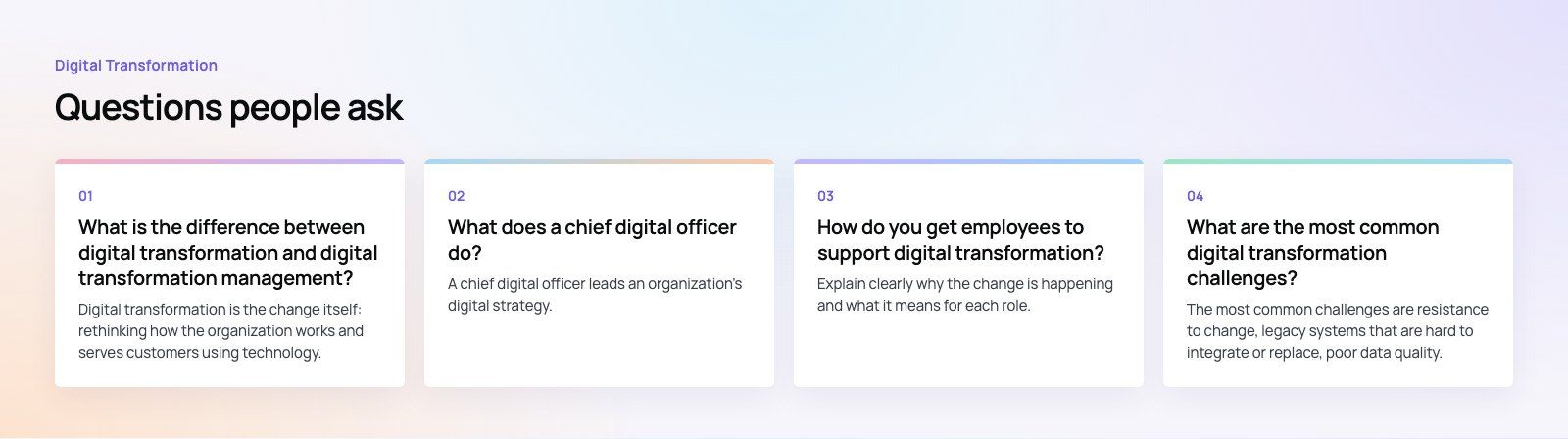
Frequently asked questions
Digital transformation is the change itself: rethinking how the organization works and serves customers using technology.
Digital transformation management is the discipline of planning, governing and measuring that change. It decides priorities, assigns ownership, sequences projects, manages risk and supports people through new ways of working, so that individual technology projects add up to real business results.
Digital TransformationHow Digital Transformation Is Reshaping BusinessesFive ways digital transformation is changing operations, customer experience, data, business models and work, plus the challenges and a practical roadmap. Digital TransformationStrategic Human Resource Management: Aligning HR With GoalsWhat strategic human resource management means, the components of a strategic HR model, and a six step process for aligning HR with business goals.
 Digital TransformationBest CRM for Small Businesses: 10 Options and How to ChooseTen CRM platforms that suit startups and small teams, from HubSpot and Zoho to Kommo and NetHunt, with a comparison table and a practical way to choose.
Tell us what the business needs. We will tell you what to build first.
Schedule a free consultation and get a written recommendation, with costs, before you commit to anything.
Get in touchPROVEN RESULTS
4.7 / 5verified reviews on Google