 Web DevelopmentWordPress vs Drupal: Which CMS Is Right for Your Business?WordPress vs Drupal compared on ease of use, content modeling, security, performance, ecommerce and cost drivers, with five questions to help you choose.
Drupal vs Sitecore: Which CMS Fits Your Enterprise?
Drupal gives open source control with no license fee; Sitecore bundles personalization and vendor support. Compare cost, usability and fit for enterprise sites.
Choose Drupal if you want an open source platform you fully control, with no license fees and deep freedom to customize. Choose Sitecore if your priority is a commercial suite where personalization, customer data and marketing tools come from one vendor with a support contract. Both handle enterprise traffic; the real difference is ownership model, total cost and who will run the platform day to day.
This comparison looks at how each platform works in 2026, where each one is strong, and the questions that usually settle the decision.
What is Drupal?
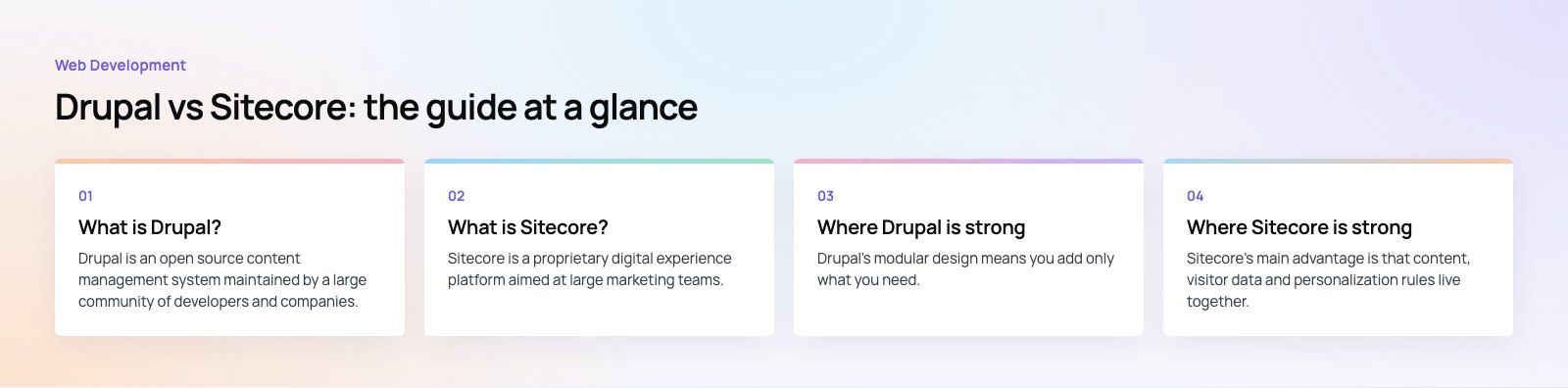
Drupal is an open source content management system maintained by a large community of developers and companies. You download it for free, host it where you like and extend it with contributed modules or your own code. It is common on government, university, media and nonprofit sites, where complex content models, granular permissions and multilingual publishing matter more than packaged marketing features.
Drupal is built in PHP and gives developers fine control over content types, fields, workflows and access rules. It can render pages itself or act as a headless content API behind a separate frontend.
What is Sitecore?
Sitecore is a proprietary digital experience platform aimed at large marketing teams. Its cloud CMS, formerly called XM Cloud, now sits inside a SaaS product Sitecore calls SitecoreAI, which bundles content management with customer data, personalization, search and AI assisted tooling (Sitecore, 2026). Older self hosted Sitecore installations built on .NET are still widely used, and many organizations are deciding whether to migrate them to the SaaS version.
Sitecore's appeal is that marketers can segment visitors, test variations and personalize content inside the same product they publish from, with vendor support behind it.
Drupal vs Sitecore at a glance
| Factor | Drupal | Sitecore |
|---|---|---|
| Ownership model | Open source, no license fee | Proprietary, subscription or license based |
| Hosting | Any PHP host or managed Drupal host | Vendor SaaS, or self hosted on .NET for older versions |
| Marketing tools | Added through modules and integrations | Personalization, testing and customer data built in |
| Customization | Very high, full code access | High within the platform's framework |
| Developer pool | Large PHP and Drupal community | Smaller, specialist .NET and Sitecore talent |
| Support | Community, agencies and hosting partners | Direct vendor support contracts |
| Typical fit | Complex content, many sites, budget control | Marketing led enterprises wanting one suite |
Where Drupal is strong
Flexibility and control
Drupal's modular design means you add only what you need. Content types, taxonomies, editorial workflows and permissions can all be shaped to match how your organization actually publishes. Because you own the code and the hosting, there is no vendor deciding your upgrade timetable or limiting where the site can run.
Multisite and multilingual publishing
Organizations that run dozens of related sites, or publish in several languages, often pick Drupal because it handles shared content models and translation workflows well. A central team can maintain one codebase while departments or regions manage their own content.
Integration freedom
Drupal exposes content through standard APIs, so connecting it to a CRM, search engine, identity provider or decoupled frontend is a normal development task rather than a licensing question. The trade off is that someone on your side, or a partner, has to build and maintain those integrations.
Where Drupal is weaker
- Complex builds need experienced Drupal developers, and the learning curve is real.
- Marketing features such as personalization usually require extra modules or third party tools.
- Major version upgrades take planning, especially on sites with many custom modules.
- Security patching is your responsibility, or your host's, rather than the vendor's.
Where Sitecore is strong
Personalization and marketing in one place
Sitecore's main advantage is that content, visitor data and personalization rules live together. Marketers can build audience segments, show different content to each one and measure the result without stitching several products together.
Vendor accountability
A support contract gives large organizations a single party responsible for the platform. For teams in regulated industries, or those without deep in house engineering, that accountability can matter as much as features.
A clearer SaaS path
With the SaaS version, infrastructure and core upgrades are handled by the vendor, which removes a class of maintenance work that self hosted platforms require.
Where Sitecore is weaker
- License or subscription costs sit on top of implementation and hosting.
- Specialist Sitecore developers are harder to find than general PHP or JavaScript developers.
- Moving from older self hosted versions to SaaS is effectively a rebuild for many sites.
- You work within the vendor's roadmap, packaging and pricing decisions.
Cost, usability and support compared
What drives cost
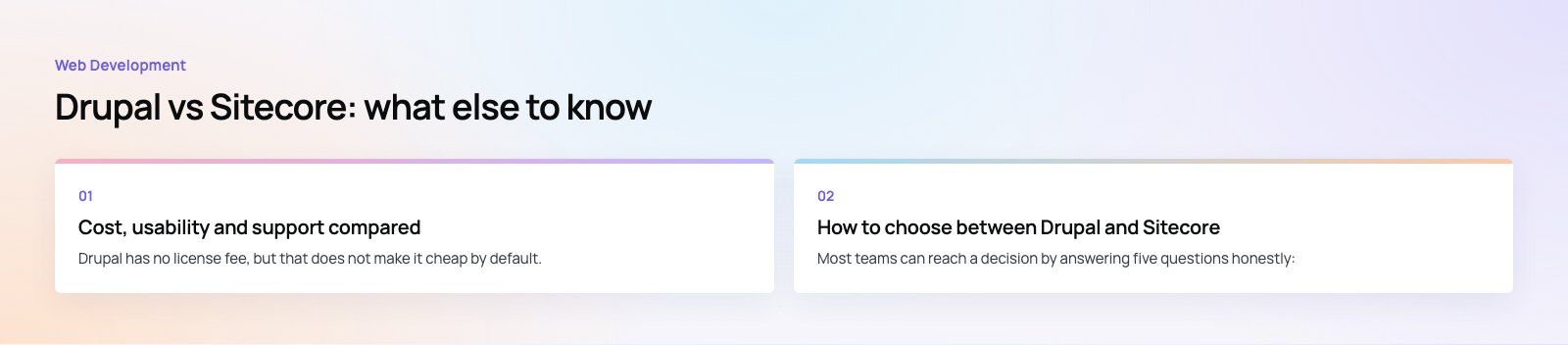
Drupal has no license fee, but that does not make it cheap by default. Total cost comes from design, development, custom modules, hosting, security maintenance and upgrades. Sitecore adds license or subscription costs, and its implementations tend to involve specialist partners. When comparing quotes, model at least three to five years of ownership, including upgrades and the people needed to run the platform, rather than comparing launch budgets.
Ease of use
Both give editors a usable interface for everyday publishing. Drupal's admin experience depends heavily on how the site was built: a well configured Drupal site is pleasant for editors, a poorly configured one is not. Sitecore offers more out of the box tooling for marketers but expects training before teams use its personalization features well.
Support and maintenance
Drupal support comes from the community, documentation, hosting providers and agencies. That gives you choice, but no single party is responsible unless you contract one. Sitecore support comes directly from the vendor under contract, which is simpler to manage but adds cost.
How to choose between Drupal and Sitecore
Most teams can reach a decision by answering five questions honestly:
- Who will run the platform after launch? If you have, or will hire, a strong engineering team, Drupal's control pays off. If not, a vendor supported product reduces risk.
- How much personalization will you really use? Many organizations buy advanced personalization and use a fraction of it. If you will not staff a team to run it, it is not a reason to pay for it.
- What does your content model look like? Many content types, sites or languages tend to favor Drupal's flexibility.
- What is already in your stack? A .NET shop with Microsoft identity and hosting may find Sitecore fits more naturally. A PHP or JavaScript team will move faster on Drupal.
- What is the five year cost? Include licenses, hosting, upgrades, specialist rates and the cost of switching later.
It is also worth asking whether you need either. Some organizations comparing these two end up on a lighter headless CMS with a modern frontend, because their real needs are fast pages and easy editing rather than enterprise personalization.
Common mistakes in enterprise CMS selection
- Choosing on features alone. The platform your team can actually operate beats the one with the longest feature list.
- Ignoring migration effort. Content cleanup, URL redirects and integrations often take longer than the build itself.
- Underestimating editor training. A powerful CMS used badly produces a slow, inconsistent site.
- Skipping a proof of concept. Build one real page type and one integration on the shortlisted platform before committing.
Planning your CMS decision
Codeeo has delivered 200+ projects across the UAE and the US with a team of 80+ across Dubai, Riyadh and Karachi. Our web development team builds content managed sites such as the bilingual Diyafah school website on Strapi and the disclosure focused Modon Holding site. If you are weighing platforms, a platform fit review tests your requirements against the options, and our site migration service covers content, redirects and SEO when you move. Get in touch to talk it through.
Frequently asked questions
Neither is better in every case.
Drupal suits enterprises that want open source control, complex content models, multisite setups and no license fees, and that have engineering capacity to run it. Sitecore suits marketing led organizations that want personalization, customer data and vendor support in one commercial product. The better choice is the one your team can operate well for the next five years.
Web DevelopmentWordPress vs Drupal: Which CMS Is Right for Your Business?WordPress vs Drupal compared on ease of use, content modeling, security, performance, ecommerce and cost drivers, with five questions to help you choose. Web DevelopmentCustom Website Development vs Website Builders: Pros and ConsAn honest comparison of custom website development and website builders: control, cost over time, SEO, integrations, and how to decide which fits your business.
 Web DevelopmentWeb Development Consultant: What They Do and When to Hire OneWhat a web development consultant does, how the role differs from a developer or agency, when hiring one pays off and how to choose the right one.
Tell us what the business needs. We will tell you what to build first.
Schedule a free consultation and get a written recommendation, with costs, before you commit to anything.
Get in touchPROVEN RESULTS
4.7 / 5verified reviews on Google