 Digital TransformationHow Digital Transformation Is Reshaping BusinessesFive ways digital transformation is changing operations, customer experience, data, business models and work, plus the challenges and a practical roadmap.
CodeeoInsightsDigital Transformation
Enterprise Digital Transformation: Why It Matters and Where to Start
What enterprise digital transformation really means, why businesses need it, the technologies involved and a practical roadmap leaders can follow.
Enterprise digital transformation is the work of changing how a company operates by rebuilding its processes, systems and data around modern software. Businesses need it because old tools, manual handoffs and disconnected records slow every decision and make it expensive to change. Done well, it is a steady program of improvements tied to business outcomes, not a single software purchase.
This guide explains what the term really covers, why it matters, the technologies involved, a practical roadmap for leaders, and the mistakes that cause programs to stall.
What enterprise digital transformation actually means
The phrase gets used loosely, so it helps to be precise. Buying a new CRM is not transformation. Moving the same paper process into a PDF form is not transformation either. Transformation happens when you redesign how work flows through the organization and then use technology to support the new design.
In practice, most programs touch four areas at once.
Modernizing legacy systems
Older on premises systems are often hard to change, hard to integrate and dependent on a few people who understand them. Modernization can mean moving to cloud platforms, replacing a custom system with a configurable product, or wrapping an old system in APIs so newer tools can talk to it. The right choice depends on how central the system is and how often it needs to change.
Decisions based on shared data
When sales, finance and operations each keep their own version of the truth, meetings turn into arguments about whose numbers are right. A large part of transformation is agreeing on one record for each customer, product and order, and making that record available to the people and systems that need it.
Better customer experience
Customers judge a company by its slowest touchpoint. Transformation work often includes customer portals, mobile apps, self service tools and faster support, so that customers can do what they came to do without waiting on a phone call or an email reply.
Better tools for employees
Staff who spend hours copying data between systems have less time for the work that needs judgment. Collaboration platforms, internal apps and workflow automation remove that drag and make it easier for teams to work across departments.
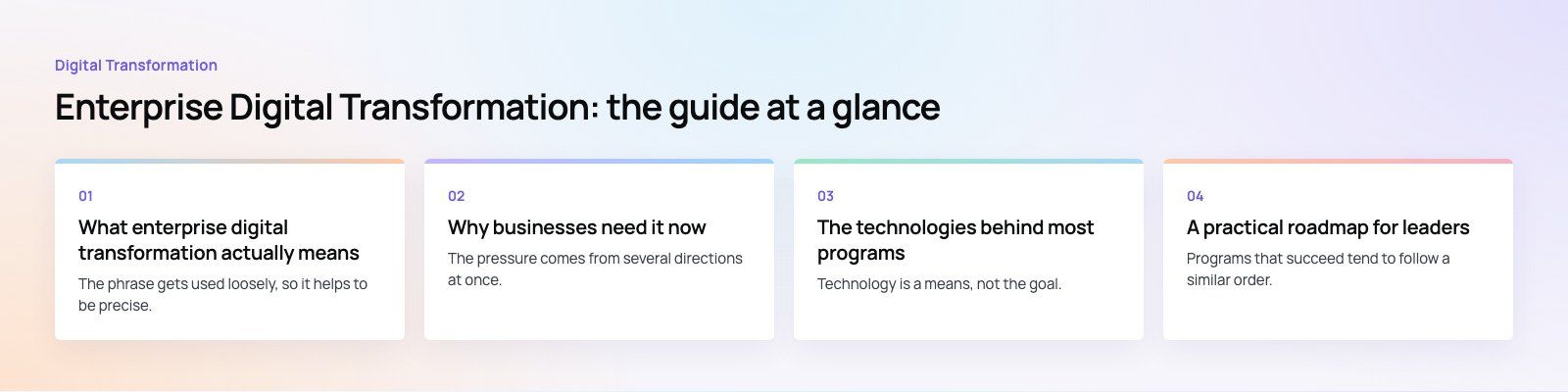
Why businesses need it now
The pressure comes from several directions at once. Customers expect to buy, book and get support online at any hour. Competitors who automate can quote faster and serve more customers with the same team. Regulators expect better data protection and audit trails. And the cost of keeping old systems running tends to rise every year as skills and vendor support become harder to find.
The benefits companies usually aim for are straightforward:
- Lower operating cost. Removing manual steps and duplicate data entry cuts time and errors.
- Faster change. Modular, well integrated systems let you launch a new product, channel or pricing model without a long rebuild.
- More productive teams. People spend their time on customers and decisions rather than spreadsheets.
- Clearer reporting. Leaders see the same numbers, closer to real time.
- Room to grow. Cloud based systems scale with demand instead of forcing a hardware project every time volume rises.
The technologies behind most programs
Technology is a means, not the goal. Still, a handful of building blocks appear in almost every enterprise program.
| Technology | What it does for the business | Typical first use |
|---|---|---|
| Cloud platforms | Flexible capacity, managed infrastructure, easier disaster recovery | Moving a core application or data store off ageing servers |
| ERP and CRM systems | One shared record for finance, operations, sales and service | Replacing spreadsheets and disconnected tools |
| Integration and APIs | Lets systems exchange data without manual copying | Connecting an online store or portal to the back office |
| Workflow automation | Handles approvals, notifications and routine tasks | Purchase approvals, onboarding, invoice processing |
| AI and analytics | Forecasting, classification, search and assistants | Demand forecasts, support triage, document extraction |
| Web and mobile apps | Self service for customers, field tools for staff | Customer portal or an internal app for field teams |
Two architectural ideas are worth understanding. Microservices and modular, or composable, architecture break large applications into smaller parts that can be changed independently. Progressive web apps give an app like experience in the browser, which can be a sensible first step before committing to native apps.
A practical roadmap for leaders
Programs that succeed tend to follow a similar order. The steps are simple to list and harder to do well.
- Assess where you are. Map the processes that matter most, the systems behind them and where time and errors pile up. Talk to the people who do the work, not only managers.
- Set outcomes, not projects. "Cut order to invoice time" is a better goal than "implement new ERP". Outcomes keep the program honest when scope grows.
- Build a small team with real authority. You need a business owner with authority, someone who understands the processes and technical leads who can make architecture decisions.
- Prioritize by value and risk. Start with a change that is visible, valuable and achievable within a few months. Early wins build trust and fund the next phase.
- Choose technology to fit the process. Prefer configurable products for standard work and custom software only where your process is a real advantage.
- Plan for people. Training, clear communication and a reason to change matter as much as the software. Adoption is where many programs fail quietly.
- Measure and adjust. Track the outcomes you set at the start and be willing to change course when a phase is not delivering.
Trends shaping enterprise programs in 2026
Automation across whole processes
Instead of automating single tasks, companies are connecting workflow tools, integrations and AI so that an entire process, such as order to cash, runs with people handling only the exceptions.
AI that is easier to adopt
AI features are now built into many business platforms, and low code tools let teams build simple assistants and automations themselves. The hard part has shifted from access to the technology to having clean data and clear rules for its use.
Composable systems
Rather than one large system that does everything, more companies assemble best fit products connected through APIs. This makes change easier but raises the importance of integration design and data ownership.
Security and privacy by design
Every new system, integration and data flow adds risk. Frameworks such as the NIST Cybersecurity Framework give a useful structure for deciding which controls each part of a program needs, and customers increasingly ask how their data is collected, stored and used.
Common mistakes that stall transformation
- Starting with the tool. Choosing a platform before understanding the process usually means bending the business to fit the software.
- Trying to change everything at once. Big bang programs carry big bang risk. Phased delivery is slower on paper and faster in practice.
- Ignoring data quality. Migrating messy data into a new system just moves the mess. Clean and agree definitions first.
- Underinvesting in change management. If staff do not understand why the change is happening, they find workarounds.
- No owner after launch. Systems drift without someone responsible for improving them.
Where to begin
If you are unsure where to start, pick one process that frustrates customers or staff, map it honestly, and fix it with the simplest technology that works. Codeeo has delivered more than 200 projects across the UAE and the US with a team of 80+ in Dubai, Riyadh and Karachi, and can help you scope that first phase. See our custom software development work, explore Microsoft Dynamics 365 and Odoo for ERP and CRM, or start with a product scoping session.
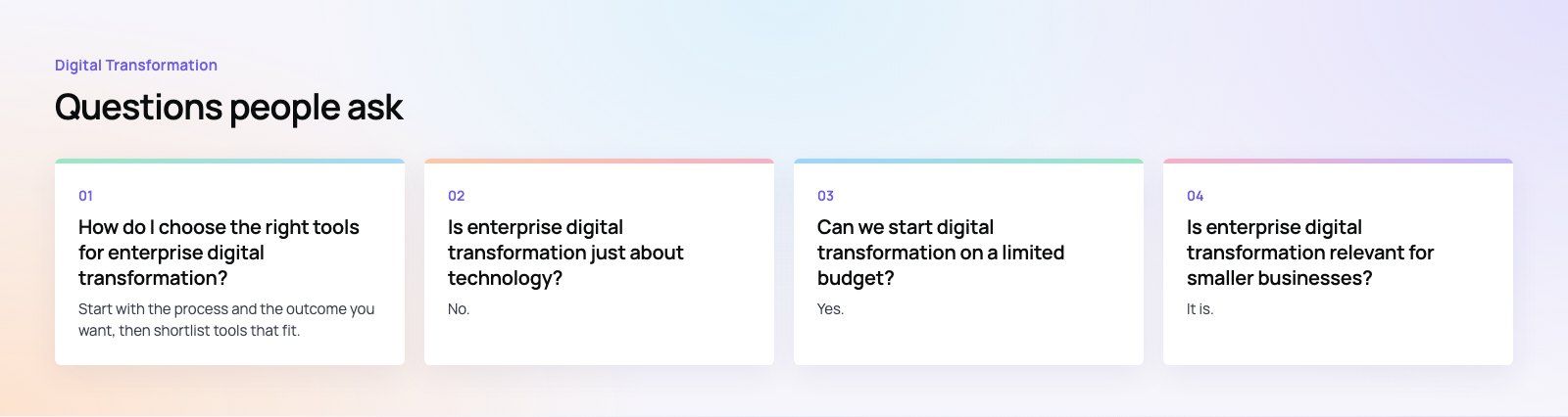
Frequently asked questions
Start with the process and the outcome you want, then shortlist tools that fit.
Prefer established, configurable products for standard work like accounting, CRM and HR, and reserve custom development for processes that set you apart. Check how each tool integrates with what you already run, who will own it, and how data moves between systems before you sign anything.
Digital TransformationHow Digital Transformation Is Reshaping BusinessesFive ways digital transformation is changing operations, customer experience, data, business models and work, plus the challenges and a practical roadmap. Digital TransformationStrategic Human Resource Management: Aligning HR With GoalsWhat strategic human resource management means, the components of a strategic HR model, and a six step process for aligning HR with business goals.
 Digital TransformationBest CRM for Small Businesses: 10 Options and How to ChooseTen CRM platforms that suit startups and small teams, from HubSpot and Zoho to Kommo and NetHunt, with a comparison table and a practical way to choose.
Tell us what the business needs. We will tell you what to build first.
Schedule a free consultation and get a written recommendation, with costs, before you commit to anything.
Get in touchPROVEN RESULTS
4.7 / 5verified reviews on Google