 Digital TransformationHow Digital Transformation Is Reshaping BusinessesFive ways digital transformation is changing operations, customer experience, data, business models and work, plus the challenges and a practical roadmap.
CodeeoInsightsDigital Transformation
What Is Fintech as a Service (FaaS) and How Does It Work?
Fintech as a Service explained: how businesses add payments, wallets and lending through licensed APIs, the benefits, the risks and how to choose a provider.
Fintech as a Service (FaaS) is a model where a business adds financial features such as payments, wallets, cards, lending or identity checks to its own product by connecting to a licensed provider's cloud platform through APIs. The provider runs the regulated infrastructure and the business builds the customer experience on top. It lets companies outside banking offer financial services without building or licensing that infrastructure themselves.
This guide covers how FaaS works, what it is good for, where it goes wrong, and how to choose a provider.
What Fintech as a Service means in practice
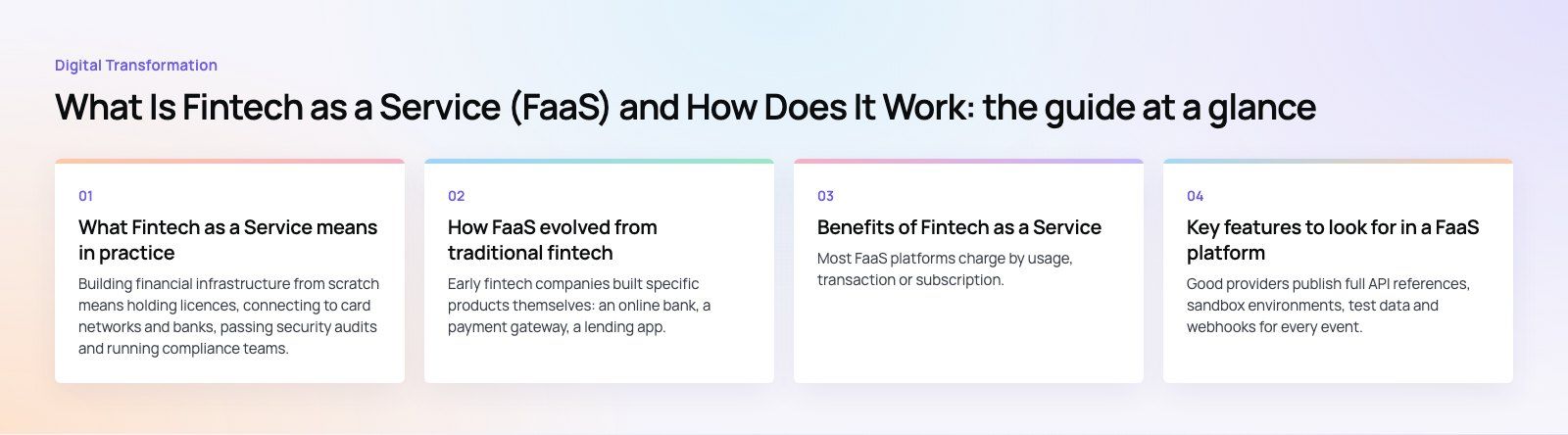
Building financial infrastructure from scratch means holding licences, connecting to card networks and banks, passing security audits and running compliance teams. Very few businesses want that. FaaS splits the work in two:
- The provider holds the licences, bank relationships and core systems, and exposes them through APIs and dashboards.
- The business designs the product, owns the customer relationship and calls those APIs to move money, open accounts or check identities.
You may also see the terms Banking as a Service and embedded finance. Banking as a Service usually refers to a licensed bank renting out its accounts and cards. Embedded finance describes the result, a financial feature inside a non financial product. FaaS is the broader umbrella that covers payments, lending, insurance, compliance and data services delivered this way.
How FaaS evolved from traditional fintech
Early fintech companies built specific products themselves: an online bank, a payment gateway, a lending app. Each had to solve the same infrastructure problems again. As cloud platforms and API standards matured, the infrastructure layer itself became a product. Instead of building a payments stack, a marketplace could rent one. Instead of building identity checks, a lender could call a verification API.
The result is a modular approach. A business picks only the services it needs and can swap providers as it grows or enters new markets.
| Aspect | Building in house | Fintech as a Service |
|---|---|---|
| Ownership | Full control of the stack | Provider runs the core, you own the experience |
| Upfront effort | Large infrastructure and licensing work | Smaller, mostly integration and product work |
| Time to launch | Long build and certification | Faster, using ready APIs |
| Scaling | Your team scales the infrastructure | Provider scales the platform |
| Compliance | Entirely your responsibility | Shared, with the provider covering much of it |
| Maintenance | Your team patches and upgrades | Provider handles platform updates |
| Flexibility | Anything you can build | Limited to what the provider supports |
| Main risk | Cost and delay | Dependence on one vendor |
Benefits of Fintech as a Service
Lower upfront cost
Most FaaS platforms charge by usage, transaction or subscription. That turns a large capital project into an operating cost that grows with revenue. You pay for what customers actually use rather than for capacity you hope to need.
Faster time to market
A feature that would take a long time to build and certify can often be integrated in a fraction of that time when the provider already holds the licences and the certified systems. That speed matters when you are testing whether customers want the feature at all.
Scalability
FaaS platforms are built to handle many clients at once, so a spike in your transaction volume is usually routine for them. You still need to design your own application to scale, but the payment or ledger layer is unlikely to be the bottleneck.
Focus on your core product
Your team spends its time on the parts customers see: onboarding, pricing logic, the checkout, the dashboard. The provider worries about card network rule changes, bank connections and infrastructure security.
Key features to look for in a FaaS platform
Clear, well documented APIs
Good providers publish full API references, sandbox environments, test data and webhooks for every event. Weak documentation is an early warning sign that integration and support will be slow.
Security and certification
Any platform that touches card data should be compliant with the PCI Data Security Standard. Ask for the provider's current attestation of compliance, and check how it handles encryption, tokenization of card details, access control and incident reporting.
Compliance tooling
Look for built in know your customer checks, anti money laundering monitoring, sanctions screening and audit logs. These do not remove your own obligations, but they make them far easier to meet.
Configurable products
The best platforms let you set your own limits, fees, approval rules and branding through configuration rather than custom requests. This is where your product becomes different from every other client of the same provider.
Reporting and reconciliation
Finance teams need daily settlement reports, payout records and transaction exports that match the bank statement. Poor reconciliation tools create manual work that grows with every new customer.
Use cases for Fintech as a Service
Startups
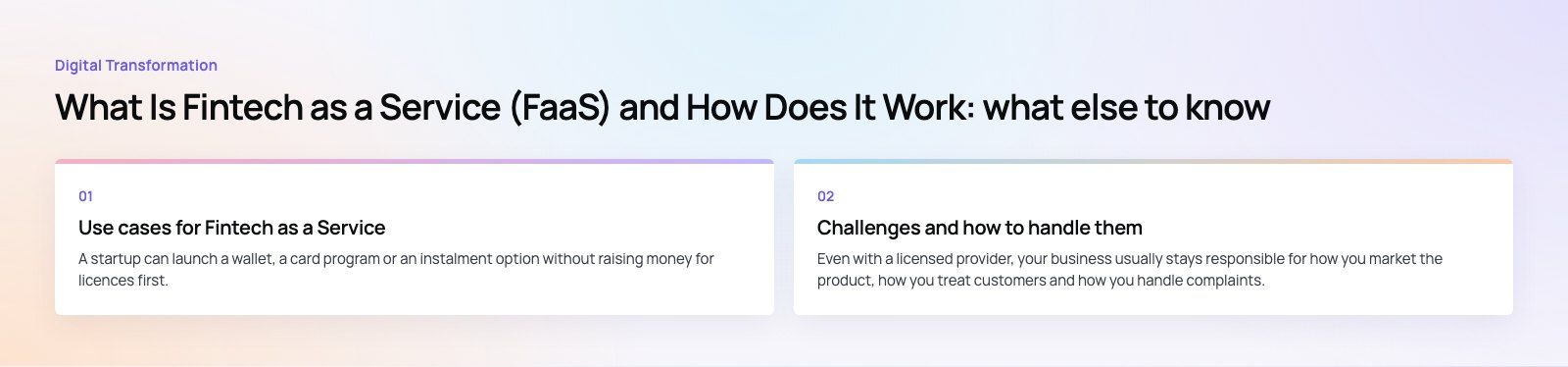
A startup can launch a wallet, a card program or an instalment option without raising money for licences first. It proves demand on rented infrastructure and decides later whether owning any part of the stack is worth it.
Banks and financial institutions
Banks use FaaS providers for specific capabilities such as identity verification, fraud scoring or open banking connections, often faster than building them internally. Some banks also act as the provider, renting their licence and accounts to fintech partners.
Ecommerce and marketplaces
Online stores use FaaS for payment gateways, instalment options, fraud screening and split payouts to sellers. Marketplaces in particular rely on providers that can hold funds, split them between parties and pay out automatically. A checkout teardown often shows where a better payment setup would cut drop off.
Insurance
Insurers and insurance distributors use FaaS for digital policy sales, premium collection, claims payouts and identity checks. Embedded insurance, offered at the moment of purchase, depends on these APIs.
Education, health and services businesses
Schools collecting fees, clinics taking deposits and service platforms paying contractors all use the same building blocks. The Edsidera school platform, for example, includes a payment portal alongside its classes and tasks.
Challenges and how to handle them
Regulatory responsibility does not disappear
Even with a licensed provider, your business usually stays responsible for how you market the product, how you treat customers and how you handle complaints. Map which obligations sit with you and which sit with the provider before launch.
Security is shared
The provider secures its platform, but your app, your API keys and your staff access are your problem. Store keys in a secrets manager, restrict who can see the provider dashboard and log every sensitive action.
Vendor dependence
If your provider raises prices, changes terms, suffers an outage or exits a market, your product is affected immediately. Reduce the risk by keeping your own record of transactions, wrapping the provider's API behind your own service layer, and knowing which alternative provider you would move to.
Limits on customization
You can only offer what the provider supports. If your product needs an unusual flow, check early whether the platform allows it, rather than discovering the limit halfway through a build.
How to choose a FaaS provider
- List the exact services you need, such as card payments, payouts, wallets or identity checks, and the markets you will operate in.
- Confirm licensing and coverage in each market, including which currencies and local payment methods are supported.
- Test the sandbox with your own developers before signing. Integration quality shows quickly.
- Read the pricing model carefully, including fees for refunds, chargebacks, currency conversion and minimum volumes.
- Check support and uptime history, and ask how incidents are communicated.
- Plan your exit, including how you would export customer and transaction data.
Where Fintech as a Service is heading
AI is being added to fraud scoring, credit decisions and support inside FaaS platforms. Open banking is widening the range of account data and payment types available through APIs. Providers are also expanding into more countries, which lets smaller businesses sell across borders with local payment methods. None of these change the basic model: rent the regulated core, own the experience.
If you are adding payments, payouts or a wallet to your product, Codeeo handles payment integration and builds fintech products, with a team of 80+ across Dubai, Riyadh and Karachi. Projects such as Purpose Payment show the app, portal and API work involved.
Frequently asked questions
Banking as a Service usually means a licensed bank renting out its core banking functions, such as accounts and cards, to other companies through APIs.
Fintech as a Service is a broader term that also covers payments, lending, insurance, identity checks, compliance and data services. Banking as a Service is one type of FaaS, focused specifically on accounts held at a regulated bank.
Digital TransformationHow Digital Transformation Is Reshaping BusinessesFive ways digital transformation is changing operations, customer experience, data, business models and work, plus the challenges and a practical roadmap. Digital TransformationStrategic Human Resource Management: Aligning HR With GoalsWhat strategic human resource management means, the components of a strategic HR model, and a six step process for aligning HR with business goals.
 Digital TransformationBest CRM for Small Businesses: 10 Options and How to ChooseTen CRM platforms that suit startups and small teams, from HubSpot and Zoho to Kommo and NetHunt, with a comparison table and a practical way to choose.
Tell us what the business needs. We will tell you what to build first.
Schedule a free consultation and get a written recommendation, with costs, before you commit to anything.
Get in touchPROVEN RESULTS
4.7 / 5verified reviews on Google