 App DevelopmentCross Platform App Development: How It Saves Time and MoneyHow shared code across iOS and Android cuts build and maintenance effort, which frameworks to consider in 2026, and when native development is still the better call.
Healthcare App Development Cost: What Drives the Price
What decides the cost of a healthcare mobile app: app type, core features, compliance, integrations, platforms and maintenance, plus ways to control the budget.
The cost of developing a healthcare mobile app depends mainly on what the app does, how sensitive the data is, and which systems it must connect to. A simple wellness or appointment app sits at the lower end, while a telemedicine platform with video consultations, prescriptions and records integration costs several times more because of the extra features, security and compliance work. The only reliable figure comes from scoping your specific app, but you can predict where the budget will go.
This guide breaks down the types of healthcare apps, the features and factors that move the cost, and how to keep the budget under control without cutting corners on safety.
What counts as a healthcare mobile app?
A healthcare app is any mobile application that helps people manage health, receive care or deliver care. That covers a wide range of products, and the category matters because it sets the level of regulation and data protection the app needs.
Apps for patients and consumers
- Fitness and activity apps: workouts, step counts and goals, often connected to wearables.
- Diet and nutrition apps: food logging, meal plans and coaching.
- Wellness and mental health apps: meditation, sleep, mood tracking and guided programs.
- Telemedicine apps: booking, video or chat consultations, e-prescriptions and follow ups.
- Chronic condition apps: medication reminders, symptom diaries and readings from connected devices.
Apps for clinicians and providers
- Clinical reference and networking apps: drug databases, guidelines and professional communities.
- Records and practice apps: access to patient records, scheduling and notes.
- Workforce apps: shift booking, staffing and compliance for healthcare workers.
- Remote monitoring dashboards: reviewing patient data collected at home.
Why healthcare apps cost more than ordinary apps
Two apps with similar screens can have very different budgets. Healthcare adds work that consumer apps usually skip:
- Data protection: health data is among the most sensitive personal data, so encryption, access control, audit logs and secure hosting are not optional.
- Regulation: depending on the market, the app may fall under health privacy law and, if it diagnoses or treats, medical device rules.
- Integrations: clinics and hospitals run electronic health record (EHR), lab and billing systems that the app may need to read from or write to.
- Testing: errors in reminders, dosages or results have real consequences, so testing is broader and deeper.
- Accessibility: users include older people and people with impairments, so design and testing must account for them.
Cost by app type
Rather than quoting figures that change with every project and market, this table shows how app types compare in relative complexity and what drives each one.
| App type | Relative complexity | Main cost drivers |
|---|---|---|
| Fitness or activity tracker | Low to medium | Wearable integrations, progress charts, subscriptions |
| Diet and nutrition | Medium | Food database, logging, coaching chat |
| Wellness and mental health | Medium | Audio and video content, personalization, privacy |
| Appointment booking | Low to medium | Calendar sync, clinic admin panel, notifications |
| Telemedicine | High | Video calls, e-prescriptions, records, payments, compliance |
| Remote patient monitoring | High | Medical device data, alerts, clinician dashboards |
| Clinician records app | High | EHR integration, role based access, audit trails |
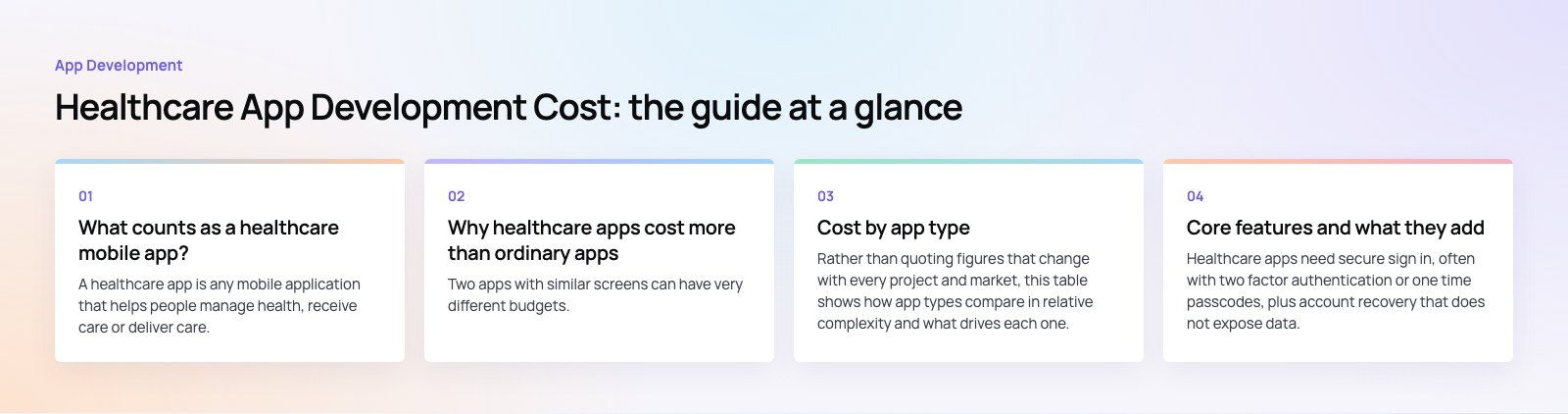
Core features and what they add
Registration and login
Healthcare apps need secure sign in, often with two factor authentication or one time passcodes, plus account recovery that does not expose data. Linking patient accounts to existing clinic records adds identity matching work.
User profiles
Profiles hold medical history, allergies, medications, insurance details and consent preferences. Each extra field of sensitive data adds storage, encryption and permission rules.
Push notifications
Reminders for medication, appointments and test results drive engagement, but their content must avoid exposing health details on a locked screen. Scheduling logic for complex medication regimes takes longer to build and test than simple alerts.
Messaging and video
Secure chat and video consultations are among the most expensive features. They need encrypted transport, reliable performance on weak connections, recording and retention rules, and a clinician side interface.
Payments
Paid consultations, subscriptions and insurance co payments require a payment gateway, refunds and receipts. Payment integration is simpler for one off card payments and more involved for insurance claims or split payments to clinicians.
Admin and clinician portals
Most healthcare apps need a web portal for staff to manage schedules, content, users and reports. This is often a sizeable part of the budget that first estimates forget.
The factors that set the final budget
Platforms
Building separate native iOS and Android apps gives the best performance and device access but means two codebases. Cross platform frameworks such as Flutter or React Native share most code between both, which usually lowers cost and time. Native still makes sense when the app relies heavily on Bluetooth medical devices or platform health frameworks.
UI and UX design
Healthcare users range from teenagers to elderly patients and busy clinicians. Clear navigation, large touch targets, readable text and accessible color contrast take research and testing. Good product design reduces support requests and training later.
Regulation and compliance
The rules depend on where the app operates and what it does. In the US, apps handling protected health information for covered entities must follow HIPAA, and software that diagnoses or treats may be regulated as a medical device under FDA guidance on device software functions. Other markets, including the EU and the Gulf, have their own health data and device rules, and some restrict where patient data can be stored. Compliance adds legal review, security controls, documentation and sometimes local hosting.
Integrations
Connecting to EHR systems, labs, pharmacies, wearables or insurers often takes longer than building the app screens. Standards such as HL7 FHIR help, but every hospital system has its own quirks.
Team location and model
Hourly rates vary widely between regions, and so does experience with healthcare projects. A cheaper team without compliance experience can end up costing more through rework. Compare teams on relevant experience and process, not rate alone.
Support and maintenance
After launch, budget for hosting, security patches, operating system updates, monitoring, bug fixes and new features. Healthcare apps also need periodic security reviews. Plan maintenance as a yearly line, not an afterthought.
How to keep healthcare app costs under control
- Start with a clear scope. Write down the users, the core problem and the must have features before asking for quotes.
- Launch a focused first version. Build the smallest product that solves the main problem safely, then add features based on real usage.
- Decide compliance early. Retrofitting security and audit logging after launch is far more expensive than designing for it.
- Use proven services. Established video, messaging and payment providers that already support healthcare requirements save months of work.
- Choose cross platform where it fits. One shared codebase usually lowers both build and maintenance costs.
- Plan the admin side. Include staff portals and reporting in the first estimate so they do not surprise you later.
We have built healthcare products such as Distinct, a healthcare workforce platform with shifts, bookings, incident reports and a design system shared by web and admin, and a content managed website for a physiotherapy and sports medicine group with appointment requests. To see more, visit our healthcare industry page. If you are planning a healthcare app, our mobile app development team can help, and a product scoping session is the quickest way to an accurate estimate.
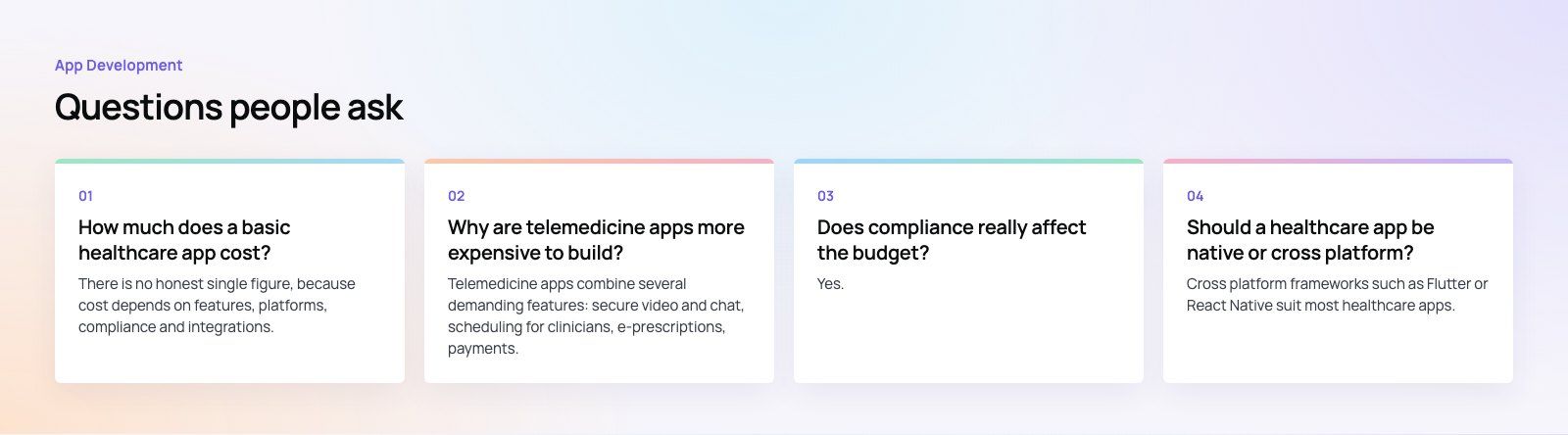
Frequently asked questions
There is no honest single figure, because cost depends on features, platforms, compliance and integrations.
A basic app such as an appointment booker or wellness tracker, with sign in, profiles, notifications and a simple admin panel, sits at the lower end. Adding video consultations, records integration or medical device data moves it significantly higher. A scoping exercise gives you a figure based on your actual requirements.
App DevelopmentCross Platform App Development: How It Saves Time and MoneyHow shared code across iOS and Android cuts build and maintenance effort, which frameworks to consider in 2026, and when native development is still the better call. App DevelopmentHow to Plan an App Development Project From Start to FinishA step by step plan for an app project: define users and goals, scope an MVP, choose platforms, design, build the team, phase the timeline, test and launch.
 App DevelopmentMust Have Features of an HR Management AppThe features an HR management app needs, from onboarding and self service to payroll, performance and analytics, plus when to buy or build.
Tell us what the business needs. We will tell you what to build first.
Schedule a free consultation and get a written recommendation, with costs, before you commit to anything.
Get in touchPROVEN RESULTS
4.7 / 5verified reviews on Google