 E-Commerce10 Features of a High-Converting Ecommerce WebsiteThe ten features that turn store visitors into buyers, from product pages and checkout to speed, mobile design, social proof and ongoing testing.
How to Hire Someone to Build a Shopify Store
When to outsource a Shopify build, freelancer vs agency, what drives cost, the questions to ask and how to plan support after your store launches.
Hire someone to build your Shopify store when the store needs more than a theme and a product upload: custom design, integrations, migrated data, multiple markets or a checkout that must convert from day one. A freelancer suits small, well defined builds, while an agency suits stores that need design, development, testing and ongoing support together. Either way, define your scope first, check real Shopify work, and agree on ownership and support in writing.
This guide covers when outsourcing makes sense, who to hire, what drives the cost, the questions to ask and what happens after launch.
Should you build it yourself or hire help?
Shopify is designed so non developers can launch a basic store. If you sell a handful of products, use a standard theme and accept default checkout and shipping, building it yourself is realistic.
Things change once the store needs to do more. Common signs it is time to bring in help:
- You need a design that reflects your brand rather than a lightly edited theme.
- You are migrating products, customers and order history from another platform.
- The store must connect to an ERP, CRM, warehouse or accounting system.
- You sell in several countries, currencies or languages.
- You need local payment methods, subscriptions, bundles or complex shipping rules.
- You have tried to build it yourself and progress has stalled.
What makes a Shopify build harder than it looks
Adding pages and products is the easy part. The work that separates a store that sells from one that just exists includes:
- Theme customization: sections, templates and metafields so product pages show the information your buyers need.
- Payments and checkout: choosing gateways and local payment methods, and keeping checkout fast and trustworthy.
- Shipping and tax: zones, rates, delivery promises and tax settings for each market you serve.
- App selection: every app adds scripts and cost, so the right answer is often fewer apps and some custom code.
- Search and speed: clean URLs, structured data, image handling and Core Web Vitals.
- Data migration: moving products and customers without breaking URLs and search rankings.
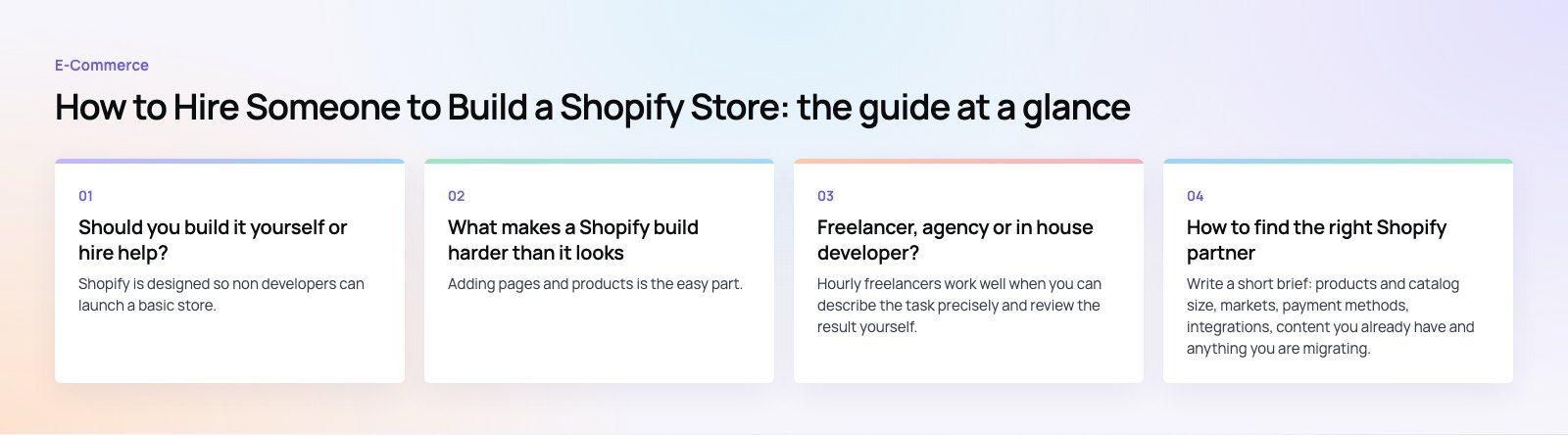
Freelancer, agency or in house developer?
| Option | Best for | Strengths | Watch out for |
|---|---|---|---|
| Freelancer | Small stores, theme tweaks, defined tasks | Flexible, direct contact, lower overhead | Single point of failure, limited design or QA cover |
| Agency | Custom builds, migrations, integrations, multi market stores | Design, development, testing and support in one team | Higher upfront investment, less day to day control |
| In house developer | Large stores with constant change | Deep product knowledge, always available | Recruiting, management and keeping skills current |
| Dedicated developer from a partner | Ongoing roadmap without hiring | Steady capacity with team backup | Needs clear priorities and product ownership on your side |
Hourly freelancers work well when you can describe the task precisely and review the result yourself. An agency makes more sense when you need someone to own the whole outcome, including design decisions, testing across devices and fixes after launch.
How to find the right Shopify partner
1. Define what you need
Write a short brief: products and catalog size, markets, payment methods, integrations, content you already have and anything you are migrating. Note what success looks like, such as a launch date or a conversion target. A clear brief makes quotes comparable.
2. Look for relevant Shopify work
Ask for live stores, not just screenshots. Click through product pages, add items to the cart and test on your phone. Shopify's own Partner Directory is one place to start a shortlist, alongside referrals from other merchants.
3. Check reviews and references
Read independent reviews and speak to at least one past client. Ask what went wrong and how it was handled, since every project has problems.
4. Test communication early
Notice how quickly and clearly they respond during the sales process. That is usually the best it will be. Agree on who your contact is, how often you get updates and where feedback is tracked.
5. Compare value, not just price
A lower quote that excludes testing, content entry or post launch fixes may cost more in the end. Compare what each proposal includes line by line.
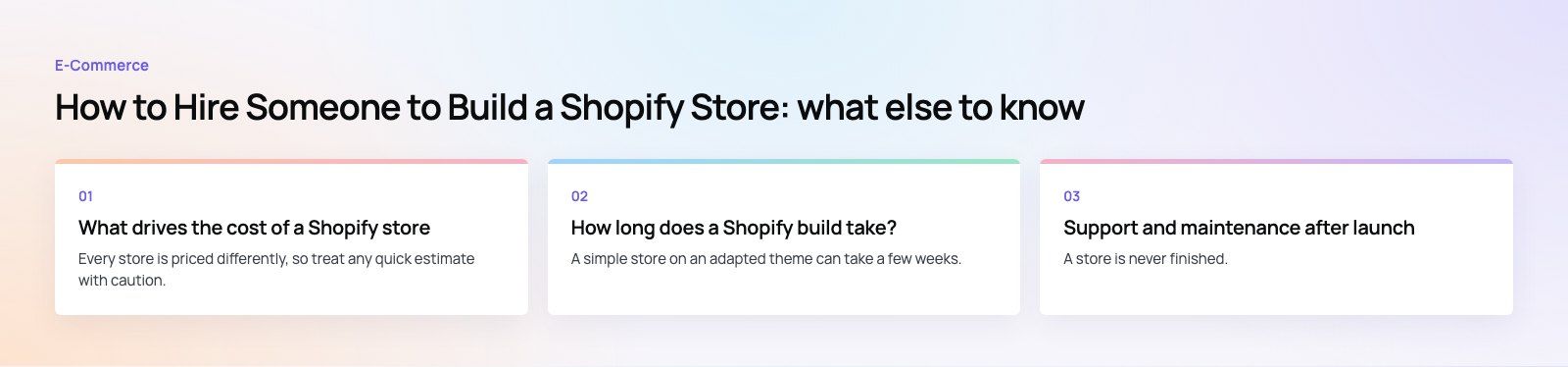
What drives the cost of a Shopify store
Every store is priced differently, so treat any quick estimate with caution. The factors that move the budget are:
- Your Shopify plan: plan level affects features, staff accounts and payment processing rates.
- Design approach: adapting a premium theme costs far less than a fully custom design system.
- Custom development: custom sections, custom apps and checkout extensions add development time.
- Integrations: each connection to an ERP, CRM, marketplace or warehouse needs mapping and testing.
- Apps: most charge monthly, and costs add up as you install more.
- Migration: catalog size, customer data, order history and redirects all add work.
- Content: product photography, copywriting and translation are often forgotten in budgets.
- Ongoing support: updates, fixes and improvements after launch.
How long does a Shopify build take?
A simple store on an adapted theme can take a few weeks. A custom design with integrations, migration and several markets usually takes a few months. Timelines stretch most when content arrives late, decisions wait on approvals or integrations depend on third parties. Break the project into milestones, such as design sign off, build, content entry, testing and launch, and review progress at each one.
Questions to ask before you hire
- What Shopify stores have you built that are similar to ours? Look for comparable catalogs, markets and integrations.
- How do you decide between an app and custom code? A good partner explains the trade off in speed, cost and maintenance.
- What exactly is included in the quote? Design rounds, content entry, testing, training and post launch fixes should be listed.
- Who owns the theme code and accounts? The store and all code should belong to you.
- How will you access our store? Partners should use Shopify's collaborator accounts, not your owner login.
- What support do you offer after launch? Ask about response times, monthly hours and what counts as a change request.
Support and maintenance after launch
A store is never finished. Plan for:
- Theme and app updates to stay compatible with platform changes.
- Performance checks as new apps and content slow pages down.
- Content updates for new products, campaigns and seasonal pages.
- Conversion improvements based on analytics and customer feedback.
- SEO and marketing to keep traffic growing.
- Exports and backups of products, customers and theme code.
A hiring checklist
- Brief written, with goals, markets, integrations and launch date
- Three or more proposals compared on scope, not just price
- Live store examples tested on mobile
- At least one reference call completed
- Contract covering scope, milestones, ownership and support
- Collaborator access set up, owner login kept private
- Testing plan agreed, including checkout and payments
Working with Codeeo on Shopify
Codeeo has delivered 200+ projects across the UAE and the US with a team of 80+ across Dubai, Riyadh and Karachi. Our work includes EGO Sustainable, a bilingual Shopify store for a GCC athleisure label with Tabby and Tamara across five markets. Our Shopify developers handle custom builds, theme work and integrations, and you can also bring in dedicated developers for an ongoing roadmap. If you already have a store, a checkout teardown is a quick way to find what is costing you sales, or contact us to scope a new build.
Frequently asked questions
A professional saves time and avoids common mistakes in theme structure, apps, checkout and search setup.
That matters most when you need custom design, integrations, data migration or several markets. If your store is small and uses a standard theme, building it yourself is realistic. Many merchants start that way and bring in help once growth makes the store more complex.
E-Commerce10 Features of a High-Converting Ecommerce WebsiteThe ten features that turn store visitors into buyers, from product pages and checkout to speed, mobile design, social proof and ongoing testing. E-CommerceBenefits of Using a CMS for Ecommerce WebsitesHow a CMS helps online stores manage products, SEO, growth and security, how it compares with a custom build, and how to choose between WooCommerce, Shopify and headless.
 E-CommerceEcommerce Website Development: 9 Elements Every Store NeedsThe nine parts every online store needs, from catalog data and search to checkout, security, operations and analytics, with what to decide before you build.
Tell us what the business needs. We will tell you what to build first.
Schedule a free consultation and get a written recommendation, with costs, before you commit to anything.
Get in touchPROVEN RESULTS
4.7 / 5verified reviews on Google