 DevOpsPlatform Engineering vs DevOps: Differences and How They FitPlatform engineering vs DevOps explained: what each one is, where they overlap, the tools involved, and how to tell which one your organization needs next.
How Do Agile and DevOps Work Together?
Agile shapes how software is planned and built; DevOps shapes how it is released and run. See how they connect, where they differ and how to combine them.
Agile and DevOps are two halves of the same goal: getting working software to users quickly and safely. Agile shapes how a team plans and builds, in short iterations with constant feedback. DevOps shapes how that work is tested, released and run in production through automation and shared ownership. Agile without DevOps produces features that wait to be deployed; DevOps without Agile ships quickly but may ship the wrong thing.
This article explains each approach, how they connect in practice, the myths that get in the way, and how to start combining them.
What Agile is
Agile is a set of values and principles for building software in small increments and adjusting as you learn. It was set out in the Manifesto for Agile Software Development in 2001, which favors individuals and interactions, working software, customer collaboration and responding to change.
In practice, Agile teams:
- Break work into short cycles, often called sprints or iterations.
- Deliver a working, testable piece of the product at the end of each cycle.
- Review results with stakeholders and reprioritize the backlog based on what they learn.
- Hold regular retrospectives to improve how the team works.
Scrum and Kanban are the most common frameworks for putting Agile into practice. Both aim to shorten the gap between an idea and feedback on that idea.
What DevOps is
DevOps is a culture and set of practices that brings software development and IT operations together. Instead of developers handing code to a separate operations team, the same people, or closely linked teams, share responsibility for building, releasing and running the software.
Its core practices include:
- Continuous integration: developers merge small changes often, and every change is built and tested automatically.
- Continuous delivery: code is always in a deployable state, and releases are routine rather than risky events.
- Infrastructure as code: servers, networks and environments are defined in version controlled files.
- Monitoring and observability: teams watch how software behaves in production and respond quickly to problems.
- Blameless reviews: incidents are treated as chances to improve systems, not to assign fault.
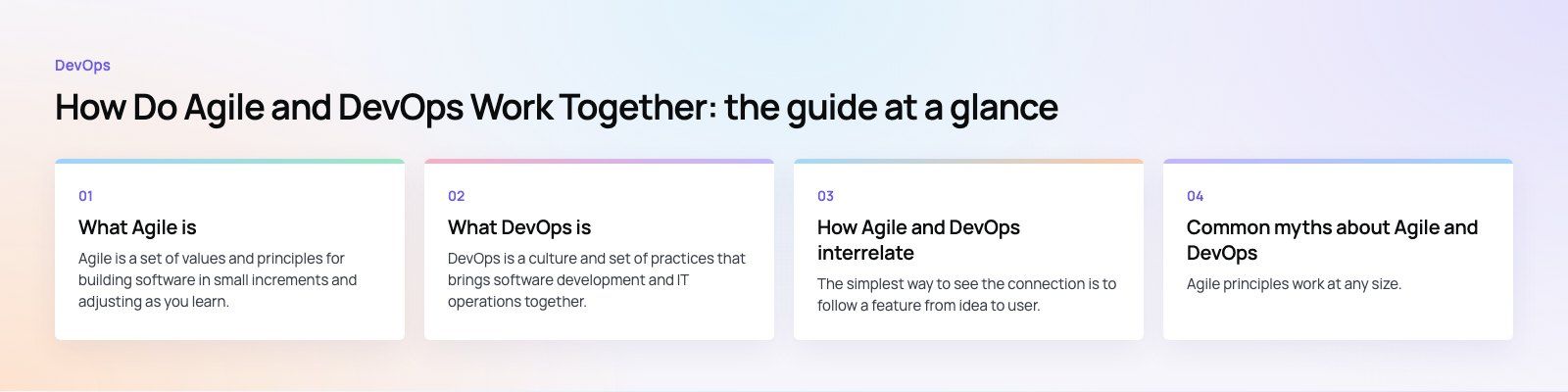
How Agile and DevOps interrelate
The simplest way to see the connection is to follow a feature from idea to user.
- Plan (Agile): the team picks a small, valuable change from the backlog.
- Build (Agile and DevOps): developers write the code in small commits, and continuous integration tests every commit.
- Release (DevOps): an automated pipeline deploys the change to staging and then production.
- Operate (DevOps): monitoring shows whether the change works and how users respond.
- Learn (Agile): that evidence feeds the next planning session.
Agile creates a steady stream of small changes. DevOps provides the automated path that lets those changes reach users without delay. Production feedback from DevOps then gives Agile teams real data for deciding what to build next. Each makes the other more valuable.
Where they differ
| Aspect | Agile | DevOps |
|---|---|---|
| Main focus | How work is planned and built | How work is integrated, released and run |
| Feedback source | Stakeholders and users at each iteration | Automated tests, monitoring and production data |
| Typical team | Developers, testers, product owner, designer | Development plus operations, security and platform roles |
| Key practices | Sprints, backlog, stand ups, retrospectives | CI/CD, infrastructure as code, monitoring, incident review |
| Typical measures | Delivered value, predictability, team health | Deployment frequency, lead time, failure and recovery rates |
Where they overlap
- Both favor small batches over large, infrequent releases.
- Both rely on fast feedback loops.
- Both depend on collaboration across roles rather than handoffs.
- Both expect continuous improvement of the process itself.
Common myths about Agile and DevOps
"Agile is only for small teams"
Agile principles work at any size. Larger organizations coordinate several Agile teams around shared goals. What matters is commitment to working in short cycles and acting on feedback, not headcount.
"Agile and DevOps are the same thing"
They share values, but they solve different problems. Agile is mainly about deciding and building the right things. DevOps is mainly about delivering and running them reliably. Treating one as a substitute for the other leaves a gap.
"They only suit new products"
Existing systems often benefit most. Adding automated tests and a deployment pipeline to an older application reduces release risk immediately, and moving its backlog to short iterations makes change more predictable.
"You need a large budget to start"
Both can be introduced in small steps. A team can start with a shared backlog, a two week cycle and a single automated build, then add automated deployment and monitoring as confidence grows.
Benefits of using Agile and DevOps together
- Faster delivery: small changes flow from idea to production without waiting for a big release.
- Lower risk: each release is small, tested automatically and easy to roll back.
- Better decisions: production data shows what users actually do, not what the team assumed.
- Stronger collaboration: developers, testers and operations share goals instead of passing work over walls.
- More flexibility: the team can change direction between iterations without disrupting releases.
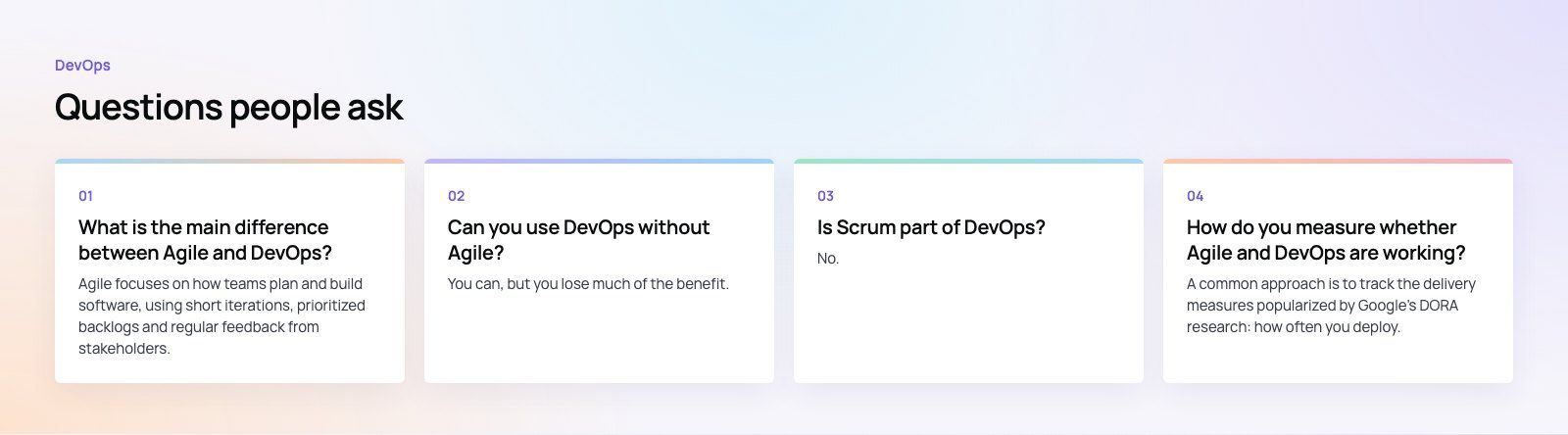
Google's DevOps Research and Assessment program, known as DORA, tracks delivery performance through measures such as deployment frequency, lead time for changes, change failure rate and recovery time. These are a practical way to see whether the combination is working in your team.
How to start combining them
- Make work visible. Put all work, including operations tasks and incidents, on one board.
- Shrink the batch size. Aim for changes that can be built, reviewed and released within days.
- Automate the build and tests. Every commit should trigger a build and a meaningful test suite.
- Automate deployment. Start with staging, then production, with a one step rollback.
- Add monitoring early. Know when something breaks before customers tell you.
- Share on call and reviews. Developers who see production issues write more reliable code.
- Measure and adjust. Track a few delivery metrics and discuss them in retrospectives.
Mistakes to avoid
- Renaming without changing. Calling a team "DevOps" without changing responsibilities or tooling changes nothing.
- Sprints with quarterly releases. If finished work waits months to deploy, the Agile feedback loop is broken.
- Tool first thinking. Buying pipeline tools before agreeing on how the team works usually adds complexity.
- Skipping tests to go faster. Without automated tests, frequent releases become frequent incidents.
Putting it into practice
Codeeo has delivered 200+ projects across the UAE and the US with a team of 80+ across Dubai, Riyadh and Karachi, building web platforms and apps in short iterations with automated releases. Our custom software development and mobile app development teams work this way by default. You can also add capacity through dedicated developers or one of our team models. If releases on an existing product feel slow or risky, a codebase review is a good first step, or get in touch.
Frequently asked questions
Agile focuses on how teams plan and build software, using short iterations, prioritized backlogs and regular feedback from stakeholders.
DevOps focuses on how that software is integrated, tested, released and operated, using automation, monitoring and shared ownership between development and operations. Agile helps you build the right thing in small steps; DevOps helps you deliver and run it reliably and often.
DevOpsPlatform Engineering vs DevOps: Differences and How They FitPlatform engineering vs DevOps explained: what each one is, where they overlap, the tools involved, and how to tell which one your organization needs next. DevOpsGitLab vs Jenkins: Which CI/CD Tool Fits Your Team?GitLab vs Jenkins compared on setup, features, scaling, security, integrations and total cost, with a simple checklist for choosing the right CI/CD tool.
 DevOpsConfiguration Management Tools in DevOps: How the Leaders CompareAnsible, Puppet, OpenVox, Chef, Salt, Terraform and OpenTofu compared: what configuration management does in DevOps and how to choose a tool.
Tell us what the business needs. We will tell you what to build first.
Schedule a free consultation and get a written recommendation, with costs, before you commit to anything.
Get in touchPROVEN RESULTS
4.7 / 5verified reviews on Google