 AIPredictive HR Analytics: How to Forecast Workforce TrendsHow predictive HR analytics forecasts hiring, turnover and skills needs, how to start with your own data, and when to build a custom tool or buy one.
How AI Is Changing Industries: Real Uses by Sector
What AI actually does in healthcare, finance, manufacturing, customer service, education and transport, where it struggles, and what to take from it.
Artificial intelligence is changing industries mainly by taking over pattern recognition at scale: reading images, spotting fraud, forecasting demand, answering routine questions and drafting content. The biggest gains so far come from narrow, well defined tasks with good data behind them, not from replacing whole jobs. Healthcare, finance, manufacturing, customer service, education and transport each show this in different ways.
This article looks at what AI actually does in each of those sectors, where it struggles, and what businesses should take from it.
Why AI is spreading now
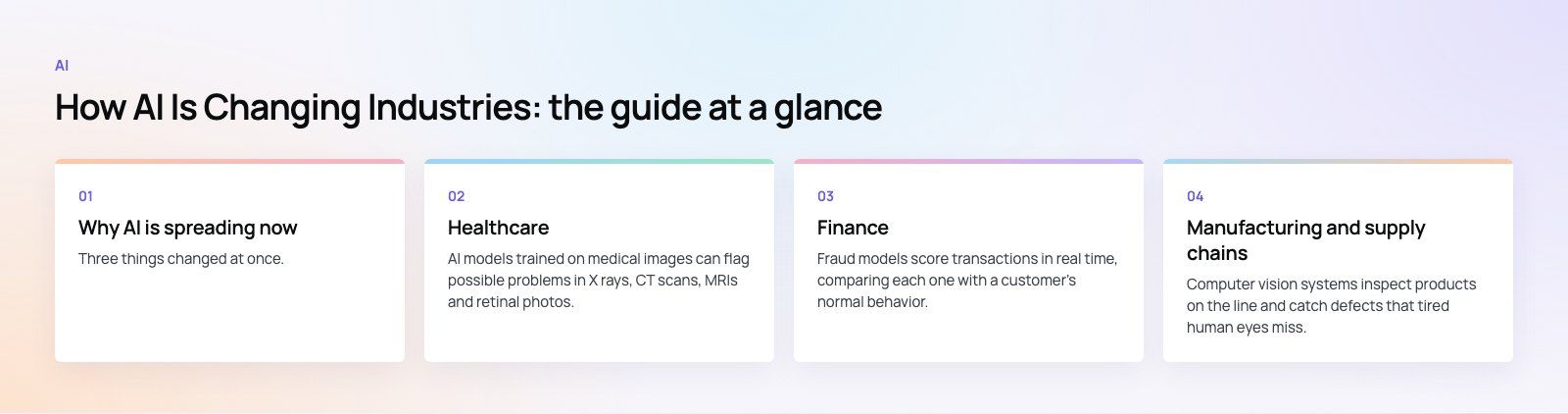
Three things changed at once. Cloud platforms made large amounts of computing power available on demand. Businesses built up years of digital records that models can learn from. And large language models made AI usable through plain text, so staff without technical training can work with it directly. The result is that AI has moved from research teams into everyday software such as CRMs, office suites, help desks and analytics tools.
Healthcare
Diagnostics and imaging
AI models trained on medical images can flag possible problems in X rays, CT scans, MRIs and retinal photos, helping clinicians prioritize which cases to review first. In the US, the Food and Drug Administration maintains a public list of AI enabled medical devices it has authorized, most of them in radiology. These tools support doctors rather than replace them, and the final decision stays with a clinician.
Records and admin
Natural language processing can summarize clinical notes, draft letters and code records for billing. Ambient documentation tools that listen to consultations and draft notes are reducing the time clinicians spend typing.
Drug discovery
Models that predict how molecules behave and how proteins fold help researchers narrow down candidates faster. This shortens early research, although clinical trials still take years.
Operations
Hospitals and staffing providers use forecasting to plan shifts and beds. Platforms that match workers to shifts, like the healthcare workforce platform in our Distinct case study, are the kind of system where this sort of scheduling logic can be added. See more on our healthcare industry page.
Finance
Fraud detection
Fraud models score transactions in real time, comparing each one with a customer's normal behavior. Unusual patterns, such as a new device, an odd location or a sudden change in spending, trigger checks or blocks. This is one of the oldest and most proven uses of machine learning in business.
Risk and credit
Lenders use models to assess applications, often adding data beyond traditional credit scores. Regulators expect these decisions to be explainable and free from unfair bias, which shapes how models are built and documented.
Trading and advice
Algorithmic trading has used statistical models for decades. AI adds faster analysis of news and filings. Banks are also deploying assistants that help staff search policies and draft client communications.
Fintech products in particular are built with data and automation in mind from the start. Our fintech page covers the kinds of platforms we build.
Manufacturing and supply chains
Quality control
Computer vision systems inspect products on the line and catch defects that tired human eyes miss. They work consistently across shifts and can log every inspection for traceability.
Predictive maintenance
Sensors on machines feed models that learn what normal vibration, temperature and power use look like. When readings drift, the system schedules maintenance before a breakdown stops production.
Demand forecasting and logistics
Forecasting models combine sales history, seasonality, promotions and outside signals to predict demand. Better forecasts mean less excess stock and fewer shortages. Route optimization does the same for deliveries, cutting distance and fuel.
Customer service
Chatbots and assistants
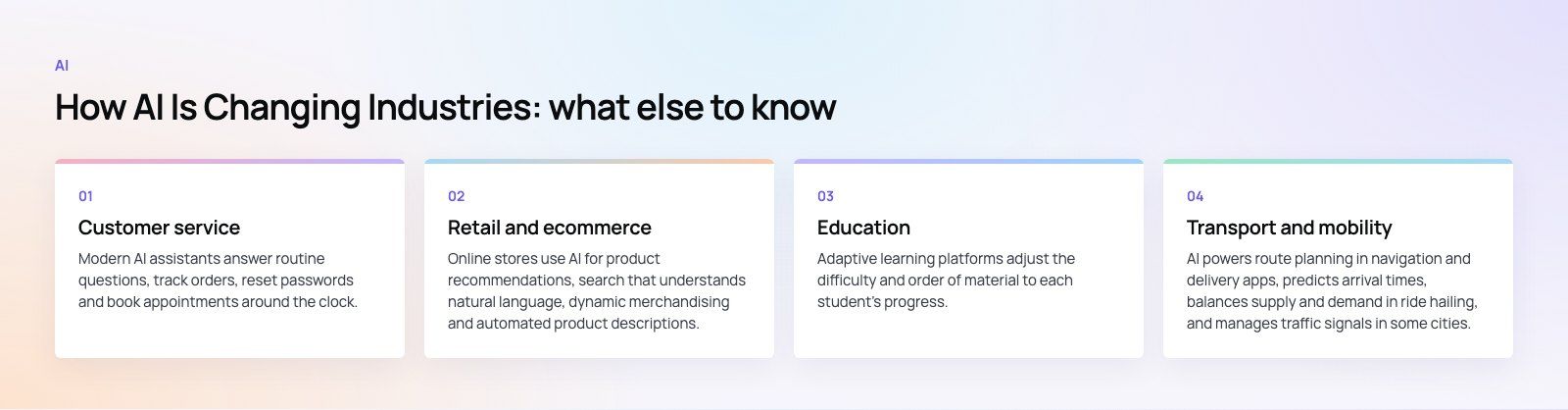
Modern AI assistants answer routine questions, track orders, reset passwords and book appointments around the clock. The best ones hand over to a person when a question is complex or the customer is frustrated, passing along the conversation so nobody has to repeat themselves.
Agent support
AI also helps human agents directly by suggesting replies, summarizing long ticket histories and pulling up the right help article. This often delivers more value than a fully automated bot, because quality stays high while handling time drops.
Feedback analysis
Sentiment analysis reads reviews, surveys and tickets at scale to show what customers complain about most, so product and service teams can fix root causes.
Retail and ecommerce
Online stores use AI for product recommendations, search that understands natural language, dynamic merchandising and automated product descriptions. Retailers also use demand forecasting to plan stock across locations. For more, see our retail and ecommerce page.
Education
Personalized learning
Adaptive learning platforms adjust the difficulty and order of material to each student's progress. AI tutors can explain concepts in different ways and answer questions outside class hours.
Teacher support
Teachers use AI to draft lesson plans, quizzes and feedback, saving time on preparation. Schools still need clear rules on academic honesty and on how student data is handled.
Accessibility
Speech to text, text to speech and live translation make lessons more accessible to students with disabilities and to those learning in a second language.
Platforms like the one in our Edsidera case study, with classes, tasks, preset feedback, exports and payments, show the structured data that education tools run on.
Transport and mobility
AI powers route planning in navigation and delivery apps, predicts arrival times, balances supply and demand in ride hailing, and manages traffic signals in some cities. Driver assistance features such as lane keeping and automatic braking are now common in new cars. Fully driverless services operate in a limited number of cities, with progress slower than early predictions suggested.
A summary by industry
| Industry | Main AI uses | Main limit |
|---|---|---|
| Healthcare | Imaging support, documentation, drug discovery, scheduling | Regulation and the need for clinical oversight |
| Finance | Fraud detection, credit risk, analysis, staff assistants | Explainability and fairness requirements |
| Manufacturing | Visual inspection, predictive maintenance, forecasting | Sensor data quality and integration with old equipment |
| Customer service | Chatbots, agent assist, sentiment analysis | Wrong answers when content is out of date |
| Education | Adaptive learning, tutoring, teacher tools | Academic integrity and student privacy |
| Transport | Routing, demand prediction, driver assistance | Safety validation for autonomy |
The risks that come with it
AI adoption brings real challenges that every sector shares:
- Accuracy: language models can produce confident but wrong answers. Systems that matter need checks and human review.
- Bias: models trained on skewed data can treat groups unfairly, especially in hiring, lending and healthcare.
- Privacy: AI often needs personal data, which must be handled under the laws that apply to your users.
- Jobs: tasks change before roles do. Organizations that retrain staff tend to get more from AI than those that only cut costs.
- Governance: frameworks such as the NIST AI Risk Management Framework give a practical structure for managing these risks.
What this means for your business
The pattern across industries is consistent. AI works best on a specific task, with good data, inside an existing workflow, with a person checking results where mistakes are costly. Start by finding the repetitive, data heavy tasks in your own operation, then test one well scoped use case before expanding.
Codeeo has delivered 200+ projects across the UAE and the US with a team of 80+ across Dubai, Riyadh and Karachi. If you want to add AI features to your software or build a new product around them, our custom software development team can help you scope a first use case.
Frequently asked questions
AI is changing how organizations handle tasks that depend on recognizing patterns in large amounts of data.
It reads medical images, flags fraudulent payments, predicts machine failures, answers customer questions and personalizes learning. Most of the change comes from AI handling narrow, repetitive tasks inside existing workflows, which frees people to focus on judgment, relationships and complex problems.
AIPredictive HR Analytics: How to Forecast Workforce TrendsHow predictive HR analytics forecasts hiring, turnover and skills needs, how to start with your own data, and when to build a custom tool or buy one. AIHow Dubai Police Uses AI to Improve Public ServicesHow Dubai Police uses AI for minor accident reports, vehicle history checks and the Amna virtual officer, and what UAE businesses can learn from it.
 AIHow to Add a Chatbot to Your Website in 5 StepsAdd a chatbot to your website in five steps: choose its job, set KPIs, map users and flows, build and install the script, then target and improve it.
Tell us what the business needs. We will tell you what to build first.
Schedule a free consultation and get a written recommendation, with costs, before you commit to anything.
Get in touchPROVEN RESULTS
4.7 / 5verified reviews on Google