 E-Commerce10 Features of a High-Converting Ecommerce WebsiteThe ten features that turn store visitors into buyers, from product pages and checkout to speed, mobile design, social proof and ongoing testing.
How Much Does the Average Shopify Store Make per Month?
Why published Shopify revenue averages mislead, how to estimate your own store's monthly revenue and profit, and the changes that lift it most.
There is no reliable "average" monthly revenue for a Shopify store. Shopify does not publish per store averages, and the figures that circulate online come from third party estimates that mix hobby stores with large brands, so they say very little about what your store will earn. What a store makes each month comes down to three numbers you control: traffic, conversion rate and average order value, minus the costs of getting each sale.
This guide explains why the averages mislead, how to estimate your own monthly revenue and profit, and which changes move those numbers most.
Why published averages are misleading
Search for Shopify store revenue and you will find confident monthly figures. Treat them with caution. Most come from surveys or scraped estimates rather than from Shopify, and they suffer from three problems.
The distribution is extremely uneven
A small number of established stores earn a very large share of all sales on the platform, while a long tail of stores make few or no sales at all. When a handful of big earners sit in the same pool as thousands of inactive stores, the mean is pulled upward and describes almost nobody. A median would be more useful, but reliable median data for Shopify stores is not publicly available.
Many stores are not trying to be businesses
Shopify is easy to start, so the platform includes test stores, side projects, stores that were never launched and stores that stopped trading but kept their plan. Any average that counts them says nothing about a store run as a real business with a marketing budget.
Revenue is not profit
Even an accurate revenue figure hides the cost side. A store selling high margin digital products and a store reselling low margin electronics can show the same top line and very different take home results. Margins depend on the product, the supplier, shipping and how much you pay for each customer.
How to estimate what your Shopify store can make
Instead of borrowing someone else's average, build your own estimate. Monthly revenue follows a simple formula:
Monthly revenue = monthly sessions × conversion rate × average order value
Each part is something you can measure in Shopify and improve on purpose.
Sessions
Sessions are visits to your store. A new store with no audience, no ads and no search rankings will see very little traffic, which is why so many stores report low early sales. Traffic comes from search, paid ads, social media, email, marketplaces and referrals. Write down where you expect visits to come from and how many each channel can realistically send.
Conversion rate
Conversion rate is the share of sessions that end in an order. It varies widely by product, price point, device and traffic source. Returning visitors from email usually convert far better than cold visitors from a broad social ad. If 10,000 sessions produce 150 orders, your conversion rate is 1.5%.
Average order value
Average order value (AOV) is total sales divided by the number of orders. Bundles, free shipping thresholds and relevant add ons raise it. Low priced single items keep it low, which means you need more orders to reach the same revenue.
From revenue to profit
To see what the store actually earns, subtract:
- Cost of goods, including packaging
- Shipping and fulfillment costs you do not pass on
- Payment processing and any platform transaction fees
- Your Shopify plan and paid apps
- Advertising and other customer acquisition costs
- Returns, refunds and chargebacks
The most common surprise for new store owners is acquisition cost. If you pay for most of your traffic, a store can show healthy revenue and still lose money on every first order. Repeat purchases are where many stores make their profit.
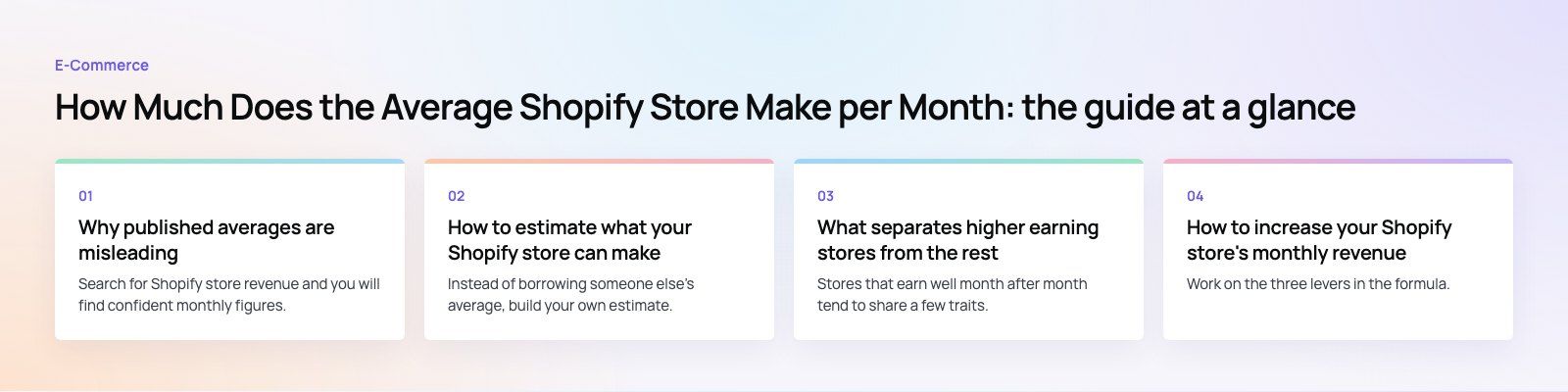
What separates higher earning stores from the rest
Stores that earn well month after month tend to share a few traits. None of them are secrets, but they take steady work.
| Factor | Lower earning stores | Higher earning stores |
|---|---|---|
| Traffic | Rely on one channel, often paid social | Mix search, email, ads and returning customers |
| Product | Generic items sold by many others | Clear niche, differentiated product or brand |
| Store experience | Slow pages, thin product details, long checkout | Fast pages, clear photos and specs, short checkout |
| Retention | No email list or follow up | Email and SMS flows that bring buyers back |
| Measurement | Check sales totals only | Track conversion, AOV and cost per order by channel |
How to increase your Shopify store's monthly revenue
Work on the three levers in the formula. Small gains on each multiply together.
Improve conversion before buying more traffic
Sending more visitors to a store that does not convert only makes losses bigger. Start with the basics:
- Make product pages answer the questions buyers ask: size, materials, delivery time, returns.
- Use clear, consistent photography and show the product in use.
- Keep the checkout short and offer the payment methods your market expects.
- Make pages load quickly on mobile, where most browsing happens.
- Show shipping costs early so they do not appear as a surprise at checkout.
If you are not sure where buyers drop off, a structured checkout teardown will show the friction points step by step. Speed problems are often caused by heavy themes and too many apps, which a Core Web Vitals review can isolate.
Raise average order value
Add bundles, product recommendations on the cart page and a free shipping threshold set slightly above your current AOV. Keep upsells relevant: a cable with a phone case makes sense, a random discount pop up does not.
Build repeat purchases
Collect email addresses from the first visit and set up the core automated flows: welcome, abandoned cart, post purchase and win back. Customers who have already bought once cost far less to reach again than new visitors from ads.
Expand the range carefully
Adding products can lift revenue when they suit the customers you already have. Use your order data to see what people buy together, and test new products in small batches before committing to stock.
Choose channels you can measure
Run digital marketing across a few channels you can track properly, rather than spreading a small budget thin. Search engine optimization takes longer but brings traffic you do not pay for per click, which improves margin over time.
Use Shopify analytics to track the right numbers
Shopify's built in analytics and reports show sessions, conversion rate, average order value and sales by channel. Review them weekly and compare like with like, for example this month against the same month last year, because seasonality distorts short comparisons.
The metrics worth watching closely are:
- Conversion rate by device and traffic source. A weak mobile rate usually points to a design or speed issue.
- Average order value. Watch how it responds to bundles and shipping thresholds.
- Returning customer rate. A rising rate means retention work is paying off.
- Cost per order by channel. This tells you which marketing is actually profitable.
- Refund rate by product. High refunds often reveal unclear descriptions or supplier quality problems.
Common mistakes that keep monthly revenue low
- Launching without a traffic plan. A store does not attract visitors on its own.
- Copying a competitor's product and price. Without a reason to buy from you, price becomes the only lever.
- Installing too many apps. Each adds scripts that slow the store and can conflict with the theme.
- Ignoring the numbers after launch. Without tracking conversion and cost per order, it is impossible to know what to fix.
- Judging the store too early. The first months are for learning which products and channels work.
For a real reference point, our EGO Sustainable case study shows a bilingual Shopify store for a GCC athleisure label selling across five markets with local payment options.
Getting a store that is built to convert
Monthly revenue is the result of traffic, conversion and order value, so the store itself matters. A clear structure, fast pages and a short checkout make every visitor more valuable. Codeeo's Shopify developers build and improve stores with those basics in place, drawing on 200+ projects delivered across the UAE and the US.
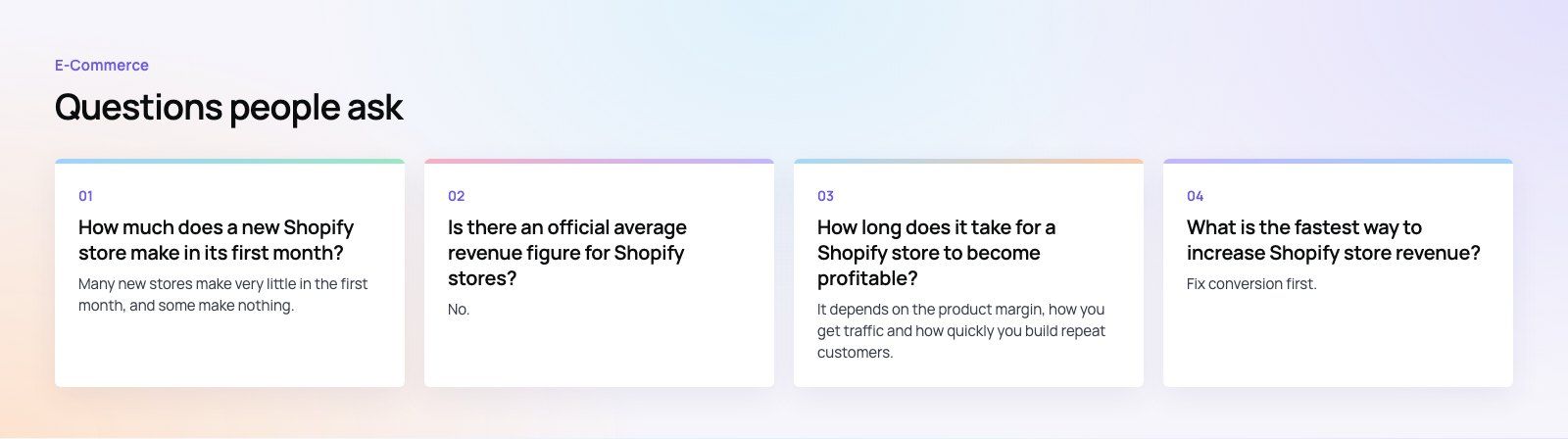
Frequently asked questions
Many new stores make very little in the first month, and some make nothing.
Without an existing audience, search rankings or an advertising budget, traffic is low and conversion data is thin. Treat the first months as a testing period: measure which products and channels bring orders, fix the store experience, then scale the spending that works rather than judging the business on the first few weeks.
E-Commerce10 Features of a High-Converting Ecommerce WebsiteThe ten features that turn store visitors into buyers, from product pages and checkout to speed, mobile design, social proof and ongoing testing. E-CommerceBenefits of Using a CMS for Ecommerce WebsitesHow a CMS helps online stores manage products, SEO, growth and security, how it compares with a custom build, and how to choose between WooCommerce, Shopify and headless.
 E-CommerceEcommerce Website Development: 9 Elements Every Store NeedsThe nine parts every online store needs, from catalog data and search to checkout, security, operations and analytics, with what to decide before you build.
Tell us what the business needs. We will tell you what to build first.
Schedule a free consultation and get a written recommendation, with costs, before you commit to anything.
Get in touchPROVEN RESULTS
4.7 / 5verified reviews on Google