 MarketingShopify Email vs Mailchimp: Which Is Better for Your Store?Shopify Email, now Shopify Messaging, against Mailchimp: ease of use, Shopify data, automation, segmentation, design and how pricing scales, with a clear way to choose.
How Much Should You Spend on Digital Marketing Services?
How to set a digital marketing budget from your own numbers: what you pay for, what drives cost, how to split channels and when to spend more.
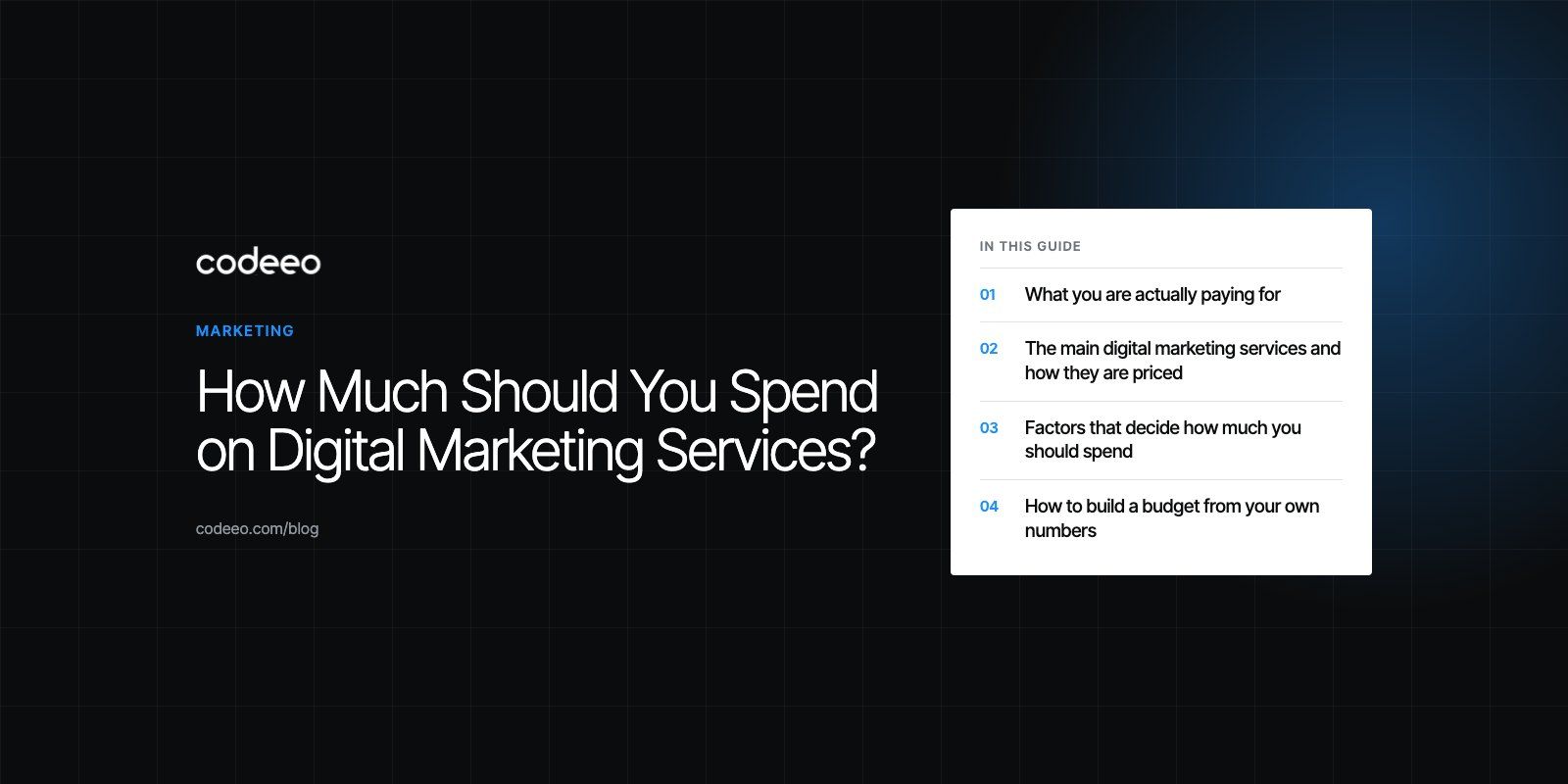
There is no single right amount to spend on digital marketing. The right budget is the amount that lets you reach a clear goal, such as a number of qualified leads or online sales, at a cost per result your margins can carry. Work it out backwards from that goal, start with the channels closest to buying intent, and adjust every month based on what the numbers show.
This guide explains what drives the cost of digital marketing services, how to build a budget from your own figures rather than a rule of thumb, and how to get more out of whatever you spend.
What you are actually paying for
Most digital marketing budgets cover three different things, and mixing them up is the most common reason a budget feels wrong.
- Media spend: the money paid directly to platforms such as Google, Meta, LinkedIn or TikTok for ads. You control it day by day and it stops the moment you pause a campaign.
- Services and people: strategy, campaign management, content writing, design, SEO work and reporting, whether delivered by an in house team, a freelancer or an agency.
- Tools and assets: analytics, email platforms, SEO software, landing pages and the website itself. These are easy to forget and easy to overbuy.
When you compare quotes or plan a year, keep these three lines separate. A proposal that bundles media and management into one number makes it hard to see how much is actually reaching your audience.
The main digital marketing services and how they are priced
Each channel behaves differently. Some produce results quickly and stop when spending stops; others build slowly and keep paying back.
| Service | How cost usually works | When results appear | Best suited to |
|---|---|---|---|
| Search engine optimization (SEO) | Ongoing monthly work on content, technical fixes and links | Builds over months, then compounds | Businesses people already search for |
| Pay per click search ads | Media spend per click plus management | Within days | High intent searches, quick lead flow |
| Social media advertising | Media spend per impression or result plus creative | Within days to weeks | Visual products, awareness, retargeting |
| Content marketing | Per piece or monthly retainer | Months | Considered purchases and B2B |
| Email marketing | Platform fees plus writing and design | Immediate for existing lists | Repeat sales and nurturing leads |
| Analytics and reporting | Setup project, then light monthly upkeep | Supports every other channel | Everyone, before scaling spend |
Factors that decide how much you should spend
Your goals and how ambitious they are
Holding steady in a market you already lead costs less than breaking into a new one. A goal of a few extra enquiries a month needs a very different budget from a goal of doubling online revenue in a year. Write the goal down as a number before you think about spend.
Competition in your industry
In crowded categories such as legal, finance, real estate, education and healthcare, more advertisers bid on the same searches, so each click costs more and SEO takes longer. In niche markets the same budget goes much further.
How narrow your audience is
Reaching a broad consumer audience is usually cheaper per person than reaching a small group of senior decision makers. Highly targeted B2B campaigns cost more per impression but can still be efficient if each customer is worth a lot.
Geography
Ad costs vary widely between countries and cities, and so do agency rates. Targeting several markets at once splits a budget thin; it is often better to win one market before adding the next.
Scope of services
A business running search ads alone needs far less than one running SEO, paid social, content and email together. More channels also mean more creative, more reporting and more coordination.
The state of your website
Marketing sends people to your site. If the site is slow, confusing on mobile or has a weak contact form, every channel performs worse and you pay more for each lead. Fixing conversion problems first is often the cheapest way to make a budget go further. A website audit will show whether this applies to you.
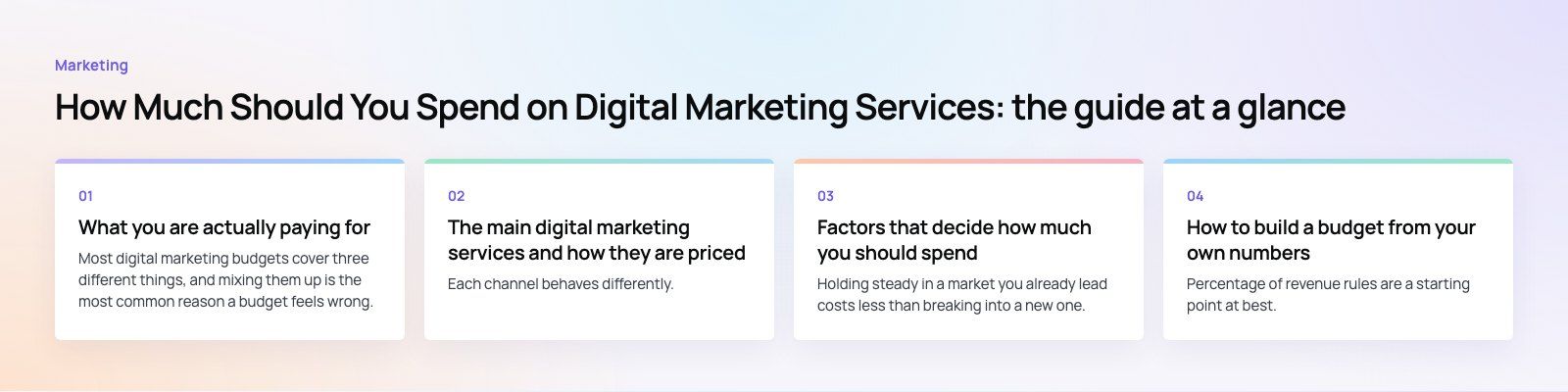
How to build a budget from your own numbers
Percentage of revenue rules are a starting point at best. A budget built from your own sales figures is easier to defend and easier to adjust.
Step 1: Know what a customer is worth
Work out average order value or contract value, and how many times a typical customer buys from you. Lifetime value tells you how much you can afford to pay to win a customer and still make a profit.
Step 2: Work out your conversion rates
How many enquiries turn into sales? How many website visitors become enquiries? Use your own CRM and analytics where you can. If you have no data yet, use cautious estimates and replace them after the first month.
Step 3: Set a target cost per lead and per sale
From lifetime value and margin, decide the most you will pay for a new customer. Divide by your lead to sale rate to get the most you can pay for a lead. This number is the line every channel has to beat.
Step 4: Calculate the volume you need
Multiply the number of new customers you want by the cost you are willing to pay for each. That gives you a working media budget. Add management, content and tools on top.
Step 5: Split it across channels
Put most of the money into channels with proven intent, usually search ads and SEO, and a smaller share into testing new channels. Keep a reserve for scaling whatever works.
Step 6: Choose a budgeting period
A monthly budget is flexible and lets you react quickly. A quarterly or annual budget gives SEO and content enough time to show results and makes planning easier. Many businesses set an annual envelope and review it every month. Ad platforms help here: Google Ads, for example, works with an average daily campaign budget, so a monthly plan has to be translated into daily settings.
Common budgeting mistakes
- Spreading too thin. A small budget split across six channels rarely gives any of them enough data to learn. Fewer channels, done properly, beat many done badly.
- Judging SEO in the first month. Organic search compounds slowly. Cutting it after a few weeks wastes the work already done.
- Paying for traffic the site cannot convert. If the landing page does not answer the visitor's question, extra spend only buys more bounces.
- No tracking. Without conversion tracking you cannot tell which channel produced a sale, so you cannot move money towards what works.
- Measuring the wrong thing. Clicks, likes and impressions are inputs. Leads, sales and cost per sale are the numbers that matter.
Getting the best return from your budget
Prioritize goals and channels
Every channel works differently for each business. Rank your goals, then fund the channels that serve the top goal first. Brand awareness can wait if the urgent need is enquiries this quarter.
Measure everything that matters
Set up conversion tracking for forms, calls, WhatsApp clicks and purchases before you scale. Review cost per lead and cost per sale by channel every month and move money accordingly.
Choose the right help
A freelancer can be a good fit for one channel and a small budget. An agency makes more sense when you need several skills working together, such as ads, SEO, design and development. Ask any provider to show how they report results and who will actually run your account.
Keep optimizing
Digital marketing is never finished. Test ad copy, refresh creative, improve landing pages and prune keywords that waste money. Small monthly improvements add up to large differences over a year.
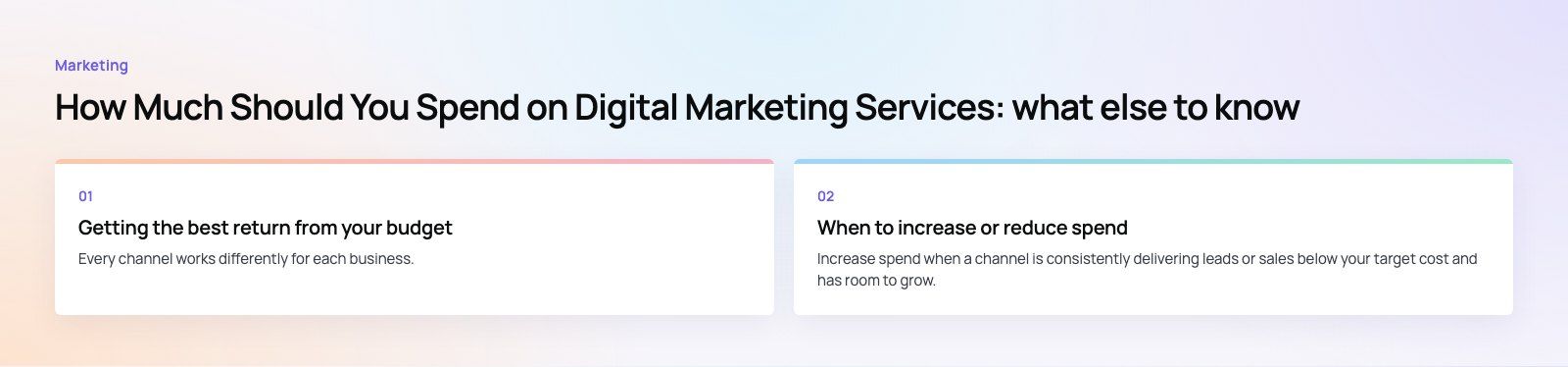
When to increase or reduce spend
Increase spend when a channel is consistently delivering leads or sales below your target cost and has room to grow, for example when search ads are limited by budget rather than by demand. Reduce or pause spend when cost per result rises above your target for several weeks and changes to targeting, creative and landing pages have not fixed it.
Your budget should also change with the business. A new product launch, a new market or a busy season may justify a temporary increase. A sales team at full capacity may mean you should hold spend steady and focus on conversion quality instead.
Where to go from here
The most useful first step is to agree a target cost per lead, set up proper tracking and fund one or two high intent channels well. If you want help building that plan, Codeeo's digital marketing team works across search, social and content, and our local SEO service suits businesses that win customers in one city. With 200+ projects delivered across the UAE and the US, we can also fix the website side so your spend converts. Get in touch to talk it through.
Frequently asked questions
A small business should spend enough to reach a specific goal at a cost per customer it can afford, not a fixed percentage.
Start by working out what a customer is worth, set a target cost per lead, then fund one or two high intent channels such as search ads or local SEO. Review results monthly and only add channels once the first ones are profitable.
MarketingShopify Email vs Mailchimp: Which Is Better for Your Store?Shopify Email, now Shopify Messaging, against Mailchimp: ease of use, Shopify data, automation, segmentation, design and how pricing scales, with a clear way to choose. MarketingHow to Use Social Media to Drive Traffic to Your WebsiteHow to turn social media followers into website visitors: choosing platforms, content that earns clicks, landing pages, paid social and UTM tracking.
 MarketingHow to Develop a Digital Marketing Strategy for Your WebsiteA step by step plan for a website digital marketing strategy: audience, goals, site readiness, SEO, content, social, email, paid ads and measurement.
Tell us what the business needs. We will tell you what to build first.
Schedule a free consultation and get a written recommendation, with costs, before you commit to anything.
Get in touchPROVEN RESULTS
4.7 / 5verified reviews on Google