 E-Commerce10 Features of a High-Converting Ecommerce WebsiteThe ten features that turn store visitors into buyers, from product pages and checkout to speed, mobile design, social proof and ongoing testing.
How to Build a Marketplace Website Like AliExpress
How to build a multi vendor marketplace like AliExpress: choosing a niche, buyer and seller features, tech stack, payments and the factors that drive cost.
To build a website like AliExpress, you build a multi vendor marketplace: a platform where many independent sellers list products, buyers search and order from all of them in one place, and the platform handles payments, payouts, disputes and reviews in between. The hard part is not the storefront. It is the seller tools, split payments, trust systems and logistics that make a marketplace work at scale.
This guide walks through how a marketplace like this is structured, the features it needs, the technology choices, the factors that decide cost, and whether building one is the right move for your business.
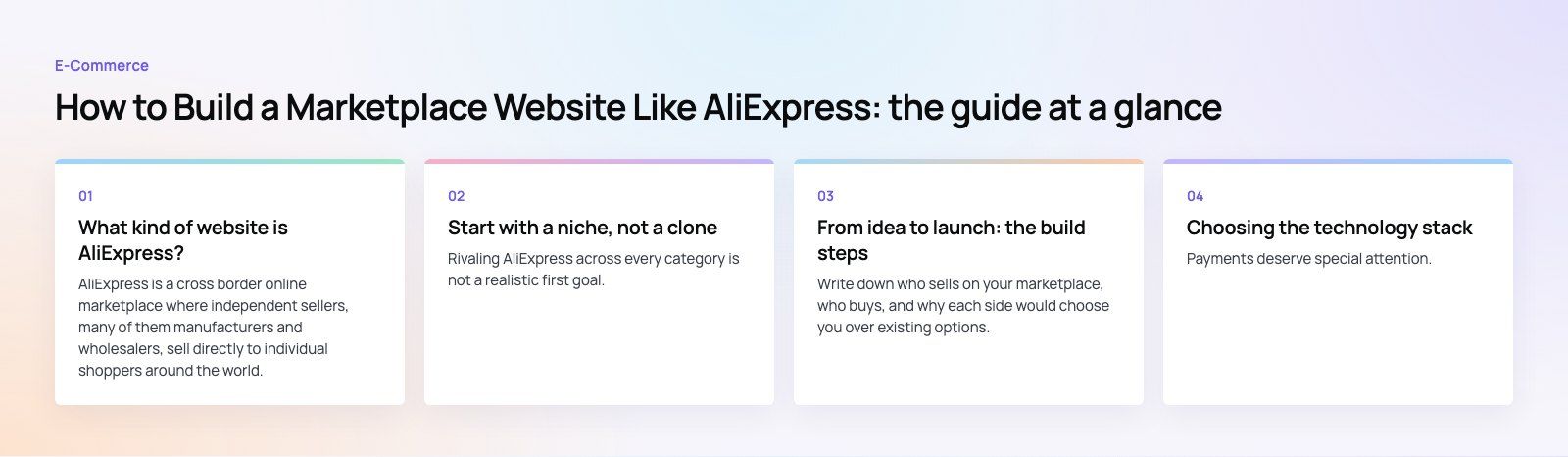
What kind of website is AliExpress?
AliExpress is a cross border online marketplace where independent sellers, many of them manufacturers and wholesalers, sell directly to individual shoppers around the world. It sits alongside Alibaba.com, which serves businesses buying in bulk. AliExpress is retail: small quantities, consumer prices and international shipping.
That makes it a three sided product:
- Buyers who browse, compare, order, track and review.
- Sellers who list products, manage stock, ship orders and get paid.
- The platform operator who sets the rules, takes a commission, resolves disputes and keeps bad actors out.
Every feature on the site serves one of these three groups. Keep that in mind when scoping, because founders often design the buyer side in detail and underestimate the seller and admin sides.
Start with a niche, not a clone
Rivaling AliExpress across every category is not a realistic first goal. Successful new marketplaces usually start narrow: one product category, one region, or one type of seller. Examples of workable niches include handmade goods from one region, spare parts for a specific type of vehicle, or B2B supplies for one trade.
A niche gives you three advantages. You can recruit enough sellers to make the catalog feel full. You can design filters and product pages that fit the category exactly. And you can market to a defined audience instead of everyone. A short product scoping exercise will help you test the niche before you commit to a build.
From idea to launch: the build steps
1. Define your buyers and sellers
Write down who sells on your marketplace, who buys, and why each side would choose you over existing options. If you cannot answer the seller question, you do not yet have a marketplace.
2. Decide the business model
Marketplaces earn through commissions on each sale, seller subscriptions, listing fees, paid promotion, or a mix. The model drives what you build: commissions need split payments; subscriptions need billing and plan limits; paid promotion needs an ads system.
3. Choose a platform approach
You can extend an ecommerce platform with marketplace plugins, use a dedicated marketplace product, or build a custom platform. Plugins are faster to launch but hit limits as you grow. A custom or headless commerce build takes longer but gives you control over search, seller tools and performance.
4. Design the three experiences
Design the buyer storefront, the seller dashboard and the admin panel as separate products with their own user testing.
5. Build the core features
Build catalog, search, cart, checkout, orders, seller onboarding, payouts and disputes first. Everything else can follow.
6. Integrate payments and shipping
Connect payment methods your buyers trust, a payout system for sellers, and shipping or tracking integrations for the regions you serve.
7. Test, soft launch and grow
Run a closed launch with a small group of sellers and buyers, fix what breaks, then open up. Plan your seller recruitment and buyer marketing before launch, not after.
Features a marketplace like AliExpress needs
For buyers
- Search with filters by category, price range, rating, shipping location and delivery time, with suggestions as people type.
- Detailed product pages with photos, video, variants such as size and color, shipping options and seller information.
- Reviews and ratings, ideally with photos from buyers and the most helpful reviews shown first.
- Wish lists and alerts when a saved item drops in price or comes back in stock.
- A short checkout with saved addresses, multiple payment methods and clear delivery estimates.
- Order tracking with status updates by email, SMS or app notification.
- Dispute and refund flows that buyers can start without contacting support.
- Language and currency options if you sell across borders.
For sellers
- Onboarding and verification with identity and business checks.
- Product management with bulk upload, variants and stock levels.
- Order management with shipping labels, tracking numbers and returns.
- Payout reports showing sales, commission and pending balances.
- Messaging with buyers inside the platform.
- Promotion tools such as coupons and sponsored listings.
For the operator
- Seller approval and moderation, including product listing review.
- Commission and fee rules by category or seller tier.
- Dispute resolution tools with full order history.
- Fraud monitoring for fake listings, fake reviews and payment abuse.
- Analytics on sales, search terms, conversion and seller performance.
Choosing the technology stack
| Layer | Typical choices | Why it matters for a marketplace |
|---|---|---|
| Front end | React or Next.js | Fast, searchable product and category pages that rank in search |
| Back end | Node.js, Laravel or Django | Orders, sellers, commissions and APIs for web and app |
| Database | PostgreSQL or MySQL | Reliable transactional data for orders and payouts |
| Search | Elasticsearch, OpenSearch or a hosted search service | Typo tolerant search and filtering across large catalogs |
| Payments | A provider with marketplace support | Split payments, seller payouts and compliance checks |
| Hosting | AWS, Google Cloud or Azure | Scaling for sales events and traffic peaks |
| APIs | REST or GraphQL | Sharing one back end between the website and mobile apps |
Payments deserve special attention. A marketplace collects money from a buyer and passes most of it to a seller, which brings identity checks and payout rules. Providers such as Stripe document this pattern in detail in their Connect documentation for platforms and marketplaces. Getting payment integration right early avoids painful migrations later.
Designing a better buyer experience
Large marketplaces carry a lot of clutter. A focused marketplace can win on clarity:
- Simple navigation. Clear categories and subcategories, with a prominent search bar.
- Clean layouts. Use whitespace, consistent fonts and consistent buttons so product information stands out.
- Fast pages. Compress images, load what is visible first and keep scripts lean. Speed affects both sales and search rankings.
- Mobile first design. Most marketplace browsing happens on phones, so design touch targets, filters and checkout for small screens first.
- Personal recommendations. Suggest products based on browsing and purchase history once you have enough data.
- Visible trust signals. Seller ratings, verified badges, clear return policies and secure payment marks.
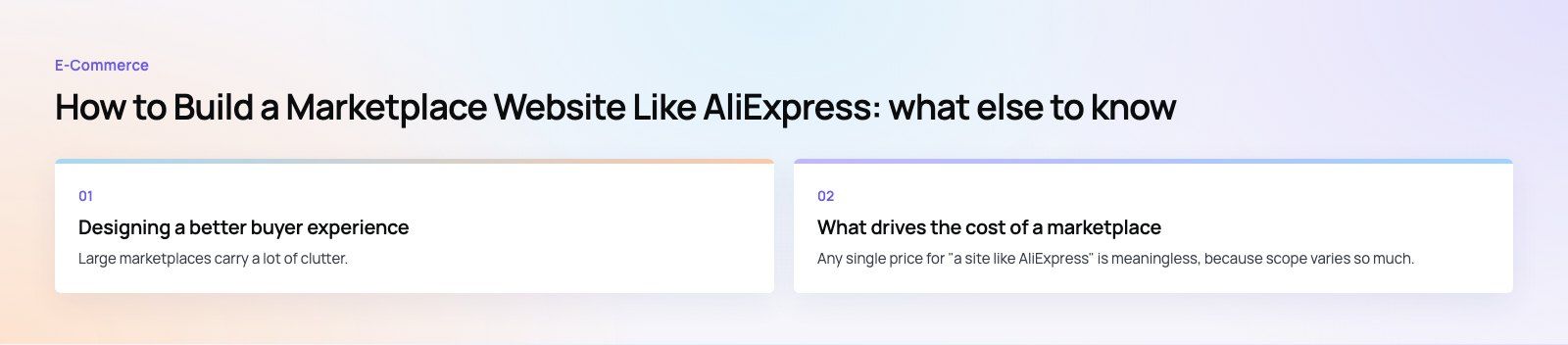
What drives the cost of a marketplace
Any single price for "a site like AliExpress" is meaningless, because scope varies so much. These are the factors that decide your budget:
- Build approach. Plugins on an existing platform cost least up front; custom builds cost more but scale further.
- Number of apps. A website alone is cheaper than a website plus buyer and seller mobile apps.
- Payment complexity. Split payments, multiple currencies and payout schedules add development and compliance work.
- Search and catalog size. Large catalogs need dedicated search infrastructure.
- Integrations. Shipping carriers, tax tools, ERP or accounting systems each add work.
- Legal and compliance. Terms for sellers and buyers, consumer protection, data privacy and tax rules in each market you serve.
- Ongoing costs. Hosting, payment processing fees, support, moderation, maintenance and marketing continue every month.
Marketing is often the largest ongoing cost for a new marketplace, because you must attract both sellers and buyers at the same time.
Is building an AliExpress style marketplace worth it?
The upside
- Revenue from commissions and seller subscriptions without holding stock.
- A catalog that grows as sellers join, not as you buy inventory.
- A strong position in a niche if you become the default place to buy that category.
The downside
- You must solve the chicken and egg problem: buyers want sellers, sellers want buyers.
- Trust and fraud management never stop.
- Large, established platforms compete hard on price and delivery.
A marketplace makes sense when you have a clear niche, access to sellers, and the resources to run it as an operating business rather than a one off website.
Codeeo has delivered 200+ projects across the UAE and the US, including marketplaces such as Gloss and Hammer, a two sided platform where restaurant owners post jobs and verified trades pick them up. If you are planning a marketplace, see how we approach marketplaces and on demand platforms, or talk to our web development team about scoping your first release.
Frequently asked questions
AliExpress is a cross border online marketplace.
Independent sellers, many of them manufacturers and wholesalers, list products, and individual shoppers buy in small quantities with international shipping. The platform handles search, payments, buyer protection and disputes, while sellers manage their own listings, stock and shipping. It is the retail counterpart to Alibaba.com, which focuses on bulk buying between businesses.
E-Commerce10 Features of a High-Converting Ecommerce WebsiteThe ten features that turn store visitors into buyers, from product pages and checkout to speed, mobile design, social proof and ongoing testing. E-CommerceBenefits of Using a CMS for Ecommerce WebsitesHow a CMS helps online stores manage products, SEO, growth and security, how it compares with a custom build, and how to choose between WooCommerce, Shopify and headless.
 E-CommerceEcommerce Website Development: 9 Elements Every Store NeedsThe nine parts every online store needs, from catalog data and search to checkout, security, operations and analytics, with what to decide before you build.
Tell us what the business needs. We will tell you what to build first.
Schedule a free consultation and get a written recommendation, with costs, before you commit to anything.
Get in touchPROVEN RESULTS
4.7 / 5verified reviews on Google