 E-Commerce10 Features of a High-Converting Ecommerce WebsiteThe ten features that turn store visitors into buyers, from product pages and checkout to speed, mobile design, social proof and ongoing testing.
How to Build a Website Like Groupon: Steps, Features and Cost
A step by step guide to building a Groupon style deals website: niche, business model, merchant portal, vouchers, security, cost drivers and launch risks.
To build a website like Groupon, you choose a niche and a business model, design a simple deal browsing and checkout flow, build a merchant portal for creating and tracking deals, add secure payments and voucher redemption, then test, launch and grow both sides of the marketplace. The cost depends mostly on how many features you launch with, how custom the design is, and how much you spend on marketing to attract the first merchants and buyers.
This guide covers each step, the features a deals platform needs, what drives the cost and the risks that are easy to miss.
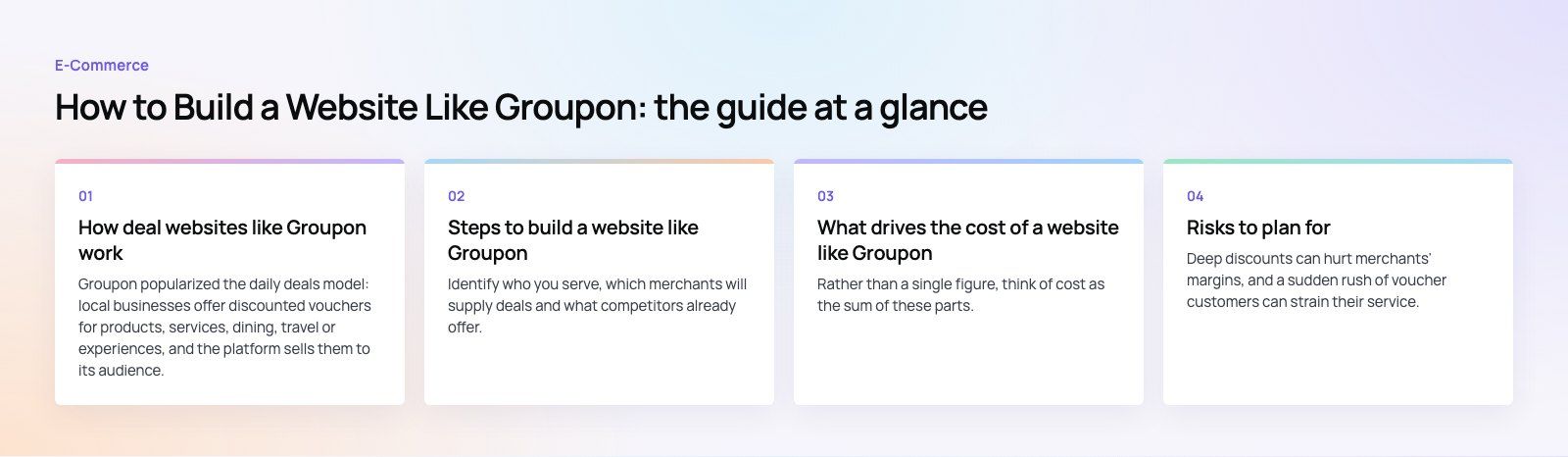
How deal websites like Groupon work
Groupon popularized the daily deals model: local businesses offer discounted vouchers for products, services, dining, travel or experiences, and the platform sells them to its audience. The merchant gains new customers and exposure; the buyer saves money; the platform takes a share of each sale. Coupon sites, cashback platforms and loyalty apps work on similar principles.
A general deals site competing with established players is hard. A focused one is realistic: deals for one city, one industry such as wellness or dining, one community such as students or corporate employees, or a deals section inside an existing brand.
Steps to build a website like Groupon
1. Research the market and define your niche
Identify who you serve, which merchants will supply deals and what competitors already offer. Talk to merchants early: if they will not list deals at launch, buyers will find an empty site and leave. Write down your unique selling point in one sentence.
2. Choose a business model
- Commission: you take a percentage of each voucher sold. This is the classic deals model.
- Listing or featured fees: merchants pay to list or to appear in prominent spots.
- Subscriptions: buyers pay for access to members only deals, or merchants pay a monthly plan.
- Hybrid: a mix of the above, which is common once the platform has traffic.
Your model shapes the features you need, from payout logic to merchant billing.
3. Design a simple user experience
Deals should be easy to find and buy in a few taps. Focus on clear deal cards, location based browsing, categories, filters, search and a short checkout. The design must work on phones first, since most deal browsing happens on mobile.
4. Build the backend and database
The backend handles users, merchants, deals, orders, vouchers, payouts and reporting. Choose a technology stack that can handle traffic spikes, because a popular deal can bring a sudden rush of buyers. Use a reliable payment gateway and store transaction history carefully.
5. Build the merchant and deal management system
Merchants need a portal to create deals, set limits and expiry dates, schedule campaigns, see sales and redeem vouchers. You need an admin to approve deals, manage commissions and handle disputes. This side of the platform is often underestimated, yet it decides whether merchants stay.
Our Gloss and Hammer project is a two sided marketplace where restaurant owners post jobs and verified trades, cleaners and maintenance firms pick them up, with a separate experience for each side. A deals platform has the same structure: two audiences with different needs on one system.
6. Add voucher redemption
Buyers need a voucher they can show in store or use online, usually as a QR code or unique code. Merchants need a quick way to validate it and mark it used so it cannot be redeemed twice. Get this flow right, because it is where the platform meets the real world.
7. Put security in place
You handle personal data and payments, so use HTTPS everywhere, encrypt sensitive data, use a payment provider that meets PCI DSS requirements and run regular security reviews. If you serve users in Europe, the GDPR applies; other regions have their own data protection laws.
8. Plan marketing and SEO
Deals platforms live on traffic. Plan social media, email alerts, referral programs, partnerships with local businesses and SEO for category and city pages. Our digital marketing team works on exactly this kind of two sided growth.
9. Test thoroughly
Test browsing, checkout, payments, refunds, voucher redemption, merchant tools and load handling. Run load tests before a big campaign so the site does not fail when a popular deal goes live.
10. Launch, measure and improve
Launch with a set of strong deals and a marketing push. Then track which deals sell, where users drop off and which merchants come back. Use that data to improve the product and your deal selection.
Key features of a deals website
| Feature | Who it serves | Launch or later |
|---|---|---|
| Deal browsing, categories, search and location filters | Buyers | Launch |
| Accounts, wish lists and order history | Buyers | Launch |
| Secure checkout and refunds | Buyers and platform | Launch |
| Vouchers with QR or unique codes | Buyers and merchants | Launch |
| Merchant portal for deals, limits and redemption | Merchants | Launch |
| Admin for approvals, commissions and payouts | Platform | Launch |
| Email and push deal alerts | Buyers | Launch or soon after |
| Reviews and ratings | Buyers and merchants | Soon after launch |
| Personalized recommendations | Buyers | Later |
| Mobile apps | Buyers and merchants | Later |
What drives the cost of a website like Groupon
Rather than a single figure, think of cost as the sum of these parts. Each one can be kept small for a first version or expanded later.
- Planning and research: defining the niche, model, features and technical plan.
- Design: buyer flows, merchant portal and admin, on desktop and mobile.
- Development: the largest part, covering frontend, backend, payments, vouchers and the merchant system.
- Integrations: payment gateways, maps, email, analytics and messaging.
- Security: encryption, secure payments, audits and compliance.
- Content management: an admin or CMS for deals, merchants and pages.
- Testing: functional, performance and acceptance testing.
- Hosting: cloud infrastructure that can scale for traffic peaks.
- Marketing and launch: attracting the first merchants and buyers.
- Maintenance: updates, fixes and improvements after launch.
The fastest way to an accurate estimate is a scoped feature list. Our product scoping quick start produces one, so you can price a realistic first version.
For a related example, JobIQ is a marketplace where customers book a technician, vendors run their teams, and the platform handles chat, dispatch and payment.
Why build a custom deals platform
- Your own brand and experience: a focused, uncluttered site for your niche instead of a crowded general one.
- Room to grow: add payment methods, recommendations, loyalty or new cities without starting again.
- Security on your terms: controls designed for the data and regulations you deal with.
- SEO from the start: clean URLs, fast pages and structured category and city pages.
- Useful analytics: dashboards built around the numbers your business actually runs on.
- Features competitors lack: exclusive categories, loyalty schemes or merchant tools that keep partners loyal.
Risks to plan for
Deep discounts can hurt merchants' margins, and a sudden rush of voucher customers can strain their service. If merchants have a bad experience, they will not return. Protect them with sensible deal limits, clear terms and good reporting. On your side, refunds, fraud and expired vouchers need clear rules from day one.
Build it with an experienced team
Codeeo has delivered 200+ projects across the UAE and the US, including several marketplaces. Explore our marketplaces and on demand work or our custom software service to plan your platform.
Frequently asked questions
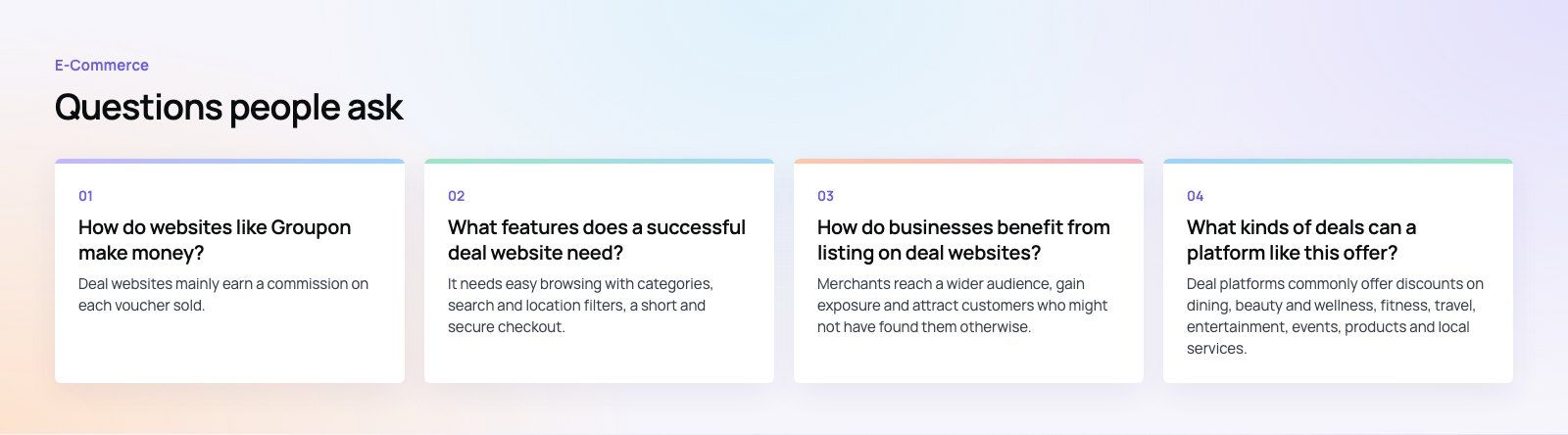
Deal websites mainly earn a commission on each voucher sold, keeping a share of the price and paying the rest to the merchant.
Many also charge merchants for featured placement or premium listings, and some offer paid memberships to buyers for exclusive deals. Advertising and partnerships can add extra income once the platform has a steady, engaged audience.
E-Commerce10 Features of a High-Converting Ecommerce WebsiteThe ten features that turn store visitors into buyers, from product pages and checkout to speed, mobile design, social proof and ongoing testing. E-CommerceBenefits of Using a CMS for Ecommerce WebsitesHow a CMS helps online stores manage products, SEO, growth and security, how it compares with a custom build, and how to choose between WooCommerce, Shopify and headless.
 E-CommerceEcommerce Website Development: 9 Elements Every Store NeedsThe nine parts every online store needs, from catalog data and search to checkout, security, operations and analytics, with what to decide before you build.
Tell us what the business needs. We will tell you what to build first.
Schedule a free consultation and get a written recommendation, with costs, before you commit to anything.
Get in touchPROVEN RESULTS
4.7 / 5verified reviews on Google