 Digital TransformationHow Digital Transformation Is Reshaping BusinessesFive ways digital transformation is changing operations, customer experience, data, business models and work, plus the challenges and a practical roadmap.
CodeeoInsightsDigital Transformation
How to Find the Right Learning Management System Consultant
What an LMS consultant does, the qualities to look for, an eight step hiring process, interview questions and the red flags that signal a poor fit.
The right learning management system (LMS) consultant combines hands-on experience with several LMS platforms, a clear method for gathering requirements and the technical skill to integrate, migrate and configure the system. To find one, define your goals first, shortlist consultants with relevant projects, test them on a real scenario from your organization and compare written proposals on approach and value, not just cost.
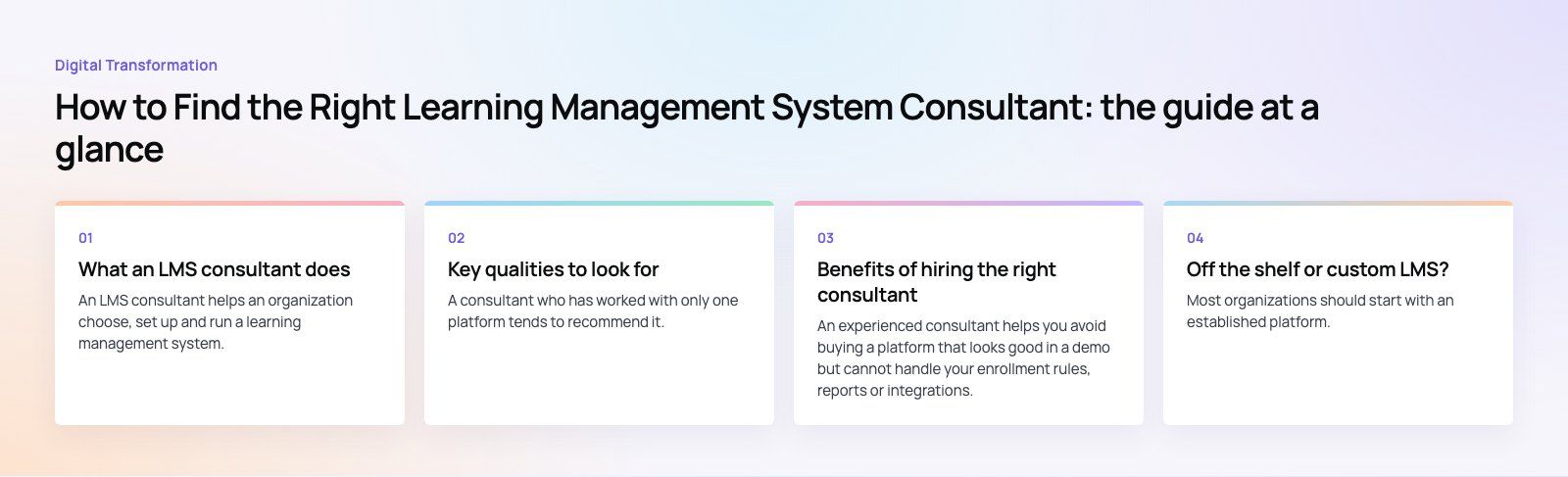
What an LMS consultant does
An LMS consultant helps an organization choose, set up and run a learning management system. The role usually spans four phases:
- Discovery: understanding who learns, what they need to learn, how training is delivered today and what must be reported.
- Selection: comparing platforms against those requirements and recommending one, or advising on a custom build.
- Implementation: configuring the platform, integrating it with HR and identity systems, migrating courses and records, and setting up reporting.
- Adoption: training administrators and instructors, supporting launch and improving the system once real usage data arrives.
Some consultants only advise. Others also build and maintain the system. Decide early which you need, because it changes who you should hire.
When you need an LMS consultant
- You are buying your first LMS and do not know which platforms fit.
- Your current LMS is underused, hard to administer or cannot produce the reports you need.
- You need to connect the LMS to an HR system, single sign on, CRM or a student information system.
- You are migrating years of course content and completion records to a new platform.
- You need compliance training with reliable audit trails.
Key qualities to look for
Experience across several LMS platforms
A consultant who has worked with only one platform tends to recommend it. Look for someone who can explain the trade offs between open source, commercial SaaS and custom options, and who understands content standards such as SCORM, xAPI and LTI.
Strong analysis and problem solving
Good consultants ask hard questions about your current training process before talking about software. They spot gaps, challenge assumptions and propose practical fixes, such as simplifying enrollment rules or restructuring course catalogs.
Clear communication
Your stakeholders will include HR, IT, trainers, managers and learners. The consultant must explain technical decisions in plain language, set realistic expectations and give regular, honest updates.
A track record of real implementations
Ask for examples of projects similar to yours in size, sector and integrations. A consultant who has dealt with HR system sync, single sign on and data migration before will anticipate problems instead of discovering them on your project.
Technical depth
Integration, data migration, customization, reporting and troubleshooting all require technical skill. If the consultant does not have it personally, check that their team does.
Steps to find the right LMS consultant
- Define your requirements. List your learners, course types, delivery formats, integrations, reporting needs and compliance obligations. Rank them as must have or nice to have.
- Research candidates. Use professional networks, industry forums, platform partner directories and referrals from peers to build a long list.
- Review experience and portfolios. Shortlist consultants with projects that match your size, sector and integrations.
- Check references. Speak to past clients about timelines, communication and what happened when things went wrong.
- Run structured interviews. Ask how they approach discovery, migration, testing and training. Ask what they would do differently on their last project.
- Test problem solving. Give each finalist a real scenario from your organization, such as merging two training catalogs, and compare their answers.
- Compare written proposals. Look at scope, method, timeline, deliverables, assumptions and support terms side by side. Focus on value and risk, not only on cost.
- Agree on success measures. Before signing, define what a successful launch looks like and how it will be measured.
Questions to ask in the interview
| Question | What a good answer shows |
|---|---|
| Which platforms would you consider for us, and why? | Independent judgment rather than a default recommendation |
| How would you integrate the LMS with our HR system? | Practical integration experience and awareness of data ownership |
| How do you handle migrating completion records? | A plan for data mapping, validation and historical reporting |
| What usually causes LMS projects to slip? | Honest experience with real projects |
| How do you drive adoption after launch? | Attention to learners and administrators, not just configuration |
| What support do you offer after go live? | Clear terms for fixes, changes and knowledge transfer |
Red flags
- Recommending a platform before understanding your requirements.
- Vague proposals with no clear deliverables or assumptions.
- No plan for data migration, testing or training.
- Reluctance to share references.
- Promising unrealistic timelines to win the work.
Benefits of hiring the right consultant
Better platform decisions
An experienced consultant helps you avoid buying a platform that looks good in a demo but cannot handle your enrollment rules, reports or integrations.
Faster, smoother implementation
A proven method for configuration, migration and testing reduces delays and disruption to existing training.
Customization that fits
Consultants can tailor branding, workflows, learning paths and reports to match how your organization actually trains people.
Fewer costly mistakes
Many expensive problems, such as poor data mapping or over customization, are avoidable with the right planning.
Compliance and security
Consultants set up permissions, audit trails and data protection in line with your obligations, which matters most for regulated training.
An objective view
An outside perspective often spots issues internal teams have learned to live with.
Off the shelf or custom LMS?
Most organizations should start with an established platform. A custom LMS makes sense when learning is part of your product, when workflows are unusual, or when you need deep links with other systems. Our Edsidera case study describes a school platform with classes, tasks, preset feedback, exports and payments, delivered as a mobile app, a web app and a payment portal. For more on education projects, see our education industry page.
If you are unsure whether a platform or a custom build fits better, a platform fit review can settle the question before you commit. When integration work runs large, adding dedicated developers to your team can keep momentum.
Codeeo designs and builds learning platforms and the integrations around them, with a team of 80+ across Dubai, Riyadh and Karachi. Talk to us about custom software development for your LMS project.
Frequently asked questions
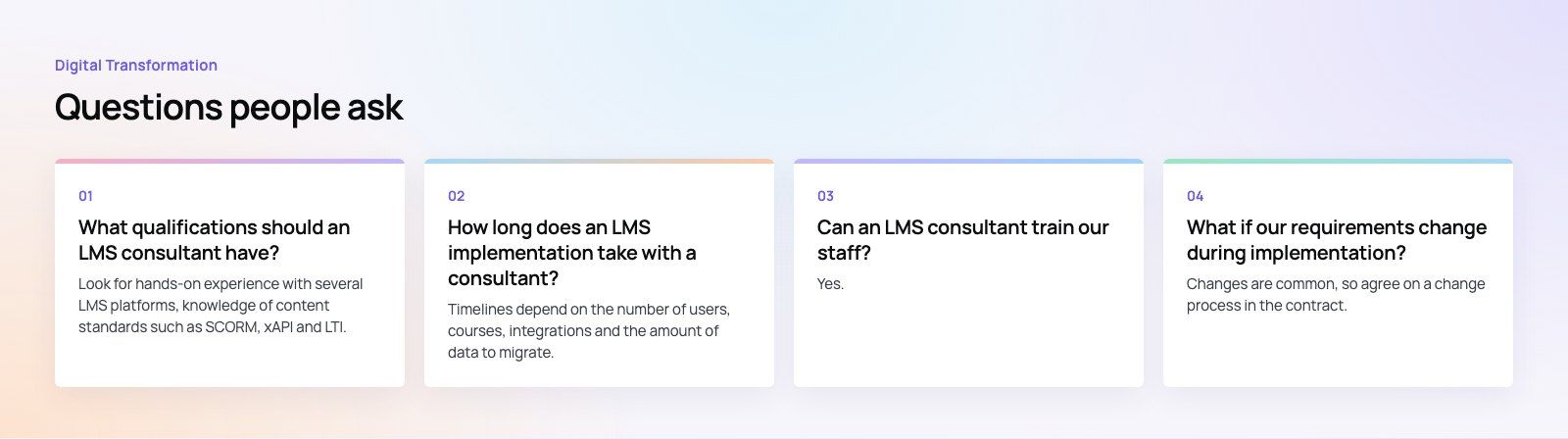
Look for hands-on experience with several LMS platforms, knowledge of content standards such as SCORM, xAPI and LTI, and proven integration and data migration work.
Platform training or vendor credentials can help, but references from similar projects matter more. The consultant should also show strong communication skills, since they will work with HR, IT, trainers and leadership.
Digital TransformationHow Digital Transformation Is Reshaping BusinessesFive ways digital transformation is changing operations, customer experience, data, business models and work, plus the challenges and a practical roadmap. Digital TransformationStrategic Human Resource Management: Aligning HR With GoalsWhat strategic human resource management means, the components of a strategic HR model, and a six step process for aligning HR with business goals.
 Digital TransformationBest CRM for Small Businesses: 10 Options and How to ChooseTen CRM platforms that suit startups and small teams, from HubSpot and Zoho to Kommo and NetHunt, with a comparison table and a practical way to choose.
Tell us what the business needs. We will tell you what to build first.
Schedule a free consultation and get a written recommendation, with costs, before you commit to anything.
Get in touchPROVEN RESULTS
4.7 / 5verified reviews on Google