 AIPredictive HR Analytics: How to Forecast Workforce TrendsHow predictive HR analytics forecasts hiring, turnover and skills needs, how to start with your own data, and when to build a custom tool or buy one.
How to Learn Artificial Intelligence: A Practical Roadmap
A practical roadmap for learning AI: the Python and math you need first, core machine learning concepts, where to practice, and how to build a portfolio.
The fastest way to learn artificial intelligence is to build a small base in Python and the math behind models, then learn machine learning by training real models on real data, and only then specialize in one area such as language, vision or reinforcement learning. Most people stall because they study theory for months without shipping anything. A project led plan, with theory pulled in when a project needs it, gets you further in less time.
This guide lays out that plan in order: what to learn first, which core concepts matter, where to practice, and how to turn what you learn into a portfolio that proves you can do the work.
Decide what kind of AI work you want to do
"Learning AI" covers very different jobs, and the right path depends on which one you want. Picking a direction early saves you from studying topics you will never use.
| Goal | What you mostly do | What to learn first |
|---|---|---|
| Use AI tools in your current role | Prompting, automating tasks, judging output | How models work at a high level, data privacy basics, prompt design |
| Build products on top of AI models | Calling model APIs, retrieval, evaluation, integration | Python or JavaScript, APIs, embeddings, testing model output |
| Machine learning engineering | Training, tuning and deploying models | Python, statistics, classic machine learning, then deep learning |
| Research | New methods, papers, experiments | Strong linear algebra, calculus, probability and deep learning theory |
If you are not sure, start on the product builder or machine learning engineering path. Both teach you enough fundamentals to move in either direction later.
Build the foundations: programming and math
Python first
Python is the default language for AI work because the main libraries live there: NumPy for arrays, pandas for tables, scikit-learn for classic machine learning, and PyTorch or TensorFlow for deep learning. If you are new to programming, the official Python tutorial covers the language itself. Aim to be comfortable with functions, lists and dictionaries, reading files, and installing packages in a virtual environment.
Other languages have their place. C++ shows up in performance critical inference and robotics, and JavaScript or TypeScript is common when you build AI features into web products. You do not need them on day one.
The math that actually matters
You need less math to start than most people fear, but you do need some. Learn each topic to the level where the model code makes sense, then go deeper when a problem requires it.
- Linear algebra: vectors, matrices and matrix multiplication. Every neural network is a stack of these operations.
- Calculus: derivatives and the chain rule, because that is how gradient descent trains a model.
- Probability: conditional probability, Bayes' theorem and common distributions.
- Statistics: sampling, bias, variance, hypothesis testing and how to tell a real result from noise.
A useful habit is to implement a small idea by hand, such as linear regression with gradient descent in plain NumPy, before using the library version. It makes the math concrete.
Learn the core AI concepts in a sensible order
1. Classic machine learning
Start here, not with neural networks. Classic methods are faster to train, easier to debug and still solve a large share of business problems.
- Supervised learning: train on labeled examples to predict an outcome. Regression predicts numbers, classification predicts categories.
- Unsupervised learning: find structure in unlabeled data through clustering or dimensionality reduction.
- Reinforcement learning: an agent learns by acting in an environment and receiving rewards or penalties.
The scikit-learn documentation is one of the clearest places to learn these methods, with worked examples for each. Pay special attention to train and test splits, cross validation and overfitting. Most beginner mistakes live there.
2. Deep learning
Once classic methods feel familiar, move to neural networks. Learn how layers, activation functions and loss functions fit together, then study the main architectures:
- Convolutional networks for images and video.
- Recurrent networks for sequences, now mostly of historical and teaching value.
- Transformers, the architecture behind modern language models and many vision models.
- Generative models such as GANs and diffusion models for creating images and other media.
3. Pick one specialty
After the general base, go deep in one area rather than skimming all of them.
- Natural language processing: text classification, sentiment analysis, translation, summarization and working with large language models.
- Computer vision: image classification, object detection and segmentation.
- Robotics: kinematics, control and perception, usually built with the Robot Operating System (ROS).
- Applied AI products: retrieval, evaluation, guardrails and connecting models to real systems and data.
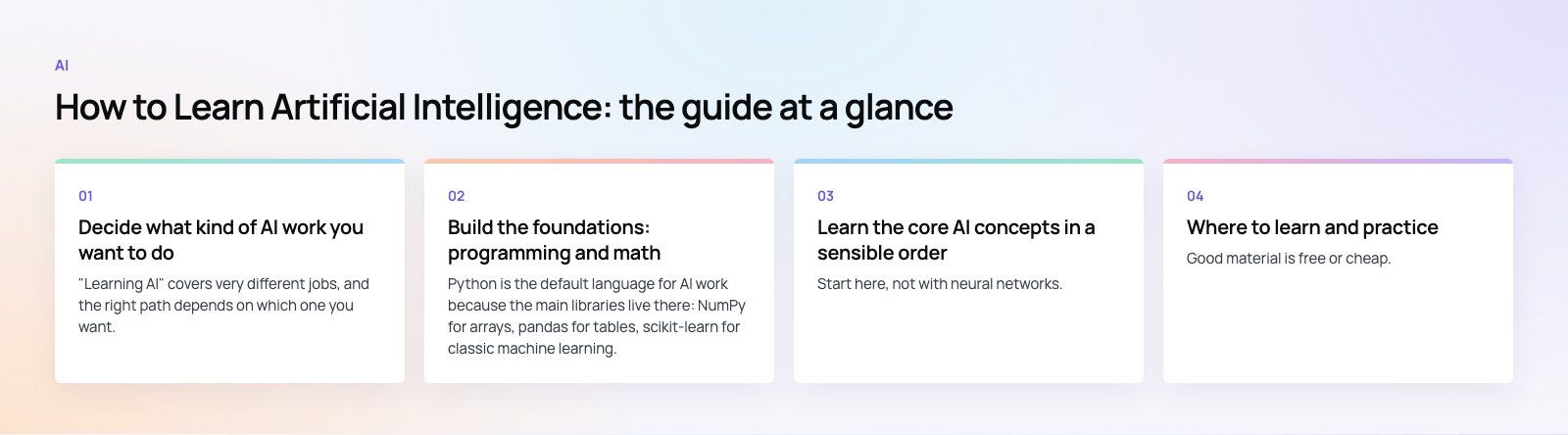
Where to learn and practice
Good material is free or cheap. The hard part is choosing a small set of resources and finishing them.
- Structured courses: Google's Machine Learning Crash Course is a free, practical introduction. University courses on major platforms suit people who want more theory and graded work.
- Practice datasets and notebooks: Kaggle Learn has short hands on courses, and Kaggle competitions give you real datasets and a way to compare your approach with others.
- Library documentation: the official docs for scikit-learn, PyTorch and TensorFlow include tutorials that are kept current, which many blog posts are not.
- Books: one well regarded machine learning textbook and one deep learning textbook, read alongside your projects, are enough for most people.
- Open source: reading and contributing to open source AI projects teaches you how production code is structured.
A realistic learning plan
How long this takes depends on your starting point and the hours you put in each week, so treat these as phases rather than deadlines.
- Foundations: Python, NumPy, pandas, and the math above. Finish with a small data analysis project.
- Classic machine learning: train regression and classification models, evaluate them properly, and write up what worked.
- Deep learning: build and train a small neural network, then fine tune a pretrained model for your own task.
- Specialty: two or three projects in your chosen area, each more realistic than the last.
- Deployment: put one model behind an API or inside a simple web app so other people can use it.
The last step is the one most learners skip, and it is the one employers and clients care about most. A model that only runs in your notebook is a homework assignment. A model wrapped in a working web application is a product.
Build a portfolio that proves your skills
Certificates show that you finished a course. A portfolio shows that you can solve problems. Aim for a few complete projects rather than many half finished ones.
- Personal projects: pick problems you understand, such as predicting demand for a small shop or classifying support tickets. Explain the data, the approach, the results and the limits.
- Open source contributions: fixing documentation or small bugs in AI libraries builds credibility and teaches you real codebases.
- Hackathons: time boxed events force you to scope, build and present, and they connect you with people working in the field.
Common mistakes to avoid
- Studying math for months before writing any model code.
- Jumping straight to large language models without understanding evaluation and overfitting.
- Copying notebooks without changing the data or the question.
- Ignoring data cleaning, which is where most real project time goes.
- Never deploying anything, so you never learn about latency, cost or monitoring.
How AI skills translate into business value
For companies, learning AI is less about research and more about applying proven techniques to specific problems. Typical uses include support chatbots that answer common questions, demand forecasting, document processing, recommendation features in apps and stores, and dashboards that flag unusual activity. Teams that understand the basics make better decisions about which of these are worth building and which are better bought off the shelf.
If you lead a team, a practical first step is to give a few people time to work through the foundations above and then run one small internal pilot with clear success measures. That builds skills and evidence at the same time.
If you would rather add AI features to a product now while your team learns, Codeeo's custom software development team builds and integrates AI into web and mobile products, and our dedicated developers can work alongside your staff. You can also start with a product scoping session to decide what is worth building first.
Frequently asked questions
Yes.
Many people working in AI came from other fields. What you need is working Python, enough linear algebra, calculus and statistics to follow how models learn, and a set of finished projects. A degree helps for research roles, but for applied machine learning and AI product work, demonstrated skill and a clear portfolio usually matter more than formal credentials.
AIPredictive HR Analytics: How to Forecast Workforce TrendsHow predictive HR analytics forecasts hiring, turnover and skills needs, how to start with your own data, and when to build a custom tool or buy one. AIHow Dubai Police Uses AI to Improve Public ServicesHow Dubai Police uses AI for minor accident reports, vehicle history checks and the Amna virtual officer, and what UAE businesses can learn from it.
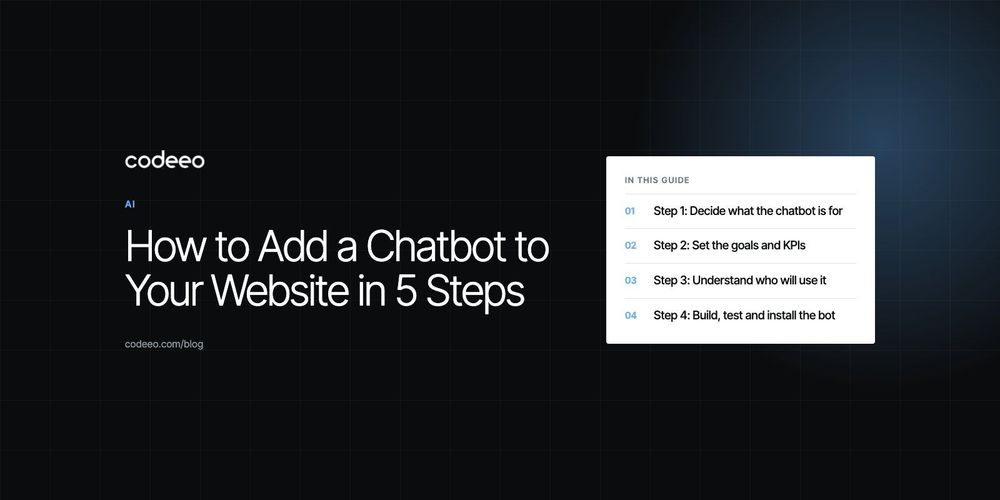 AIHow to Add a Chatbot to Your Website in 5 StepsAdd a chatbot to your website in five steps: choose its job, set KPIs, map users and flows, build and install the script, then target and improve it.
Tell us what the business needs. We will tell you what to build first.
Schedule a free consultation and get a written recommendation, with costs, before you commit to anything.
Get in touchPROVEN RESULTS
4.7 / 5verified reviews on Google