 AIPredictive HR Analytics: How to Forecast Workforce TrendsHow predictive HR analytics forecasts hiring, turnover and skills needs, how to start with your own data, and when to build a custom tool or buy one.
How to Make Money With AI: Practical Income Paths
The realistic ways to earn with AI: freelancing, AI products, data services, AI assisted content and automation inside your own business, plus the risks.
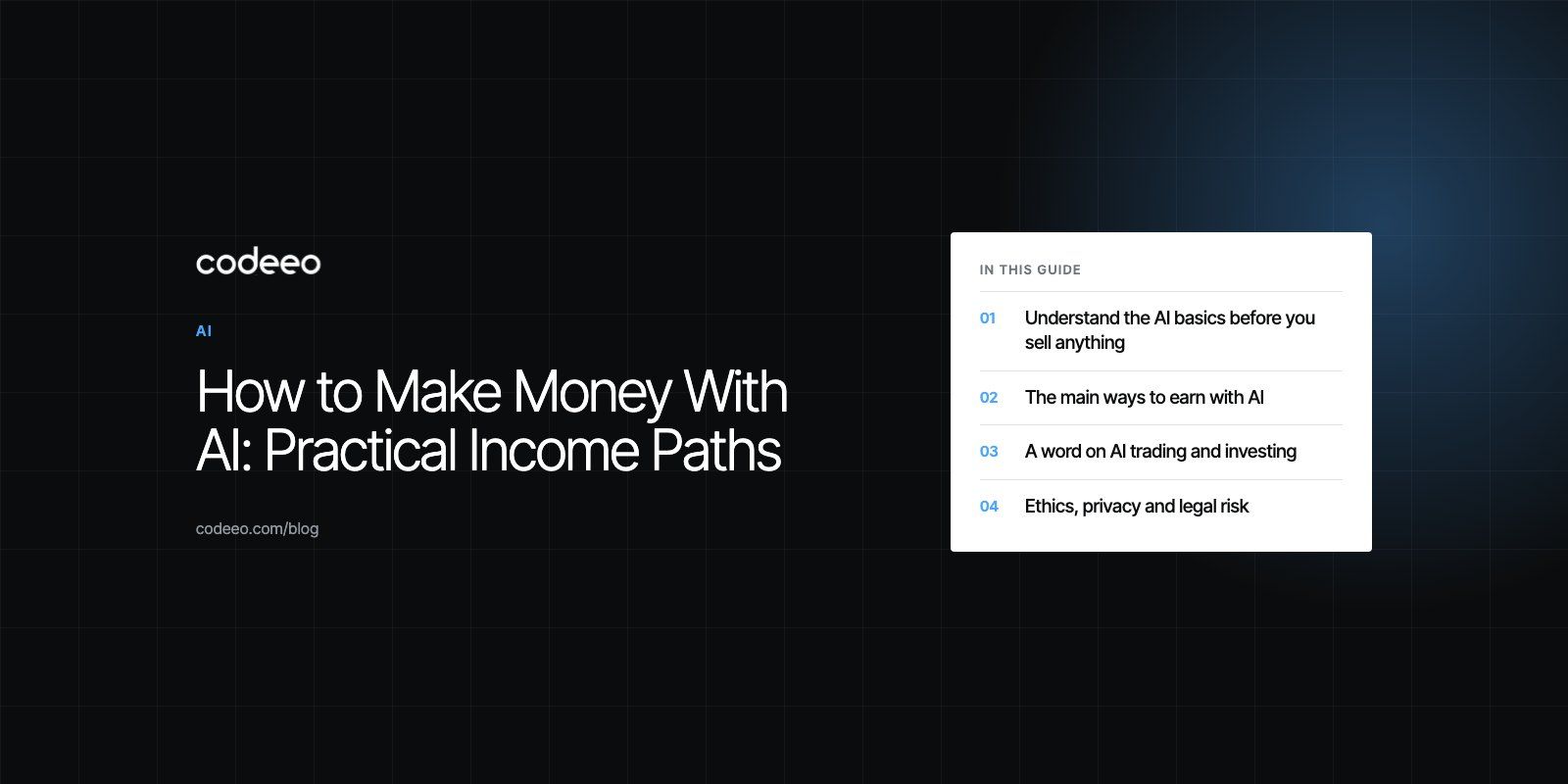
You make money with artificial intelligence in two broad ways: by selling AI skills or AI powered products to people who need them, or by using AI inside an existing business to cut costs and win more customers. The reliable routes are freelancing and consulting, building a focused AI product, data and analytics services, and AI assisted content or marketing work. Schemes that promise automatic income, especially AI trading bots, carry real risk and deserve a lot of skepticism.
This guide covers the basics you need, the income paths that work, what each one takes, and the ethical and legal issues to plan for.
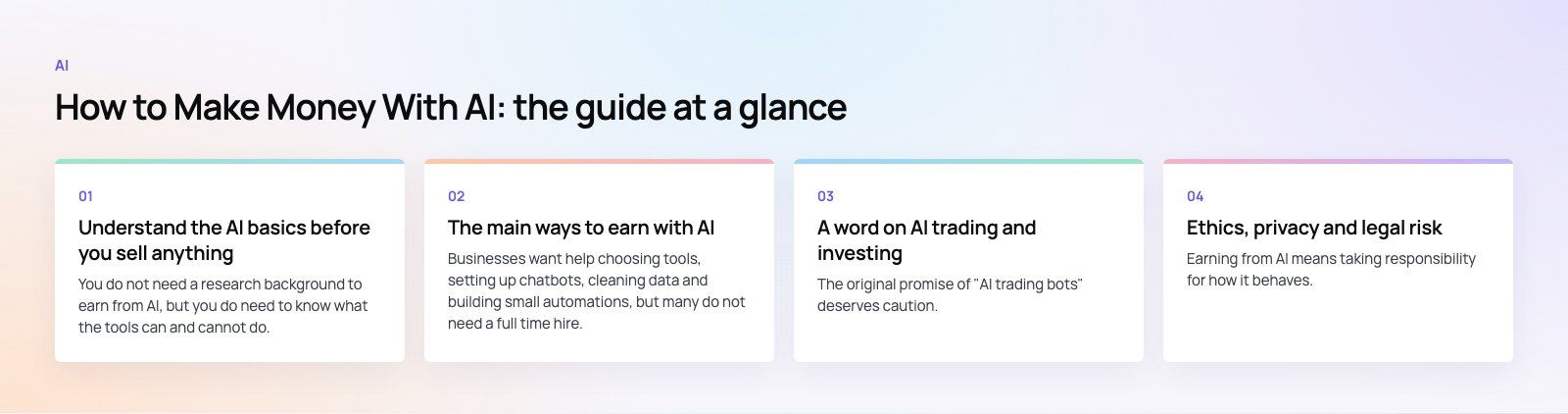
Understand the AI basics before you sell anything
You do not need a research background to earn from AI, but you do need to know what the tools can and cannot do. Clients notice quickly when someone is guessing.
- Machine learning: training algorithms on data so they recognize patterns and make predictions, such as which customers are likely to cancel.
- Deep learning: machine learning with layered neural networks, which handles complex inputs like images, audio and free text.
- Natural language processing: software that reads, writes and summarizes human language. Large language models sit here.
- Computer vision: software that interprets images and video, for tasks like defect detection or document scanning.
Just as important are the limits. Models make confident mistakes, reflect the bias in their training data, and can leak sensitive information if they are set up carelessly. Knowing this is what separates useful AI work from demos.
The main ways to earn with AI
| Path | Who it suits | What you need | Main risk |
|---|---|---|---|
| Freelancing and consulting | People with AI or data skills | Portfolio, niche, client communication | Uneven income, scope creep |
| AI powered product | Founders and product teams | A real problem, development budget, distribution | Building something nobody pays for |
| Data and analytics services | Analysts and engineers | Statistics, data tools, domain knowledge | Poor client data quality |
| AI assisted content and marketing | Writers, designers, marketers | Editorial judgment, a niche audience | Thin, low quality output |
| AI inside your own business | Business owners | Clear processes worth automating | Automating the wrong thing |
Freelancing and consulting
Businesses want help choosing tools, setting up chatbots, cleaning data and building small automations, but many do not need a full time hire. That gap is where freelancers and consultants earn.
- Pick a niche: "AI for accounting firms" or "support automation for online stores" is easier to sell than general AI help.
- Show finished work: a short write up of two or three projects, with the problem, approach and result, beats a long list of skills.
- Use the right channels: freelance marketplaces help early on, but referrals and direct outreach to your niche usually bring better clients.
- Scope tightly: agree on inputs, outputs and what "done" means before you start, because AI projects can drift.
Building an AI powered product
Products scale better than hours, but they take more upfront effort. The pattern that works is narrow and practical: a tool that drafts property listings, an app that reads receipts into a bookkeeping system, or a feature that recommends products in a store.
- Find a costly, repeated problem. Talk to the people who have it and confirm they would pay to remove it.
- Prototype quickly. Use existing model APIs before considering training your own model.
- Measure quality. Build a small test set and check output accuracy before every release.
- Plan distribution early. A good product with no route to buyers earns nothing.
- Watch running costs. Model usage fees grow with users, so price your product with that in mind.
Most of the work in an AI product is ordinary software: sign up, billing, data storage, admin screens and a mobile app or web front end. The model is one component among many.
Data science and analytics services
Plenty of companies sit on sales, operations and customer data they never analyze. If you can clean that data, find patterns and present them clearly, you can sell forecasting, segmentation and reporting work. Dashboards built in tools such as Power BI are often the deliverable clients understand best, with models running behind them.
AI assisted content and marketing
AI tools speed up drafting, editing, image creation and ad variations. The money comes from judgment, not volume. Writers and marketers who use AI to research faster and then add real expertise, original examples and careful editing can serve more clients without dropping quality. Publishing large amounts of thin, unedited AI text tends to fail with readers and search engines alike.
Monetization options include client work, affiliate content in a niche you know, digital products such as templates or courses, and advertising on a site that attracts a loyal audience.
Using AI inside your own business
For many owners, the best return is not a new income stream but a lower cost base. Common wins include automated lead follow up, chatbots that answer routine questions, invoice and document processing, and better demand forecasting. Tools for sales automation are often the quickest place to see results because they touch revenue directly.
A word on AI trading and investing
The original promise of "AI trading bots" deserves caution. Building automated strategies is a legitimate field, but it requires deep knowledge of markets, statistics and risk, and past performance in a backtest says little about the future. Regulators have also warned that fraudsters use AI claims to lure investors; an investor alert on the US Securities and Exchange Commission's Investor.gov site about artificial intelligence and investment fraud describes the common patterns. This article is not financial advice. If you explore this area, treat it as research, speak to a licensed adviser, and never risk money you cannot afford to lose.
Build the skills that earn
- Hands on projects: build small tools yourself, from raw data to a working interface.
- Courses and certificates: useful for structure, but pair each with a project you can show.
- Networking: join communities, meetups and online groups in your niche. Many AI jobs come through people who have seen your work.
- Business basics: pricing, proposals and contracts matter as much as technical skill once you sell your services.

Ethics, privacy and legal risk
Earning from AI means taking responsibility for how it behaves. Plan for these issues from the start:
- Privacy and security: know where client data goes when you send it to a model provider, and keep personal data out of prompts unless you have a lawful basis and proper safeguards.
- Bias and fairness: test outputs across different groups, especially for hiring, lending or pricing decisions.
- Accuracy: keep a human review step wherever a wrong answer could cause harm.
- Intellectual property: check the terms of the tools you use and be clear with clients about who owns the output.
- Effect on jobs: be honest with clients and staff about what automation will change.
The NIST AI Risk Management Framework is a free, practical reference for thinking through these risks in a structured way, whatever country you work in.
Where to start this week
- Pick one path from the table above that matches your skills.
- Choose a narrow niche and list five real problems people in it face.
- Build one small solution for one of those problems.
- Show it to people in that niche and ask what they would pay for.
If your plan is a full AI product rather than a side project, Codeeo's custom software team builds AI features into complete web and mobile products, and a product scoping session is a sensible first step to test the idea before you commit a full budget.
Frequently asked questions
For most people, the easiest route is to apply AI tools to a skill they already sell.
A writer can research and draft faster, a designer can produce more concepts, and an analyst can automate reporting. That raises output without learning a new trade. Building a product or starting a consultancy can earn more over time, but it takes longer to pay off.
AIPredictive HR Analytics: How to Forecast Workforce TrendsHow predictive HR analytics forecasts hiring, turnover and skills needs, how to start with your own data, and when to build a custom tool or buy one. AIHow Dubai Police Uses AI to Improve Public ServicesHow Dubai Police uses AI for minor accident reports, vehicle history checks and the Amna virtual officer, and what UAE businesses can learn from it.
 AIHow to Add a Chatbot to Your Website in 5 StepsAdd a chatbot to your website in five steps: choose its job, set KPIs, map users and flows, build and install the script, then target and improve it.
Tell us what the business needs. We will tell you what to build first.
Schedule a free consultation and get a written recommendation, with costs, before you commit to anything.
Get in touchPROVEN RESULTS
4.7 / 5verified reviews on Google