 App DevelopmentCross Platform App Development: How It Saves Time and MoneyHow shared code across iOS and Android cuts build and maintenance effort, which frameworks to consider in 2026, and when native development is still the better call.
How Much Does It Cost to Develop an iOS App?
What decides the cost of an iOS app: complexity, design, backend, integrations, testing and team, how the budget splits, and how to keep spending under control.
The cost to develop an iOS app depends on how complex the app is, how much custom design it needs, what backend it relies on and who builds it. A simple app with a few screens and no server is at the low end; an app with accounts, payments, real time features and a custom backend costs many times more. Plan for ongoing maintenance as well, because every iOS release and new device means updates.
Below we break down each cost factor, show how the budget splits across a typical project and explain when a custom iOS app is worth it.
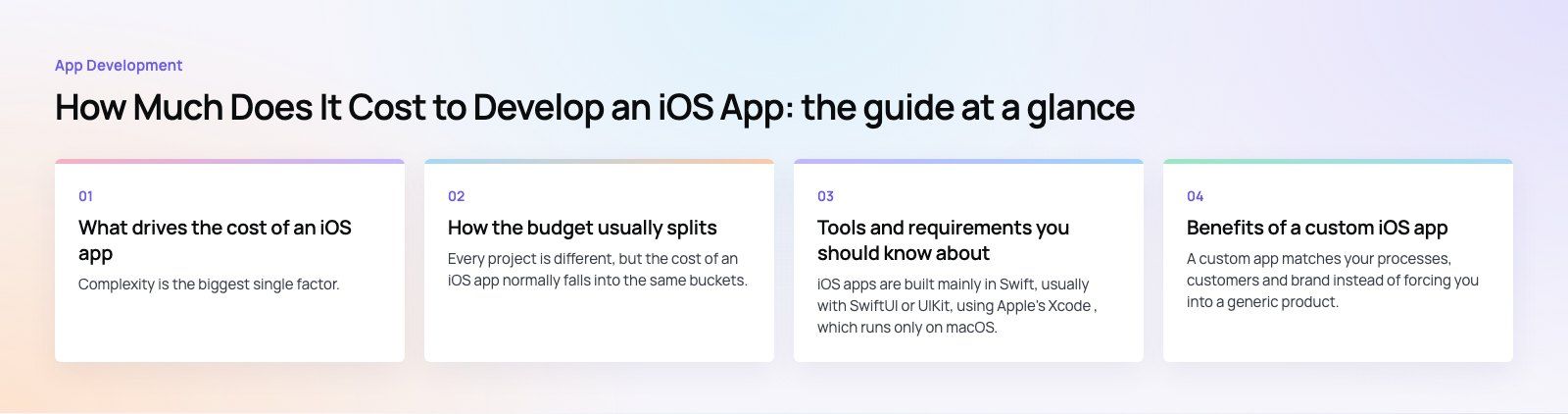
What drives the cost of an iOS app
App complexity
Complexity is the biggest single factor. An app that displays information or collects a simple form is quick to build. Real time chat, live tracking, payments, offline sync, augmented reality or hardware connections each add weeks of design, development and testing.
Design and user experience
Apps that follow Apple's standard components are faster to design and build. Custom interfaces, animations and interactive elements need more design work, more engineering and more testing across screen sizes. Good design is not optional, though; an app that is confusing gets deleted. Our product design team plans flows before a single screen is polished.
Number of features
Each feature is a small project: sign in, profiles, push notifications, in app purchases, social sharing, search, settings. A long feature list at launch is the most common reason budgets overrun. Building a focused first version and adding features from real usage is cheaper and less risky.
Backend development
Most apps need a backend: servers, a database, APIs and an admin panel for your team. A backend with complex data processing, real time sync or heavy traffic costs more to build and to host. Some apps can use managed backend services; others need a custom API.
Third party integrations
Payment gateways, maps, analytics, CRM, messaging and identity services each need integration work and testing, and some carry their own license or usage fees.
For example, Purpose Payment is a payments app where every purchase sends a share to the customer's chosen charity and earns reward points, delivered as an app, portals and an API. Apps that move money also need careful payment integration and security work.
Testing
Testing covers functionality, performance, security and usability across iPhone models and iOS versions. Apps that handle payments, health data or personal information need deeper testing. Skipping it does not save money; it moves the cost to bad reviews and emergency fixes.
Team expertise and location
Experienced iOS developers and specialist teams charge more, but usually ship faster and with fewer defects. Rates differ widely by region, with North America and Western Europe typically the most expensive. What matters is the total cost to a working, maintainable app, not the hourly rate.
Timeline
A tight deadline often means adding developers or working in parallel, which raises cost. A realistic timeline with clear milestones is usually cheaper.
Compliance and security
Apps that store personal, health or financial data must meet rules such as GDPR in Europe or HIPAA in US healthcare, as well as Apple's own privacy requirements. Encryption, secure storage, consent flows and audit logs add to scope.
Maintenance and updates
Apple releases a major iOS version every year, and new devices appear regularly. Apps need updates to stay compatible, fix bugs and meet changing App Store rules. Treat maintenance as a yearly cost from the start.
How the budget usually splits
Every project is different, but the cost of an iOS app normally falls into the same buckets. This table shows what each covers and how its share changes with complexity.
| Area | What it covers | Share of budget as complexity grows |
|---|---|---|
| Discovery and scoping | Requirements, user flows, technical plan | Small but essential at every level |
| UI and UX design | Wireframes, prototypes, final screens | Grows with custom interfaces and animation |
| iOS development | Swift code, screens, device features | Usually the largest share |
| Backend and admin | Server, database, APIs, admin panel | Grows sharply with real time and data heavy apps |
| Testing and QA | Functional, performance, security and device testing | Grows with payments, health or personal data |
| Maintenance | Updates, fixes, iOS compatibility, monitoring | Ongoing every year after launch |
Simple, moderate and complex apps
- Simple app: a handful of screens, standard interface, little or no backend. Examples: a calculator, a content viewer, a basic form.
- Moderately complex app: user accounts, custom interface, a backend and a few integrations. Examples: a booking app, a loyalty app, a diary with reminders.
- Complex app: real time features, payments, extensive backend, custom animation and often a companion web app. Examples: marketplaces, fintech apps, on demand delivery.
The fastest way to place your idea is a short scoping exercise. Our product scoping quick start turns an idea into a feature list and a build plan you can price.
Tools and requirements you should know about
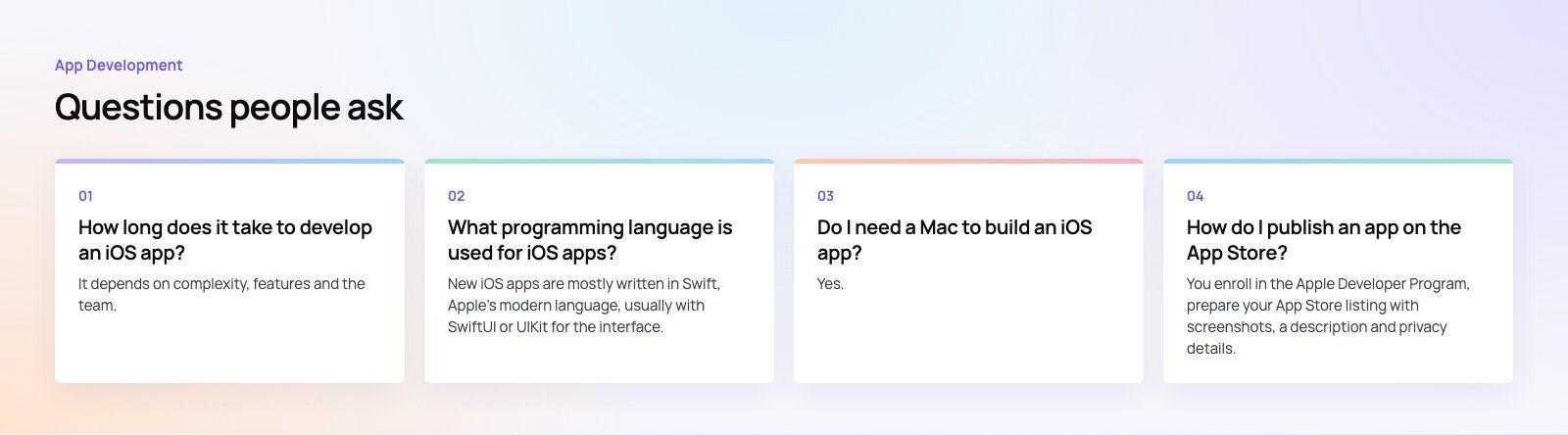
iOS apps are built mainly in Swift, usually with SwiftUI or UIKit, using Apple's Xcode, which runs only on macOS. To publish, you need a membership in the Apple Developer Program, and every release must pass review against the App Store Review Guidelines. Plan time for review in your launch schedule, especially for a first submission.
Benefits of a custom iOS app
Built around your business
A custom app matches your processes, customers and brand instead of forcing you into a generic product. Every screen can support a specific goal, from bookings to repeat orders.
A better user experience
Designing for your audience lets you remove friction: fewer steps, clearer navigation and features people actually use. That drives retention, which is what makes an app pay back.
A competitive edge
Off the shelf apps look and work like everyone else's. A custom app can offer features competitors do not have and can change quickly when the market does.
Room to scale
A well architected app can handle more users, more features and new markets without a rebuild.
Stronger security
You decide how data is encrypted, stored and accessed, and you can design for the regulations that apply to your industry.
Integration with your systems
A custom app can connect directly to your CRM, ERP, booking or payment systems so data flows without manual work.
Ways to control the cost
- Launch a focused first version with the features that deliver the core value.
- Use standard iOS components where custom ones add little.
- Decide early whether you also need Android, and consider a cross platform approach if you do.
- Agree a clear scope and change process before development starts.
- Budget for maintenance from day one so the app does not fall behind iOS updates.
Talk to an iOS team
Codeeo has delivered 200+ projects across the UAE and the US, with a team of 80+ across Dubai, Riyadh and Karachi. If you are planning an iOS app, our mobile app development team can scope it, design it and build it, and our case studies show the kinds of apps we ship.
Frequently asked questions
It depends on complexity, features and the team.
A simple app can take a few weeks to a couple of months. A moderately complex app with a backend often takes several months, and a complex app with payments, real time features and a web companion can take six months or more. Clear scope and fast feedback from your side shorten the timeline more than anything else.
App DevelopmentCross Platform App Development: How It Saves Time and MoneyHow shared code across iOS and Android cuts build and maintenance effort, which frameworks to consider in 2026, and when native development is still the better call. App DevelopmentHow to Plan an App Development Project From Start to FinishA step by step plan for an app project: define users and goals, scope an MVP, choose platforms, design, build the team, phase the timeline, test and launch.
 App DevelopmentMust Have Features of an HR Management AppThe features an HR management app needs, from onboarding and self service to payroll, performance and analytics, plus when to buy or build.
Tell us what the business needs. We will tell you what to build first.
Schedule a free consultation and get a written recommendation, with costs, before you commit to anything.
Get in touchPROVEN RESULTS
4.7 / 5verified reviews on Google