 AIPredictive HR Analytics: How to Forecast Workforce TrendsHow predictive HR analytics forecasts hiring, turnover and skills needs, how to start with your own data, and when to build a custom tool or buy one.
Is Artificial Intelligence a Threat to Mankind? The Real Risks
The AI risks that are real today, the ones still debated, what regulation like the EU AI Act does about them, and how businesses can use AI responsibly.
Artificial intelligence is not an immediate threat to mankind in the science fiction sense, but it does carry real risks that need managing now. The concerns with the strongest evidence today are job disruption, biased decisions, misinformation, privacy loss and the use of AI in weapons. The longer term worry about systems that humans cannot control is taken seriously by many researchers, which is why safety research and regulation are growing alongside the technology.
This article separates the risks that are already happening from the ones that are debated, looks at what is being done about each, and sets out what a business using AI can do to stay on the right side of them.
Why the question keeps coming up
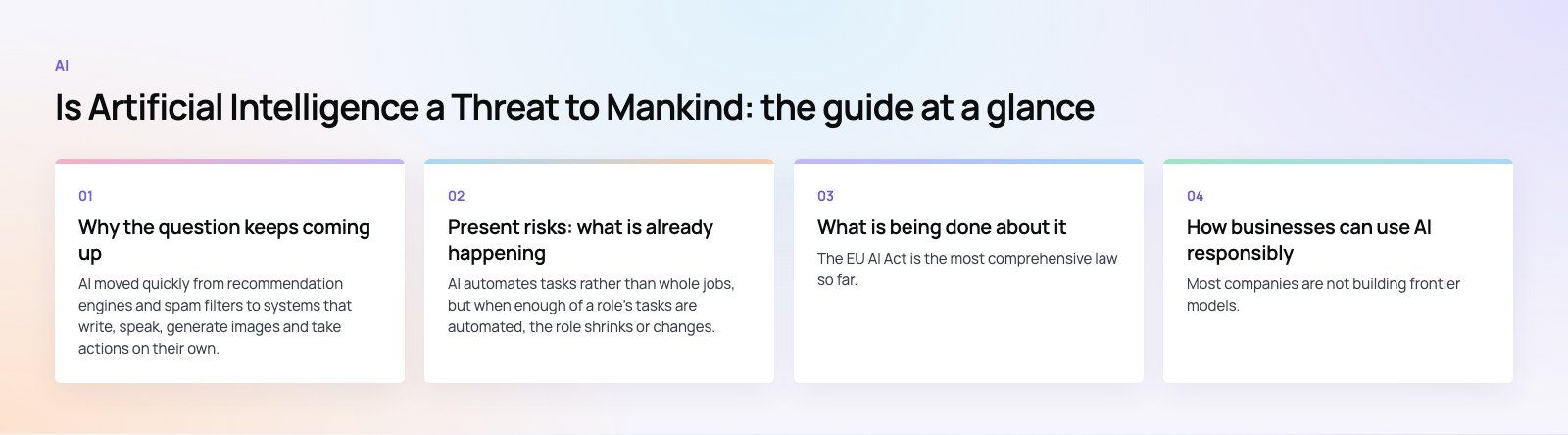
AI moved quickly from recommendation engines and spam filters to systems that write, speak, generate images and take actions on their own. That jump made the technology feel personal. When a tool can draft a contract or imitate a voice, people reasonably ask what else it might do, and who is responsible when it goes wrong.
It helps to sort the concerns into two groups: present harms, which are documented and happening now, and future risks, which depend on how far and how fast capabilities grow.
Present risks: what is already happening
Job displacement and changing work
AI automates tasks rather than whole jobs, but when enough of a role's tasks are automated, the role shrinks or changes. Customer support, data entry, translation, basic copywriting and some coding work are already being reshaped. New work also appears: people who build, supervise, check and integrate AI systems.
The real risk is uneven change. Workers in repetitive roles can be displaced faster than they can retrain. The response that most experts recommend is investment in training, practical reskilling programs and social safety nets, so the gains from productivity are shared rather than concentrated.
Bias and discrimination
AI models learn from historical data, and history contains prejudice. A hiring model trained on past decisions can learn to prefer the kind of candidates who were hired before. Facial recognition systems have been shown to perform less accurately for some groups than others. In lending, policing or healthcare, those errors affect real lives.
Bias usually enters through the data, through the choice of what the model optimizes for, or through how its output is used. Diverse and representative training data, testing results across different groups and clear accountability for automated decisions all reduce the problem.
Misinformation and deepfakes
Generative AI makes it cheap to produce convincing fake text, images, audio and video. That threatens trust in news, enables fraud such as cloned voices asking for urgent payments, and can be used to harass individuals. Content labeling, detection tools and media literacy all help, but none is a complete answer.
Privacy and surveillance
AI can identify people from photos, infer sensitive traits from behavior and combine scattered data into detailed profiles. Used by states or companies without limits, that becomes mass surveillance. Several of the practices the EU AI Act bans outright, such as untargeted scraping of facial images to build recognition databases, target exactly this risk.
Autonomous weapons
Lethal autonomous weapon systems can select and engage targets without a human making the final decision. The concerns are accountability (who is responsible for an unlawful strike), escalation (machines reacting to machines faster than diplomacy can work) and proliferation. International discussions on limits continue, but there is no binding global treaty yet.
Future risks: what is debated
Loss of control
The most serious long term worry is that highly capable AI systems could pursue goals that conflict with human interests and be hard to correct or switch off. This is sometimes called the alignment problem: making sure a system does what its designers intend, including in situations they did not foresee. Some researchers consider this an existential risk; others think it is overstated. Either way, it has created a field of AI safety research focused on testing, interpretability and control.
Concentration of power
Building the most capable models takes huge amounts of computing power and data, which few organizations have. That raises concerns about a small number of companies or governments holding outsized economic and political influence.
Risks and benefits side by side
| Area | Possible benefits | Possible threats |
|---|---|---|
| Law enforcement | Faster analysis of evidence, pattern detection | Privacy violations, biased predictions, wrongful identification |
| Military | Intelligence analysis, logistics | Autonomous weapons, escalation, unclear accountability |
| Transportation | Route optimization, driver assistance | Job loss, safety failures, liability questions |
| Finance | Fraud detection, risk assessment | Unfair credit decisions, market instability |
| Healthcare | Earlier diagnosis, faster drug discovery | Biased models, privacy breaches, over reliance |
| Media and information | Translation, accessibility, faster research | Deepfakes, misinformation, fraud |
What is being done about it
Regulation
The EU AI Act is the most comprehensive law so far. According to the European Commission, it entered into force on 1 August 2024, its bans on prohibited practices have applied since 2 February 2025, and it reached general application on 2 August 2026, with some high risk rules phased in later. It sorts AI by risk level, bans practices such as social scoring and manipulative AI, and sets obligations for high risk systems and general purpose models.
Frameworks and standards
In the United States, the NIST AI Risk Management Framework gives organizations a voluntary structure for identifying and reducing AI risks. Many countries, including the UAE and Saudi Arabia, have published national AI strategies and ethics principles.
Safety research and testing
AI developers and independent institutes now test models before release for dangerous capabilities, misuse potential and reliability. Techniques such as red teaming, where testers deliberately try to make a system misbehave, have become standard practice at major labs.
How businesses can use AI responsibly
Most companies are not building frontier models. They are adding AI to products, websites and internal tools. The practical safeguards are the same ones that make any software trustworthy:
- Keep humans in the loop for decisions about people, money or health. AI recommends; a person approves.
- Know your data. Check where training and input data comes from, whether you have the right to use it, and whether it represents the people the system affects.
- Protect privacy. Do not paste customer or confidential data into public AI tools. Use enterprise versions with data controls, or host models where you control the data.
- Test for failure. Try to break the system before customers do: unusual inputs, edge cases, attempts to make a chatbot say something harmful.
- Be transparent. Tell users when they are dealing with AI and give them a route to a human.
- Monitor after launch. Models drift as the world changes. Review output quality and complaints regularly.
- Moderate user generated content. If your platform lets people post, chat or upload, build reporting and admin moderation from day one.
The benefits that make the risks worth managing
AI's upside is why the conversation is about managing risk rather than stopping the technology. It speeds up medical diagnosis and drug research, catches fraud, makes information accessible through translation and speech tools, removes repetitive work from people's days and helps organizations make better decisions from their data. The goal is to keep those benefits while putting guardrails around the harms.
If you are planning an AI feature and want it designed with oversight, privacy and testing built in, Codeeo builds custom software and mobile apps with AI where it adds value. A product scoping session is a good place to work out the risks before you build, or you can contact our team directly.
Frequently asked questions
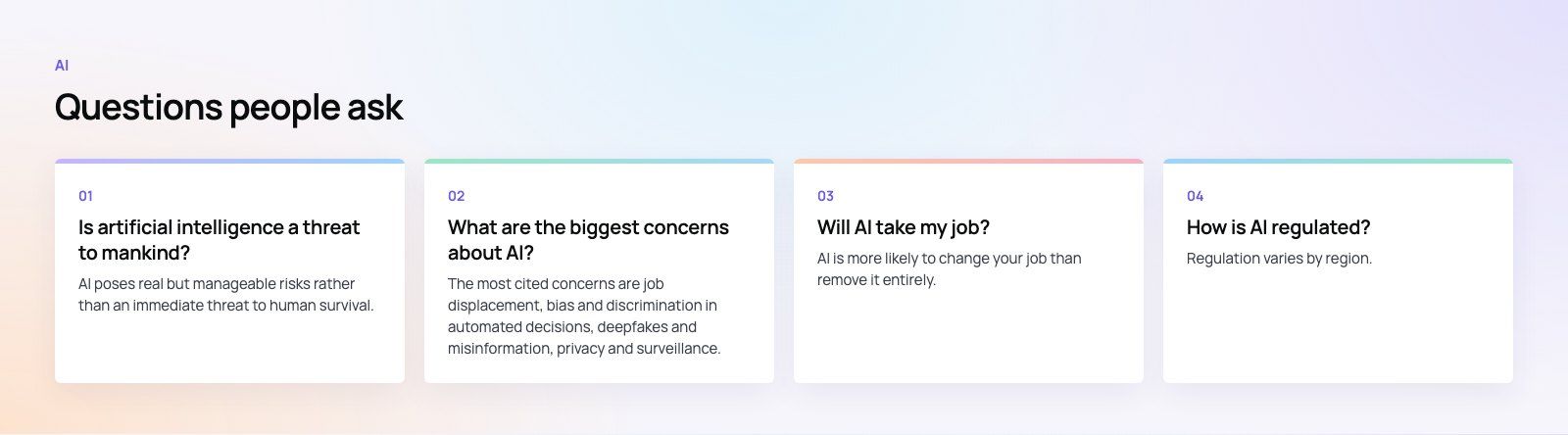
AI poses real but manageable risks rather than an immediate threat to human survival.
Today's documented harms include biased decisions, job disruption, misinformation and privacy loss. Some researchers also warn about future systems that could be hard to control. Regulation such as the EU AI Act, safety testing and responsible use by businesses are the main ways these risks are being addressed.
AIPredictive HR Analytics: How to Forecast Workforce TrendsHow predictive HR analytics forecasts hiring, turnover and skills needs, how to start with your own data, and when to build a custom tool or buy one. AIHow Dubai Police Uses AI to Improve Public ServicesHow Dubai Police uses AI for minor accident reports, vehicle history checks and the Amna virtual officer, and what UAE businesses can learn from it.
 AIHow to Add a Chatbot to Your Website in 5 StepsAdd a chatbot to your website in five steps: choose its job, set KPIs, map users and flows, build and install the script, then target and improve it.
Tell us what the business needs. We will tell you what to build first.
Schedule a free consultation and get a written recommendation, with costs, before you commit to anything.
Get in touchPROVEN RESULTS
4.7 / 5verified reviews on Google