 E-Commerce10 Features of a High-Converting Ecommerce WebsiteThe ten features that turn store visitors into buyers, from product pages and checkout to speed, mobile design, social proof and ongoing testing.
Is Dropshipping Still Profitable? How to Run the Numbers
How dropshipping works, how to test a product's profitability before spending on ads, and the costs that quietly eat into dropshipping margins.
Dropshipping can still be profitable, but only for sellers who pick products with room for a real margin, control what they spend to win each customer, and work with reliable suppliers. The model is cheap to start because you never buy stock upfront, which is exactly why competition is heavy and margins get squeezed. Whether it works for you comes down to the numbers for one specific product, not the model in general.
This guide explains how dropshipping works, how to test profitability before you spend on ads, which product types tend to suit the model, and what eats into margins once a store is running.
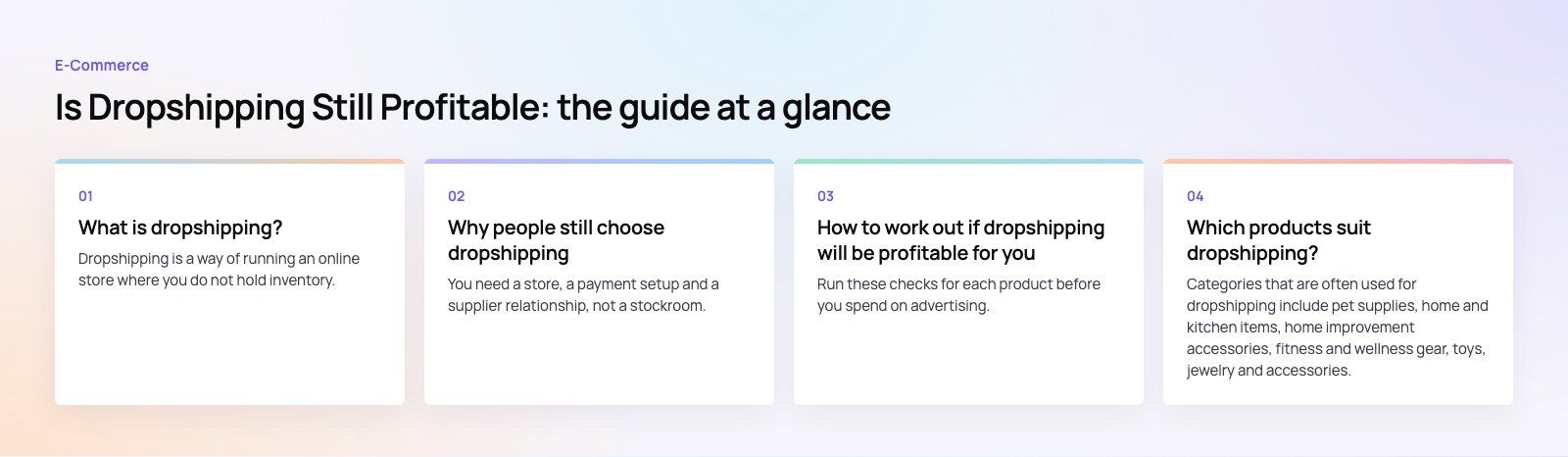
What is dropshipping?
Dropshipping is a way of running an online store where you do not hold inventory. A customer buys from your site, you pass the order to a supplier, and the supplier ships directly to the customer. You earn the difference between your selling price and what the supplier charges, minus every other cost of running the business.
The flow looks like this:
- A customer finds your product and pays you at your price.
- You, or an app connected to your store, send the order to the supplier and pay their wholesale price.
- The supplier packs and ships the order to your customer.
- You keep the margin and handle customer service, returns and marketing.
The appeal is clear: no warehouse, no unsold stock, and you can test a product without buying a container of it. The catch is that you do not control stock levels, packing or delivery times, yet the customer holds you responsible for all three.
Why people still choose dropshipping
Low cost to start
You need a store, a payment setup and a supplier relationship, not a stockroom. That lowers the money you put at risk before your first sale.
Low inventory risk
You buy only after a customer pays, so a product that does not sell costs you the marketing spent on it, not a pile of unsold units.
Easy to test and expand
Adding a product means adding a listing, so you can test demand quickly and drop what does not work. Adding suppliers lets you widen the range without new premises.
Location independence
Because fulfillment sits with the supplier, a small team can run a store from almost anywhere, as long as customer service and supplier communication are covered.
How to work out if dropshipping will be profitable for you
Run these checks for each product before you spend on advertising. A spreadsheet is enough.
1. Calculate your landed cost per order
Add the supplier's product price, the shipping they charge, any packaging or branding extras, payment processing fees, platform or app fees charged per order, and any duties or taxes that apply to your market. This is the true cost of fulfilling one order, before marketing.
2. Set a selling price customers will accept
Look at what competitors charge for the same or similar products, and at what buyers expect for the quality and delivery time you can offer. If the only way to sell is to undercut everyone, the product will not hold a margin.
3. Work out gross margin
Subtract the landed cost from the selling price, divide the result by the selling price, and multiply by 100. That percentage is your gross margin per order. It needs to be large enough to pay for marketing, returns and overheads and still leave profit.
4. Estimate customer acquisition cost
Most dropshipping stores live or die on paid traffic. Estimate how much you will spend in ads, influencer fees or content to win one paying customer. If that figure is close to your gross margin per order, every sale breaks even at best.
5. Add running costs
List the monthly costs that do not depend on order volume: store subscription, apps, hosting, email tools, design, customer service time and any staff. Divide them across the orders you realistically expect.
6. Factor in returns and refunds
Returns are harder in dropshipping because the item often cannot go back to the supplier cheaply. Budget for refunds, replacements and chargebacks as a share of orders, and check each supplier's return terms before listing their products.
7. Watch lifetime value, not just the first sale
A product that just breaks even on the first order can still be worth selling if customers come back. Track repeat purchase rate, average order value and how long customers stay. Consumables and accessories that need replacing usually do better here than one off purchases.
8. Stress test the numbers
Ask what happens if the supplier raises prices, ad costs rise, shipping times stretch or a competitor halves their price. If the product only works in the best case, keep looking.
What eats into dropshipping margins
| Cost or risk | Why it hurts | How to manage it |
|---|---|---|
| Advertising | Often the largest cost, and it rises as more sellers chase the same audience | Build email lists, content and organic search so not every sale is paid for |
| Long or unreliable delivery | Drives refunds, chargebacks and poor reviews | Choose suppliers with local or regional warehouses and test their shipping yourself |
| Returns | Items may be uneconomic to send back | Agree return terms with suppliers in writing and price returns into the margin |
| Price competition | Identical products from the same suppliers appear in many stores | Add value through bundles, better content, faster service or a niche focus |
| Payment and app fees | Small per order charges add up across a month | Review your app stack and remove tools you do not use |
| Supplier stockouts | You sell items the supplier no longer has | Use stock sync apps and keep backup suppliers for best sellers |
Which products suit dropshipping?
Categories that are often used for dropshipping include pet supplies, home and kitchen items, home improvement accessories, fitness and wellness gear, toys, jewelry and accessories, car accessories, garden and patio products, and outdoor sports equipment. Popularity alone is not the test, though. A good dropshipping product usually has:
- A healthy margin after shipping and fees, with room for marketing.
- Light, compact and sturdy items so shipping is affordable and damage is rare. Fragile, heavy or oversized items are hard to make work.
- Clear demand you can reach, such as a defined audience or search terms people actually use.
- Few compliance hurdles. Electrical goods, cosmetics, supplements and children's products often need safety certification or labeling in the destination market.
- Room to differentiate through bundling, branding or better information than other sellers offer.
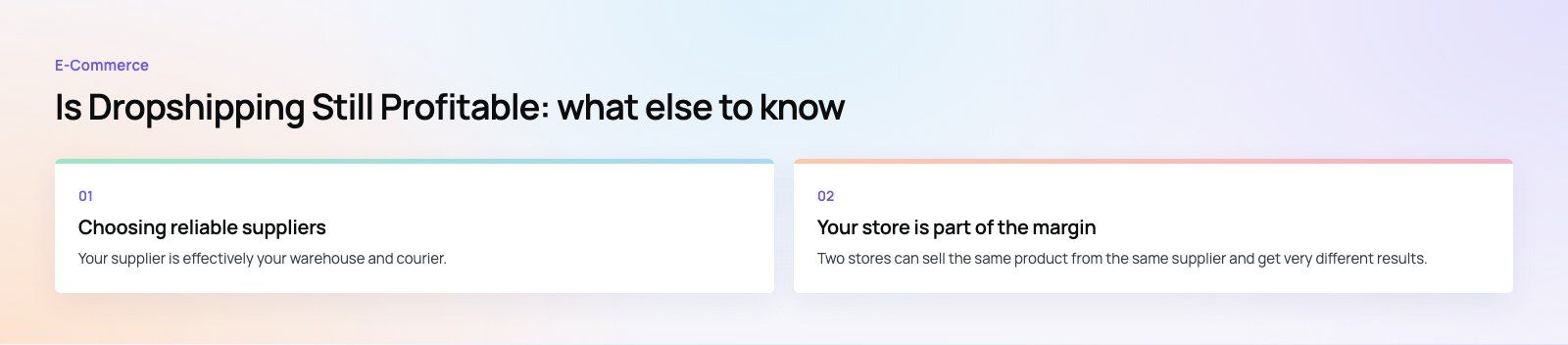
Choosing reliable suppliers
Your supplier is effectively your warehouse and courier. Before committing:
- Order samples to your own address and time the delivery.
- Check how they handle stockouts, damaged goods and returns.
- Ask whether they offer branded or plain packaging and invoices.
- Confirm they can integrate with your store so orders and tracking flow automatically.
- Keep at least one backup supplier for your best selling products.
Be honest with customers about delivery times. Consumer protection rules in many markets set expectations here; in the US, for example, the FTC's Mail, Internet or Telephone Order Merchandise Rule requires sellers to have a reasonable basis for the shipping times they advertise.
Your store is part of the margin
Two stores can sell the same product from the same supplier and get very different results. The difference is usually the store itself: fast pages, clear product information, trust signals, honest delivery estimates and a checkout without friction. A better conversion rate lowers the cost of every customer you acquire, which is often the cheapest way to improve dropshipping profit.
Mistakes that make dropshipping unprofitable
- Choosing a product because it is trending, without checking the margin.
- Scaling ad spend before the store converts well.
- Hiding long delivery times and paying for it in refunds and chargebacks.
- Relying on a single supplier with no backup.
- Ignoring product safety and labeling rules in the target market.
- Copying supplier descriptions and images that dozens of other stores already use.
Profitable dropshipping needs a store that converts. Codeeo builds and improves stores on Shopify and WooCommerce, runs digital marketing that does not depend only on paid ads, and offers a checkout teardown to find where buyers drop off. See our retail and ecommerce work, including the Ghezlan case study.
Frequently asked questions
It can be, because it lowers the money you put at risk: you do not buy stock before you sell it.
But it is not easy money. Beginners still need to learn product research, supplier vetting, store setup, advertising and customer service. Treat the first months as paid learning, test several products with small budgets, and only scale what shows a clear margin after marketing costs.
E-Commerce10 Features of a High-Converting Ecommerce WebsiteThe ten features that turn store visitors into buyers, from product pages and checkout to speed, mobile design, social proof and ongoing testing. E-CommerceBenefits of Using a CMS for Ecommerce WebsitesHow a CMS helps online stores manage products, SEO, growth and security, how it compares with a custom build, and how to choose between WooCommerce, Shopify and headless.
 E-CommerceEcommerce Website Development: 9 Elements Every Store NeedsThe nine parts every online store needs, from catalog data and search to checkout, security, operations and analytics, with what to decide before you build.
Tell us what the business needs. We will tell you what to build first.
Schedule a free consultation and get a written recommendation, with costs, before you commit to anything.
Get in touchPROVEN RESULTS
4.7 / 5verified reviews on Google