 App DevelopmentCross Platform App Development: How It Saves Time and MoneyHow shared code across iOS and Android cuts build and maintenance effort, which frameworks to consider in 2026, and when native development is still the better call.
Logistics App Development Cost: What Drives the Budget
What drives the cost of a logistics app: app types, features per panel, live tracking, integrations, running costs and ways to keep the budget in check.
The cost of a logistics app depends on three things more than anything else: how many separate apps you need (customer, driver, dispatcher, admin), how much real time tracking and routing the product does, and how many outside systems it must talk to. A single tracking app for one warehouse sits at the low end. A multi sided delivery platform with live maps, route optimization, proof of delivery and ERP integration sits at the high end, and it also costs more to run every month.
This guide explains the main types of logistics apps, the features each panel needs, and the decisions that move your budget up or down, so you can scope a build before you ask for quotes.
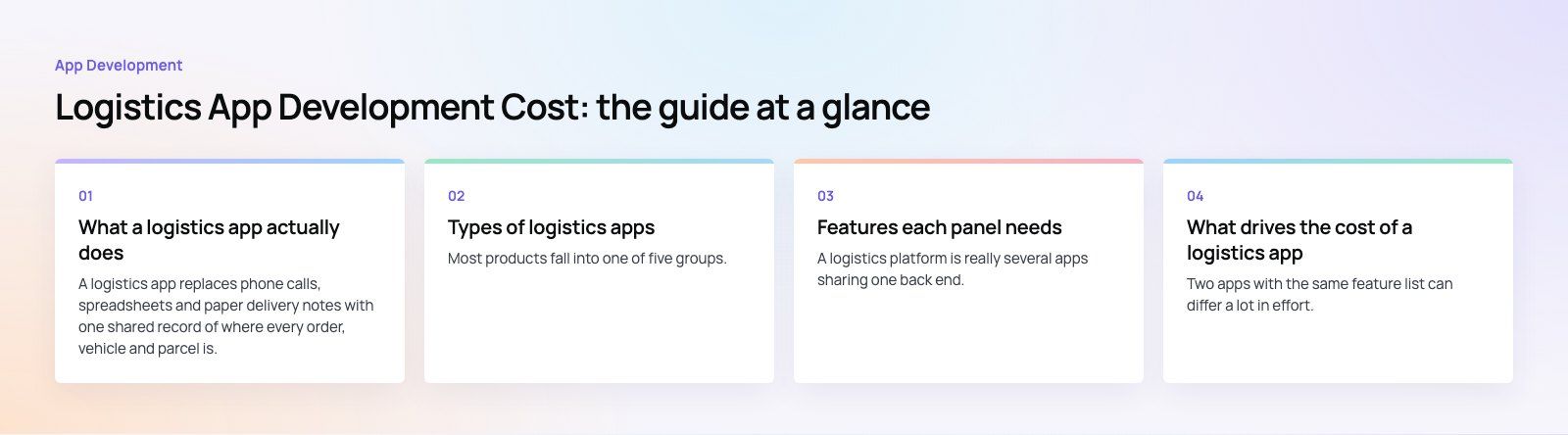
What a logistics app actually does
A logistics app replaces phone calls, spreadsheets and paper delivery notes with one shared record of where every order, vehicle and parcel is. Dispatchers assign jobs, drivers see their route and update status from the road, customers track their delivery, and managers see what happened at the end of the day.
The value comes from fewer manual steps and better information. When a driver marks a drop as complete with a photo and signature, nobody needs to call the customer to confirm it. When the dispatcher can see every vehicle on a map, a late job can be moved to the nearest free driver in minutes rather than after a round of calls.
Types of logistics apps
Most products fall into one of five groups. Many real platforms combine two or three of them, and that combination is the first thing that shapes the budget.
On demand delivery
Customers book a pickup or delivery when they need it, and the platform matches the job to an available driver. This is the most complex type because it needs a customer app, a driver app, live matching, payments and an admin panel working together.
Fleet management
Fleet apps track vehicles rather than parcels: location, mileage, fuel, maintenance schedules and driver behavior. They often pull data from GPS hardware or telematics units already fitted to the vehicles, so integration work is a large share of the effort.
Shipment and asset tracking
These apps follow goods through each stage, from warehouse to hub to final drop. They rely on barcode or QR scanning, status updates and notifications. They are simpler than on demand platforms but need careful data design so every scan lands on the right shipment.
Transportation management systems
A transportation management system plans loads, chooses carriers, books shipments and reconciles invoices. It is usually a web application for planners and finance teams rather than a phone app, and it tends to connect closely with an ERP.
Warehouse and inventory apps
Warehouse apps handle receiving, putaway, picking, packing and stock counts. Handheld scanners and offline support matter here, because warehouse Wi-Fi is rarely perfect.
Features each panel needs
A logistics platform is really several apps sharing one back end. Listing features per panel is the fastest way to see where the work is.
Customer app
- Sign up and login, ideally with OTP by phone
- Booking with pickup and drop addresses, parcel size and vehicle type
- Price estimate before confirming
- Live tracking and arrival time
- Push and SMS notifications at each status change
- In app payment and saved cards
- Order history, receipts and ratings
Driver app
- Registration with document upload and approval
- Online and offline availability toggle
- Accept or reject jobs
- Turn by turn navigation, usually by handing off to a maps app
- Proof of delivery with photo, signature or code
- Earnings and trip history
Dispatcher and admin panel
- Live map of drivers and active jobs
- Manual and automatic job assignment
- Vehicle, driver and zone management
- Pricing rules, invoices and payouts
- Reports on delivery times, failed drops and driver performance
What drives the cost of a logistics app
Two apps with the same feature list can differ a lot in effort. These are the factors that matter most.
| Factor | Lower effort | Higher effort |
|---|---|---|
| Number of apps | One app plus a simple admin | Customer, driver, dispatcher and admin apps |
| Tracking | Status updates at each scan | Continuous live location with background tracking |
| Assignment | Dispatcher assigns manually | Automatic matching and route optimization |
| Platforms | One cross platform codebase | Separate native iOS and Android apps |
| Integrations | Payments and maps only | ERP, accounting, telematics and carrier APIs |
| Offline use | Online only | Full offline mode with sync |
| Languages | One language | Multiple languages, including right to left |
Real time location and routing
Live tracking is the feature people underestimate most. Showing a dot on a map is simple. Keeping it accurate while the app runs in the background, without draining the driver's battery, is not. Both Android and Apple restrict background location access, so the app needs a clear permission flow and careful testing on real devices. Route optimization adds another layer, usually through a service such as the Google Routes API, which is billed per request and becomes a running cost as volume grows.
Integrations
Most logistics businesses already run an ERP, an accounting package or a warehouse system. Every connection needs mapping, error handling and a plan for what happens when the other system is down. If your app has to create invoices, update stock or sync orders, budget for that as its own workstream. Our team covers this kind of work under systems integration and Business Central projects.
Native or cross platform
A cross platform framework such as Flutter or React Native lets one team ship iOS and Android from a single codebase, which usually lowers both build and maintenance effort. Native apps make sense when the driver app leans heavily on background location, Bluetooth scanners or other device features where you want full control.
Design and testing
Drivers use the app with one hand, in sunlight, between stops. Large touch targets, clear status buttons and minimal typing make a real difference to adoption. Testing should cover poor signal, app restarts mid delivery and older phones, because that is how the app will be used.
Running costs after launch
The build is only part of the budget. A logistics app keeps costing money every month, and these lines should be in your plan from the start:
- Cloud hosting and databases, which grow with the number of location updates you store
- Maps, routing and geocoding APIs, usually charged per request
- SMS and push notifications
- Payment processing fees
- App store developer accounts
- Maintenance: operating system updates, security patches, bug fixes and small improvements
One issue we often see is a platform that stores every GPS ping forever. Deciding early how long to keep raw location data, and summarizing old trips, keeps hosting costs under control.
How to keep the budget under control
- Start with the panel that removes the most manual work. For many businesses that is the driver app with proof of delivery, not the customer app.
- Launch with manual dispatch. Automatic matching can come later, once you have real data on how jobs flow.
- Use proven services for maps, payments and notifications rather than building your own.
- Agree on a written scope with screens, user roles and integrations before development starts. A product scoping session is a cheap way to get this right.
- Plan the roadmap in phases so each release is useful on its own.
How long a logistics app takes
Timelines follow the same factors as cost. A focused tracking or proof of delivery app can be designed, built and tested in a few months. A full on demand platform with several apps, payments and integrations usually takes considerably longer, plus a pilot period with a small group of real drivers before wider rollout.
Ways to make money from a logistics app
If the app is a product rather than an internal tool, the common models are:
- A commission on each delivery booked through the platform
- Subscriptions for businesses that use the platform to manage their own fleet
- Premium features such as advanced analytics or API access
- Delivery fees charged to customers, with surge rules at busy times
Codeeo has delivered 200+ projects across the UAE and the US, including multi sided apps such as Teachers Lunch, a food ordering platform with customer and rider apps and an admin that sees the whole day. If you are planning a logistics or delivery product, our mobile app development team can help you scope it in phases and estimate it properly.
Frequently asked questions
The number of separate apps and the depth of real time tracking.
A platform with customer, driver, dispatcher and admin apps is several products sharing a back end. Live background location, route optimization and automatic job matching add significant work on top, and they also create ongoing costs for maps and hosting that grow as delivery volume increases.
App DevelopmentCross Platform App Development: How It Saves Time and MoneyHow shared code across iOS and Android cuts build and maintenance effort, which frameworks to consider in 2026, and when native development is still the better call. App DevelopmentHow to Plan an App Development Project From Start to FinishA step by step plan for an app project: define users and goals, scope an MVP, choose platforms, design, build the team, phase the timeline, test and launch.
 App DevelopmentMust Have Features of an HR Management AppThe features an HR management app needs, from onboarding and self service to payroll, performance and analytics, plus when to buy or build.
Tell us what the business needs. We will tell you what to build first.
Schedule a free consultation and get a written recommendation, with costs, before you commit to anything.
Get in touchPROVEN RESULTS
4.7 / 5verified reviews on Google