 App DevelopmentCross Platform App Development: How It Saves Time and MoneyHow shared code across iOS and Android cuts build and maintenance effort, which frameworks to consider in 2026, and when native development is still the better call.
How Much Does It Cost to Develop a Mobile App?
What really drives mobile app development cost, from features and platforms to design, team model and maintenance, plus how to estimate and reduce it.
The cost to develop a mobile app depends mainly on how many features it has, how complex those features are, which platforms it runs on, how custom the design is and who builds it. A simple app with a few screens and no backend costs a fraction of a marketplace with payments, chat and an admin panel. The most reliable way to get a real number is to list your features, estimate each one and add maintenance from day one.
This guide explains each cost driver, how to estimate your own project and practical ways to spend less without cutting what matters.
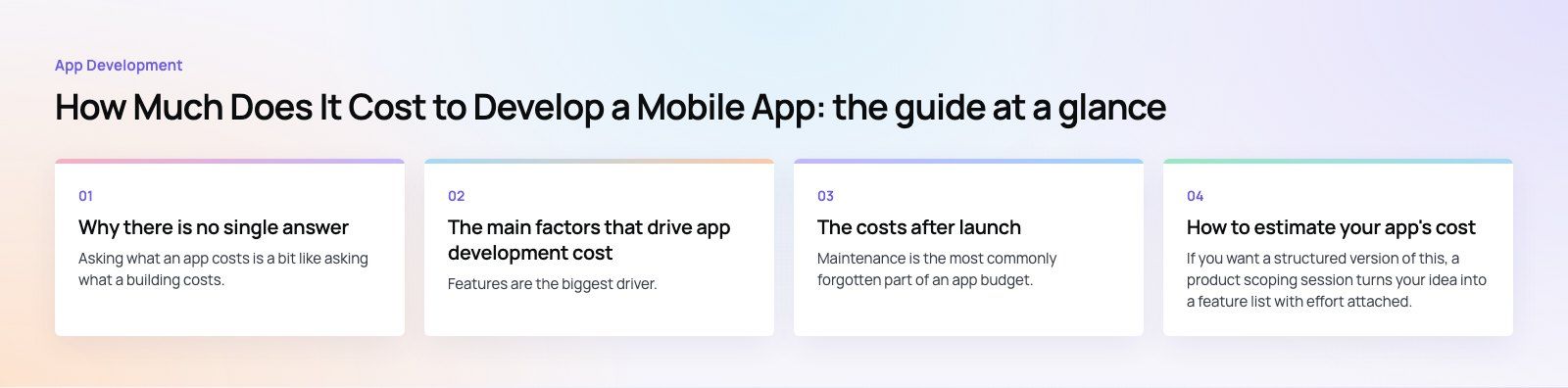
Why there is no single answer
Asking what an app costs is a bit like asking what a building costs. A garden shed and an office tower are both buildings. Apps vary just as widely, and two quotes for the "same" app can differ because the vendors have assumed different scope, quality levels and team locations. Understanding the drivers lets you compare quotes properly and make trade offs on purpose.
The main factors that drive app development cost
1. Features and complexity
Features are the biggest driver. Every feature needs design, front end work, often backend logic, testing and ongoing maintenance. It helps to think in three broad tiers.
| Tier | Typical features | What adds effort |
|---|---|---|
| Simple | A handful of screens, sign in, static or lightly dynamic content, push notifications | Little backend, standard UI components |
| Mid level | User profiles, API integrations, payments, search, real time messaging, an admin panel | Backend services, third party integrations, more states to test |
| Complex | Marketplaces, live tracking, video or media processing, AI features, offline sync, multiple user roles | Real time infrastructure, scalability, security, several apps in one product |
A marketplace is often several products in one: a customer app, a provider app and an admin. For example, the Teachers Lunch case study involved a customer app, a rider app, restaurant menus, payments and an admin that sees the whole day. Each of those is a separate piece of work.
2. Platform choice
You can build native apps for iOS and Android separately, or use a cross platform framework such as Flutter or React Native to share most of the code. Native development gives the fullest access to device features and the most polished platform feel, but you maintain two codebases. Cross platform usually lowers cost and time for most business apps, with some extra work for advanced device features. A progressive web app is cheaper again but has limits on device access and app store presence.
3. Design depth
Design covers user experience (research, flows, wireframes, usability testing) and user interface (visual style, components, animations). A basic design uses standard components with brand colors. A custom design adds tailored layouts and a component library. A high end design adds detailed animation, illustration and repeated user testing. Each step up adds weeks of design time and more front end work to build it.
4. Backend and integrations
Most apps that do anything useful need a backend: an API, a database, authentication and an admin panel. Integrations with payment gateways, maps, CRMs, ERPs or government services each add design, development and testing. Integrations with older or poorly documented systems take longer than expected far more often than the reverse.
5. Who builds it
Your team model shapes the cost structure as much as the scope does.
| Option | Strengths | Watch out for |
|---|---|---|
| In house team | Full control, deep product knowledge, long term ownership | Salaries and benefits continue between projects; hiring takes time |
| Agency or development company | A complete team from day one, established process, easier to scale | Needs clear scope and good communication; check who owns the code |
| Freelancers | Flexible for small, well defined pieces of work | Coordination falls on you; availability and continuity risks |
| Dedicated developers | An extension of your team without full hiring overhead | You still need product management and technical direction |
Rates vary widely by region and seniority, so compare the total effort and the team's experience, not only hourly rates.
6. Security and compliance
Apps that handle payments, health data or personal information need secure authentication, encryption, audit logs and sometimes formal reviews. This is non negotiable work that should be in the estimate from the start, not added later.
The costs after launch
Maintenance is the most commonly forgotten part of an app budget. Plan for these from the beginning:
- Bug fixes as real users find edge cases on devices you did not test.
- Operating system updates. Apple and Google release new versions every year, and apps need updates to stay compatible and meet store rules.
- Security patches for your code and the libraries it depends on.
- Infrastructure such as hosting, databases, storage, notifications and third party APIs, which grow with your user base.
- Store accounts. Publishing requires an Apple Developer Program membership and a Google Play developer account, and Apple and Google take a share of some in app sales.
- New features and user support, which keep the app competitive once people start using it.
How to estimate your app's cost
- Write down who the users are and what each must do. One sentence per user role is enough to start.
- List features and break them down. Feature based estimation, where each feature is estimated separately for design, front end, backend and testing, is the most practical method for most projects.
- Benchmark. Look at similar apps and note which features they have and which you can skip in version one.
- Add the hidden work. Project management, QA, deployment, analytics and app store submission all take time.
- Add contingency. Identify risks such as unclear integrations and add a buffer for them.
- Track as you go. Tools such as Jira or Trello make it easy to compare estimates with actual effort and adjust early.
If you want a structured version of this, a product scoping session turns your idea into a feature list with effort attached.
How to reduce mobile app development cost
- Start with an MVP. Launch the smallest version that solves the core problem, then add features based on real usage.
- Prioritize ruthlessly. Sort features into must have, should have and later. Most first versions carry too many "should haves".
- Use cross platform where it fits. One shared codebase for iOS and Android cuts build and maintenance effort for most business apps.
- Use proven services. Managed cloud services for authentication, storage and notifications are cheaper than building your own.
- Build in iterations. Short cycles with regular demos catch misunderstandings before they become expensive rework.
- Automate testing and deployment. CI/CD reduces manual effort and release errors over the life of the app.
- Keep scope changes visible. Every new request should come with its effort and impact on the timeline.
Getting a realistic quote
The best quotes come from clear inputs: user roles, a feature list, any integrations, your platforms and your launch date. Codeeo has delivered more than 200 projects across the UAE and the US, with a team of 80+ across Dubai, Riyadh and Karachi. See our mobile app development service, browse the case studies, or get in touch with your feature list for an estimate.
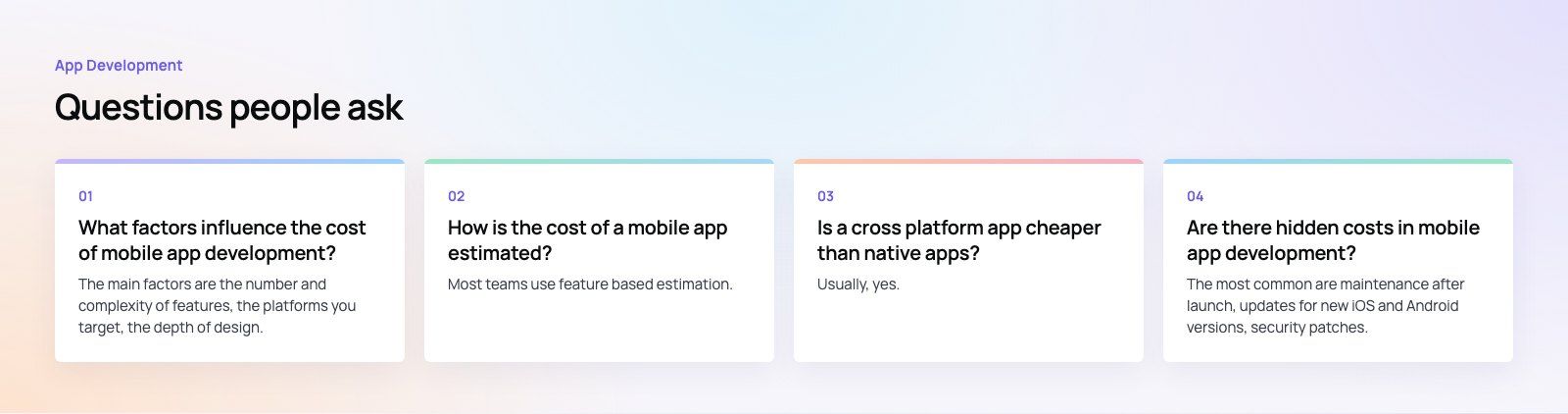
Frequently asked questions
The main factors are the number and complexity of features, the platforms you target, the depth of design, the backend and integrations required, security and compliance needs and the team model you choose.
Ongoing costs such as maintenance, hosting and operating system updates also add to the total cost of ownership and should be planned from the start rather than discovered after launch.
App DevelopmentCross Platform App Development: How It Saves Time and MoneyHow shared code across iOS and Android cuts build and maintenance effort, which frameworks to consider in 2026, and when native development is still the better call. App DevelopmentHow to Plan an App Development Project From Start to FinishA step by step plan for an app project: define users and goals, scope an MVP, choose platforms, design, build the team, phase the timeline, test and launch.
 App DevelopmentMust Have Features of an HR Management AppThe features an HR management app needs, from onboarding and self service to payroll, performance and analytics, plus when to buy or build.
Tell us what the business needs. We will tell you what to build first.
Schedule a free consultation and get a written recommendation, with costs, before you commit to anything.
Get in touchPROVEN RESULTS
4.7 / 5verified reviews on Google