 Digital TransformationHow Digital Transformation Is Reshaping BusinessesFive ways digital transformation is changing operations, customer experience, data, business models and work, plus the challenges and a practical roadmap.
CodeeoInsightsDigital Transformation
Project Integration Management: Aligning Business and IT
What project integration management covers, why it keeps business and IT aligned, and the practices, tools and change controls that make it work.
Project integration management is the discipline of coordinating every part of a project, including scope, schedule, cost, risk, quality and communication, so that decisions in one area are made with the others in view. It is how business goals and IT work stay aligned: the project manager keeps one plan, one change process and one picture of progress that both sides trust. When it is missing, technical teams build what was specified and the business still ends up with something it did not need.
This guide explains what integration management covers, why it is the main lever for business and IT alignment, the practices that make it work, the tools teams use, and the mistakes that most often break it.
What project integration management means
Most project management frameworks split the work into knowledge areas or performance domains. The Project Management Institute's PMBOK Guide is the best known reference, and integration has always been the area that ties the rest together. Its job is not to do the scheduling or the risk analysis itself. Its job is to make sure those activities feed each other.
A simple test: if your schedule changes, does someone check the effect on cost, scope, staffing and risk before the change is accepted? If yes, integration management is happening. If the schedule simply slips and everyone finds out later, it is not.
The areas it coordinates
- Scope: what the project will and will not deliver, and how requests to change it are handled.
- Schedule: a realistic timeline with dependencies the team actually agrees with.
- Cost: estimates, budget control and the effect of change on both.
- Quality: the standards each deliverable must meet and how they are tested.
- Resources: who works on what, and when people are shared with other projects.
- Communications: who needs which information, how often and in what form.
- Risk: identifying, assessing and responding to what could go wrong.
- Procurement: vendors, licences and contracts the project depends on.
- Stakeholders: who is affected, what they expect and how they are kept involved.
Each of these can be run well in isolation and still produce a failed project. Integration is what stops the silos.
The core activities
In practice, integration management comes down to a handful of recurring activities:
- Write a project charter that states the business problem, the expected outcome, the sponsor and the authority of the project manager.
- Build a single project plan that combines the scope, schedule, budget, risk and communication plans instead of keeping them in separate documents nobody cross checks.
- Direct and manage the work against that plan, including the decisions that come up every week.
- Monitor progress against agreed measures, not just task completion.
- Control change through one process that looks at business impact and technical effort together.
- Close the project formally, hand over to operations and capture lessons learned.
Why integration is the key to business and IT alignment
Misalignment rarely comes from bad intentions. It usually comes from translation gaps. The business describes an outcome ("customers should be able to reorder in two taps"), IT turns it into a specification, and by the time the feature ships the original intent has been diluted through several handoffs. Integration management closes those gaps because it forces both sides to share the same plan, the same change log and the same definition of done.
The benefits show up in a few predictable places:
- Clearer decisions. Trade offs are made with the full picture, so a cheaper option that breaks the timeline is spotted before it is approved.
- Fewer surprises. Risks raised by developers reach the business owners who can actually accept or fund a response.
- Less waste. Duplicate work and rework fall when requirements and changes go through one channel.
- Better stakeholder confidence. Sponsors who see honest, consistent reporting are more willing to back hard calls.
- Delivered value, not just delivered features. Success is measured against the business case, not only against the task list.
Practices that keep business and IT aligned
Involve both sides from the first meeting
Bring operational owners and technical leads into the project before the scope is fixed. Business people know which processes are painful and which exceptions matter. Engineers know which requests are cheap, which are expensive and which conflict with existing systems. Starting together avoids the classic pattern where IT inherits a scope written without them.
Define requirements in business language and technical detail
Write each requirement as an outcome the business can verify, then add the technical acceptance criteria underneath. "Finance can see daily sales by store before 9am" is something a sponsor can test. The technical notes then describe the data source, the sync schedule and the report. Both readers find what they need in the same place.
Plan jointly
Timelines built only by the business tend to be optimistic, and timelines built only by IT tend to ignore commercial deadlines. Build the plan together, agree the dependencies and make the assumptions visible so they can be challenged.
Run one change control process
Scope creep is the most common way integration breaks down. Every change request should record who asked, why, the business value, the technical effort and the effect on schedule, cost and risk. A small group with authority from both sides decides. Changes that skip the process, such as a quiet favour from a developer to a department head, are where budgets and timelines leak.
Manage risk together
Keep one risk register that both sides read. Technical risks such as an unstable third party API often have business consequences, and business risks such as a regulatory deadline often need technical responses. A shared register makes ownership clear.
Report with a consistent set of measures
Pick a short list of measures that matter to both groups, for example milestone dates, budget used against plan, open high risks and progress toward the business outcome. Report them the same way every time. Changing the format each month makes trends impossible to see.
Keep communication regular and honest
A short weekly update and a monthly steering review cover most projects. The important part is that bad news travels early. Teams that hide problems until a milestone is missed destroy the trust integration depends on.
Tools and techniques that support integration
No tool creates alignment by itself, but the right ones make the shared plan visible. The table below groups the common options by what they help with.
| Need | Typical tools or techniques | What to watch |
|---|---|---|
| Planning and tracking work | Jira, Asana, Trello, Microsoft Planner | One source of truth; avoid parallel spreadsheets |
| Communication | Microsoft Teams, Slack, built in comments in the project tool | Decisions must be recorded, not left in chat threads |
| Delivery method | Agile sprints, Waterfall phases or a hybrid | Match the method to how fixed the scope really is |
| Risk and change | A shared risk register and change log, dedicated risk software for larger programs | Every entry needs an owner and a review date |
| Development work | Version control, code review and issue tracking linked to requirements | Trace each change back to an approved requirement |
| Reporting | Dashboards in the project tool or a BI layer such as Power BI | Keep the measures stable from one report to the next |
For software projects, linking tickets in the tracker to the requirements and change requests they implement is one of the most useful habits. When a stakeholder asks why something was built, the answer is one click away.
Choosing a delivery method
Agile works well when the outcome is clear but the best solution is not, because short cycles let the business see working software and correct course. Waterfall suits work with fixed regulatory requirements or hardware dependencies. Many teams run a hybrid: a fixed plan for contracts, budget and integration points, with agile delivery inside it. Integration management applies to all three. What changes is how often the plan is revisited.
Common challenges and how to handle them
Silos between business and IT
If the two groups only meet at milestones, they will drift. Put a business owner in regular delivery meetings and a technical lead in steering reviews. Shared ownership of the outcome matters more than any process document.
Unclear or changing requirements
Some uncertainty is normal. Handle it with discovery work early, prototypes that stakeholders can react to, and a backlog that is reprioritised openly. A short paid scoping phase before the main build often saves far more than it costs.
Scope creep
Every unplanned addition looks small on its own. The change control process exists to make the total visible. Track approved changes and their cumulative effect on the schedule so the sponsor sees the real picture.
Resistance to change
New systems change how people work, and people push back when they were not consulted. Involve end users in testing, explain why the change is happening and plan training before launch, not after.
Losing focus after launch
Projects often declare victory at go live. Integration management includes a proper close: handover to support, documentation, a check against the original business case and a lessons learned session that actually changes the next project.
A short checklist for your next project
- A charter that names the business problem, sponsor and success measures.
- Business and technical leads involved before scope is fixed.
- One integrated plan covering scope, schedule, budget, risk and communication.
- Requirements written as verifiable outcomes with technical criteria attached.
- A single change control process with authority from both sides.
- A shared risk register with owners and review dates.
- Consistent reporting on a short list of measures.
- A formal close with handover and lessons learned.
Integration management is what turns a technical project into a business result. Codeeo's team of 80+ across Dubai, Riyadh and Karachi has delivered 200+ projects across the UAE and the US, and every build starts with the same shared plan. If you are preparing a system or platform project, our product scoping session is a practical first step, and our custom software development team can take it from plan to launch. You can also meet the teams behind the work or talk to us directly.
Frequently asked questions
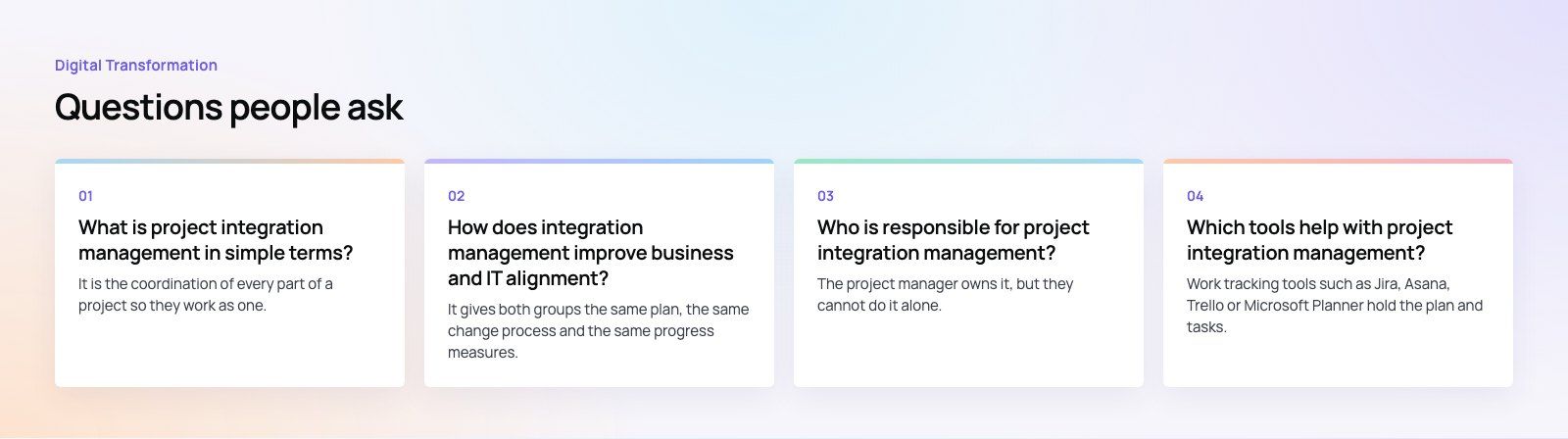
It is the coordination of every part of a project so they work as one.
Instead of managing scope, schedule, cost, risk and communication separately, the project manager keeps a single plan and checks how a change in one area affects the others. The result is fewer surprises and decisions that reflect the full picture rather than one team's view.
Digital TransformationHow Digital Transformation Is Reshaping BusinessesFive ways digital transformation is changing operations, customer experience, data, business models and work, plus the challenges and a practical roadmap. Digital TransformationStrategic Human Resource Management: Aligning HR With GoalsWhat strategic human resource management means, the components of a strategic HR model, and a six step process for aligning HR with business goals.
 Digital TransformationBest CRM for Small Businesses: 10 Options and How to ChooseTen CRM platforms that suit startups and small teams, from HubSpot and Zoho to Kommo and NetHunt, with a comparison table and a practical way to choose.
Tell us what the business needs. We will tell you what to build first.
Schedule a free consultation and get a written recommendation, with costs, before you commit to anything.
Get in touchPROVEN RESULTS
4.7 / 5verified reviews on Google