 DevOpsPlatform Engineering vs DevOps: Differences and How They FitPlatform engineering vs DevOps explained: what each one is, where they overlap, the tools involved, and how to tell which one your organization needs next.
SRE vs DevOps: Key Differences and When You Need Each
Site reliability engineering vs DevOps explained: what each means in practice, SLOs and error budgets, key differences, and which approach your team needs.
DevOps is a way of working that brings development and operations together so software ships faster and more safely. Site reliability engineering (SRE) is a specific engineering practice, started at Google, that runs production systems against measurable reliability targets. In short, DevOps describes the culture and delivery pipeline, while SRE gives you concrete tools such as service level objectives and error budgets to decide how reliable a system must be.
The two are not rivals. Most teams that do SRE well already work in a DevOps way. This guide explains what each one means in practice, where they differ, and how to decide what your team needs.
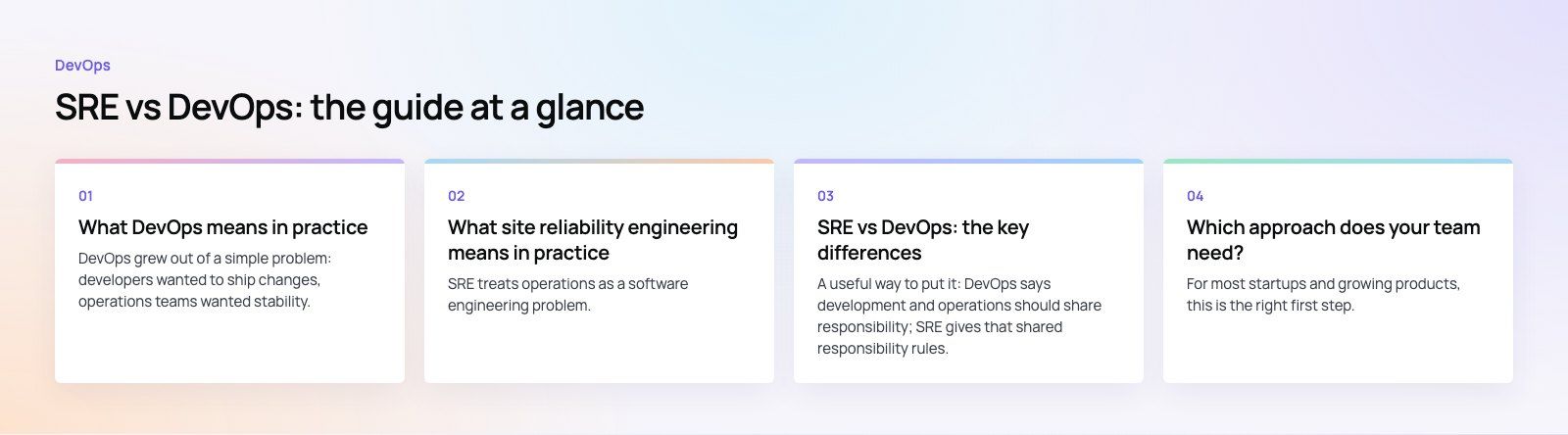
What DevOps means in practice
DevOps grew out of a simple problem: developers wanted to ship changes, operations teams wanted stability, and the handoff between them was slow and full of blame. DevOps removes that wall. The same team, or closely linked teams, owns code from commit to production.
Core DevOps practices
- Continuous integration: every change is merged often and tested automatically, so problems appear within minutes rather than at release time.
- Continuous delivery: code is always in a deployable state, and releases are small, frequent and automated.
- Infrastructure as code: servers, networks and cloud resources are defined in version controlled files using tools such as Terraform, so environments are repeatable.
- Containers and orchestration: Docker packages applications consistently, and Kubernetes runs them at scale.
- Monitoring and feedback: logs, metrics and traces show how each release behaves in production.
- Security built in: dependency scanning, secret detection and code checks run in the pipeline rather than at the end.
Teams often measure DevOps performance with DORA's software delivery metrics, such as deployment frequency, change lead time and change failure rate.
What a DevOps engineer does
- Builds and maintains CI/CD pipelines.
- Writes infrastructure as code and manages cloud environments.
- Sets up container builds, registries and deployment workflows.
- Configures monitoring, alerting and log collection.
- Works with developers to make applications easier to test, deploy and roll back.
What site reliability engineering means in practice
SRE treats operations as a software engineering problem. Instead of saying a system should be "as reliable as possible", SRE asks how reliable it needs to be for users, writes that down as a number, and manages the system against it.
Core SRE practices
- Service level indicators (SLIs): the measurements that reflect user experience, such as the share of requests that succeed or load within a set time.
- Service level objectives (SLOs): the target for each indicator over a period. Google's SRE book chapter on SLOs explains how to choose them.
- Error budgets: the gap between perfect and the SLO. While budget remains, teams ship freely. When it runs out, the focus shifts to reliability work, as described in Google's error budget policy example.
- Reducing toil: manual, repetitive operational work is measured and automated away, so engineers spend time on lasting improvements.
- Incident response and blameless postmortems: outages are handled with clear roles, then reviewed to fix causes rather than blame people.
- Capacity planning: forecasting load and testing limits before traffic arrives.
Note the difference between an SLO and an SLA. An SLO is an internal target. An SLA is a contract with customers, usually looser than the SLO, with consequences if it is missed.
What a site reliability engineer does
- Defines SLIs and SLOs with product and engineering teams.
- Builds monitoring and alerting tied to those objectives, not to every server metric.
- Leads or supports incident response and runs postmortems.
- Automates operational tasks and writes internal tools.
- Reviews designs and launches for reliability risks.
SRE vs DevOps: the key differences
| Aspect | DevOps | SRE |
|---|---|---|
| What it is | A culture and set of practices | A specific engineering role and method |
| Main focus | Speed and safety of delivery across the lifecycle | Reliability of systems in production |
| Key measures | Deployment frequency, lead time, change failure rate | SLIs, SLOs, error budget burn |
| How risk is managed | Small releases, automated tests, fast rollback | Error budgets that decide when to slow releases |
| Typical tools | CI/CD systems, Terraform, Docker, Kubernetes | Monitoring, alerting, incident tooling, load testing, internal automation |
| Who does it | Shared across development and operations | Often a dedicated team or embedded engineers |
A useful way to put it: DevOps says development and operations should share responsibility; SRE gives that shared responsibility rules, numbers and a way to settle the argument between shipping features and keeping things stable.
What they have in common
- Automation over manual work. Both push repeatable tasks into code.
- Shared ownership. Neither accepts a wall between the people who build software and the people who run it.
- Learning from failure. Both rely on monitoring, fast feedback and blameless reviews.
- Small, frequent change. Both prefer many small releases to rare large ones, because small changes are easier to test and undo.
Which approach does your team need?
Start with DevOps practices if
- Releases are slow, manual or risky.
- Environments differ between developers' machines, staging and production.
- Developers hand code to someone else to deploy and never see how it runs.
- You have a small team and no dedicated operations staff.
For most startups and growing products, this is the right first step. A reliable pipeline, infrastructure as code and basic monitoring solve more problems than any reliability framework.
Add SRE practices if
- Downtime has a clear cost to customers or revenue.
- Teams argue about whether to ship features or fix stability, with no shared way to decide.
- Alerts are noisy and on call engineers are worn out.
- You run many services and need consistent reliability standards across them.
You do not need a dedicated SRE team to start. Pick one important user flow, such as sign in or checkout, define an SLI and SLO for it, alert only when the error budget is burning too fast, and review incidents without blame. That alone changes how a team works.
Common mistakes when adopting either
- Renaming the ops team. Calling the old operations team "DevOps" or "SRE" without changing how work flows achieves nothing.
- Tools before habits. Kubernetes does not fix a team that deploys once a quarter by hand.
- Targets of 100 percent. No system is perfectly reliable, and aiming for it freezes delivery. Choose a target users would actually notice.
- Alerting on everything. Alerts should mean a person needs to act. Everything else belongs on a dashboard.
- Skipping postmortems. Without a written review and follow up actions, the same incident returns.
If you are building or scaling a product and want delivery and reliability set up properly from the start, our custom software team builds pipelines, infrastructure and monitoring alongside the application. We can also add dedicated developers to an existing team, run a codebase review to find delivery and reliability gaps, or handle Azure integration work. For an example of product engineering across app, API and firmware, see the Runvse case study.
Frequently asked questions
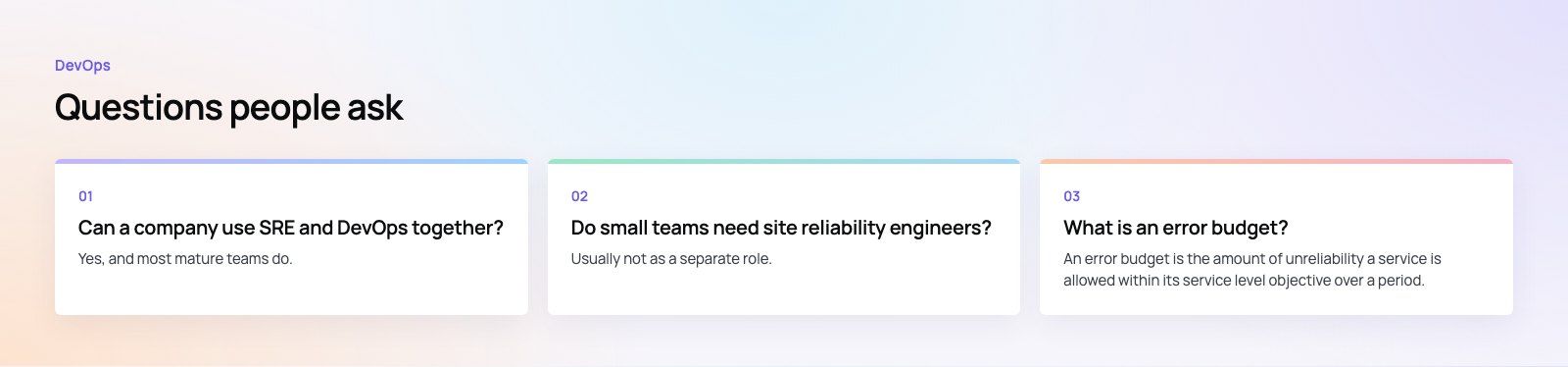
DevOps is a culture and set of practices that joins development and operations to deliver software faster and more safely across its whole lifecycle.
SRE is a specific engineering discipline focused on production reliability, using service level objectives and error budgets to decide how reliable a system must be and when to slow releases to protect it.
DevOpsPlatform Engineering vs DevOps: Differences and How They FitPlatform engineering vs DevOps explained: what each one is, where they overlap, the tools involved, and how to tell which one your organization needs next. DevOpsGitLab vs Jenkins: Which CI/CD Tool Fits Your Team?GitLab vs Jenkins compared on setup, features, scaling, security, integrations and total cost, with a simple checklist for choosing the right CI/CD tool.
 DevOpsConfiguration Management Tools in DevOps: How the Leaders CompareAnsible, Puppet, OpenVox, Chef, Salt, Terraform and OpenTofu compared: what configuration management does in DevOps and how to choose a tool.
Tell us what the business needs. We will tell you what to build first.
Schedule a free consultation and get a written recommendation, with costs, before you commit to anything.
Get in touchPROVEN RESULTS
4.7 / 5verified reviews on Google