 Digital TransformationHow Digital Transformation Is Reshaping BusinessesFive ways digital transformation is changing operations, customer experience, data, business models and work, plus the challenges and a practical roadmap.
CodeeoInsightsDigital Transformation
What Is Industry 5.0? Principles, Technologies and Benefits
What Industry 5.0 means for manufacturers: its human-centric, sustainable and resilient principles, the technologies behind it, the benefits and how to start.
Industry 5.0 is the idea that factories should use advanced technology to support people, protect the planet and withstand shocks, rather than chase automation and output alone. It builds on Industry 4.0, keeping the connected machines, data and AI, but changes the goal: workers stay at the center, and resilience and sustainability count as much as efficiency. For a manufacturer, it is less a new set of machines and more a new way of deciding what to automate and why.
This guide explains where the term comes from, its three principles, the technologies behind it, the practical benefits and the software decisions that turn the idea into something a plant can actually run.
Where the idea of Industry 5.0 comes from
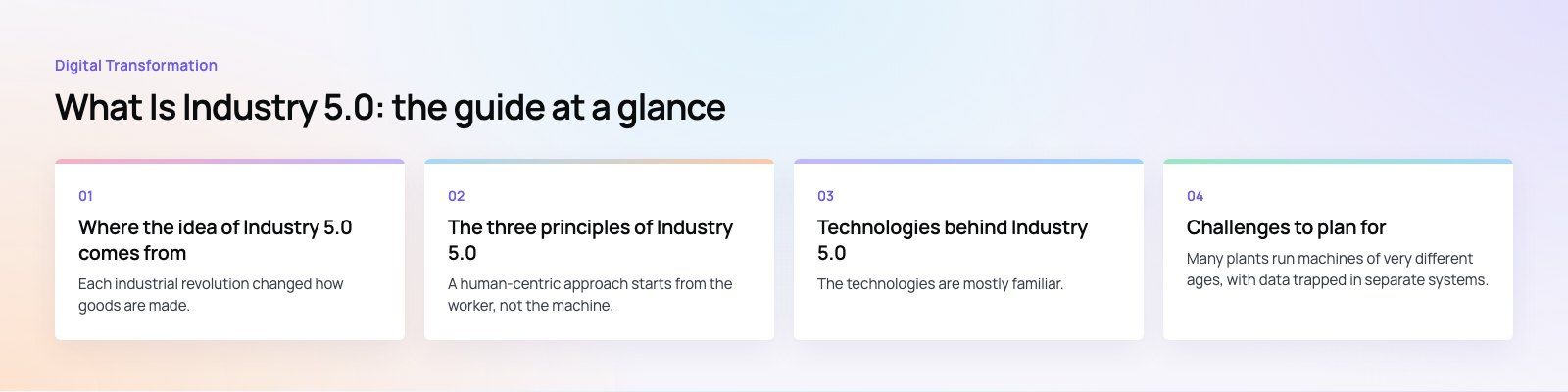
Each industrial revolution changed how goods are made. Steam and water power mechanized production. Electricity enabled mass production lines. Computers and electronics brought automation. Industry 4.0 connected all of it, with sensors, networks, cloud platforms and analytics turning factories into data systems.
Industry 4.0 was mostly about efficiency and productivity. It asked how far a process could be automated and how much data could be collected. Industry 5.0 asks a different question: what should that technology be for? The European Commission describes Industry 5.0 as a move toward a sustainable, human-centric and resilient industry, one where technology serves the workforce and wider society instead of simply replacing labor.
It is not a hard break from Industry 4.0. Most manufacturers are still completing their 4.0 programs, and many of the same tools carry straight over. The difference is in the priorities that shape each investment.
The three principles of Industry 5.0
Human-centric
A human-centric approach starts from the worker, not the machine. Instead of asking which jobs can be removed, it asks which tasks technology should take on so that people can do the skilled, judgment-based work better. Repetitive, dangerous or physically draining tasks go to machines. Problem solving, quality decisions, customer work and process improvement stay with people.
In practice this shapes small decisions: interfaces designed for the operators who will use them, tools that explain their recommendations, training built into the rollout, and safety designed into every automated cell.
Sustainable
Older approaches to sustainability often focused on reporting or reducing visible damage. Industry 5.0 treats it as an operating goal. That means measuring energy, water and material use at the process level, cutting waste and scrap, designing products for repair and reuse, and using data to find where resources are lost.
Sustainability here is measurable. If a plant cannot see its energy use per line or per batch, it cannot improve it, which is why data collection still matters.
Resilient
Recent years showed how quickly supply chains can break. Resilience means a manufacturer can keep operating, or recover quickly, when a supplier fails, demand shifts or a disruption hits. It comes from visibility across suppliers and inventory, flexible production lines that can switch products, alternative sourcing, and systems that let teams make fast decisions with accurate data.
Industry 4.0 vs Industry 5.0
| Aspect | Industry 4.0 | Industry 5.0 |
|---|---|---|
| Main goal | Efficiency and productivity | Value for people, society and the business |
| Role of workers | Often reduced through automation | Central, supported by technology |
| Robots | Isolated industrial robots | Collaborative robots working beside people |
| Production style | Mass production at scale | Flexible, customized production |
| Sustainability | A side benefit | A design requirement |
| Risk focus | Uptime and cost | Uptime, cost and recovery from disruption |
Technologies behind Industry 5.0
The technologies are mostly familiar. What changes is how they are applied.
Collaborative robots
Collaborative robots, or cobots, are designed to share space with people. They handle lifting, screwing, packing or inspection while a worker guides, checks and adjusts. The aim is to pair machine consistency with human judgment, not to empty the floor.
Artificial intelligence and machine learning
AI models spot defects on a camera feed, predict when a machine is likely to fail, and suggest production schedules. In an Industry 5.0 setting, those models act as assistants: they flag and explain, and a person decides. That keeps accountability clear and builds trust in the system.
Internet of Things and data platforms
Sensors on machines, lines and utilities feed a shared data platform. This is what makes energy tracking, predictive maintenance and supply visibility possible. Without clean, connected data, the other technologies have little to work with.
Digital twins
A digital twin is a virtual model of a machine, line or plant that updates with live data. Teams can test a layout change, a new product or a maintenance plan virtually before touching the real equipment.
Augmented reality and connected apps
Augmented reality headsets and tablet apps put work instructions, safety steps and machine data in front of the operator. This shortens training, reduces errors and helps less experienced staff handle complex tasks. Often a well designed mobile app does more for a shop floor than any headset.
Our Runvse case study is one example of this kind of connected work: a tuning and calibration product for diesel trucks built as a mobile app, an API and the microcontroller firmware that talks to the vehicle.
Benefits for manufacturers
- Better use of people. Machines take repetitive tasks, so skilled staff spend their time on quality, problem solving and improvement.
- Flexible, customized production. Collaborative cells and digital planning make it easier to run smaller batches and personalized products without retooling the whole line.
- Higher quality. Human judgment combined with machine precision and AI inspection catches defects earlier.
- Lower waste and resource use. Process level data shows where energy and materials are lost, which cuts cost as well as environmental impact.
- Faster recovery from disruption. Supply chain visibility and flexible lines help a plant switch suppliers or products when it has to.
- Easier hiring and retention. Safer, more interesting work with good tools makes manufacturing roles more attractive.
Challenges to plan for
Legacy equipment and data silos
Many plants run machines of very different ages, with data trapped in separate systems. Connecting them is often the hardest and least glamorous part of the work. Start with a clear map of what data exists, where it lives and who needs it.
Skills and change management
Human-centric technology fails if the people using it were not involved in choosing it. Bring operators and supervisors into design reviews, pilot with them, and budget time for training.
Security
Every new sensor and connected device is another way in for an attacker. Network segmentation, access control and patching need to be planned from the first pilot, not added later.
Measuring the right things
If success is measured only by headcount or output, projects will drift back to Industry 4.0 thinking. Add measures for safety, energy, scrap, recovery time and worker feedback.
How to start: a practical roadmap
- Pick one problem. Choose a line or process with a clear pain point, such as unplanned downtime, high scrap or a slow changeover.
- Get the data foundation right. Make sure your ERP, production and maintenance records agree. Many projects stall because the basic records are wrong.
- Involve the workforce early. Ask the people on that line what slows them down and what they would automate first.
- Pilot small and measure. Run a limited trial, track productivity alongside safety, energy and worker feedback, and decide based on evidence.
- Scale what works. Standardize the successful pilot, connect it to your wider systems, and move to the next problem.
Most of this work is software: connecting machines to an ERP, building operator apps, creating dashboards that show energy and quality in real time, and integrating supplier data. Tools such as Power BI dashboards and cloud integration often do more for a plant's resilience than new hardware.
Where software fits
Industry 5.0 is often described in terms of robots, but the systems that tie everything together decide whether it works. A manufacturing execution system, a well configured ERP such as Business Central or Odoo, and apps designed for operators all need to share accurate data. If you are weighing where to begin, our custom software development team can scope the integration and app work behind a first pilot. Codeeo has a team of 80+ across Dubai, Riyadh and Karachi and has delivered 200+ projects across the UAE and the US.
Frequently asked questions
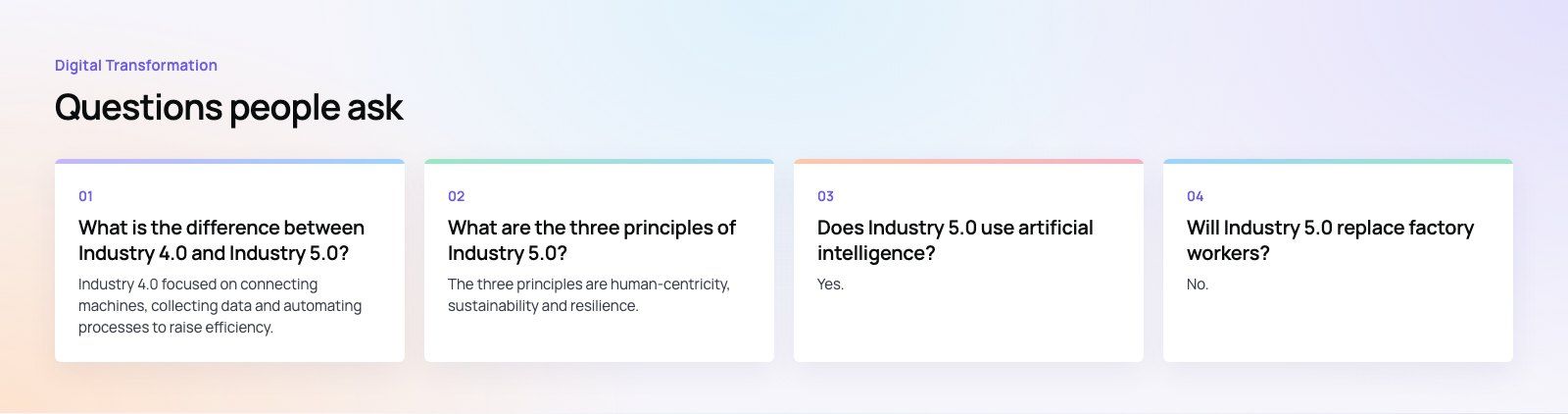
Industry 4.0 focused on connecting machines, collecting data and automating processes to raise efficiency.
Industry 5.0 keeps those technologies but changes the goal. It puts workers at the center, treats sustainability as a design requirement and adds resilience to disruption as a core objective. In short, 4.0 asks how much can be automated, while 5.0 asks how technology can best support people and society.
Digital TransformationHow Digital Transformation Is Reshaping BusinessesFive ways digital transformation is changing operations, customer experience, data, business models and work, plus the challenges and a practical roadmap. Digital TransformationStrategic Human Resource Management: Aligning HR With GoalsWhat strategic human resource management means, the components of a strategic HR model, and a six step process for aligning HR with business goals.
 Digital TransformationBest CRM for Small Businesses: 10 Options and How to ChooseTen CRM platforms that suit startups and small teams, from HubSpot and Zoho to Kommo and NetHunt, with a comparison table and a practical way to choose.
Tell us what the business needs. We will tell you what to build first.
Schedule a free consultation and get a written recommendation, with costs, before you commit to anything.
Get in touchPROVEN RESULTS
4.7 / 5verified reviews on Google