 Digital TransformationHow Digital Transformation Is Reshaping BusinessesFive ways digital transformation is changing operations, customer experience, data, business models and work, plus the challenges and a practical roadmap.
CodeeoInsightsDigital Transformation
What Is the Fintech Industry? Segments, Trends and Challenges
A plain guide to the fintech industry: what it covers, how it evolved, the trends shaping payments and banking, its benefits and the challenges firms face.
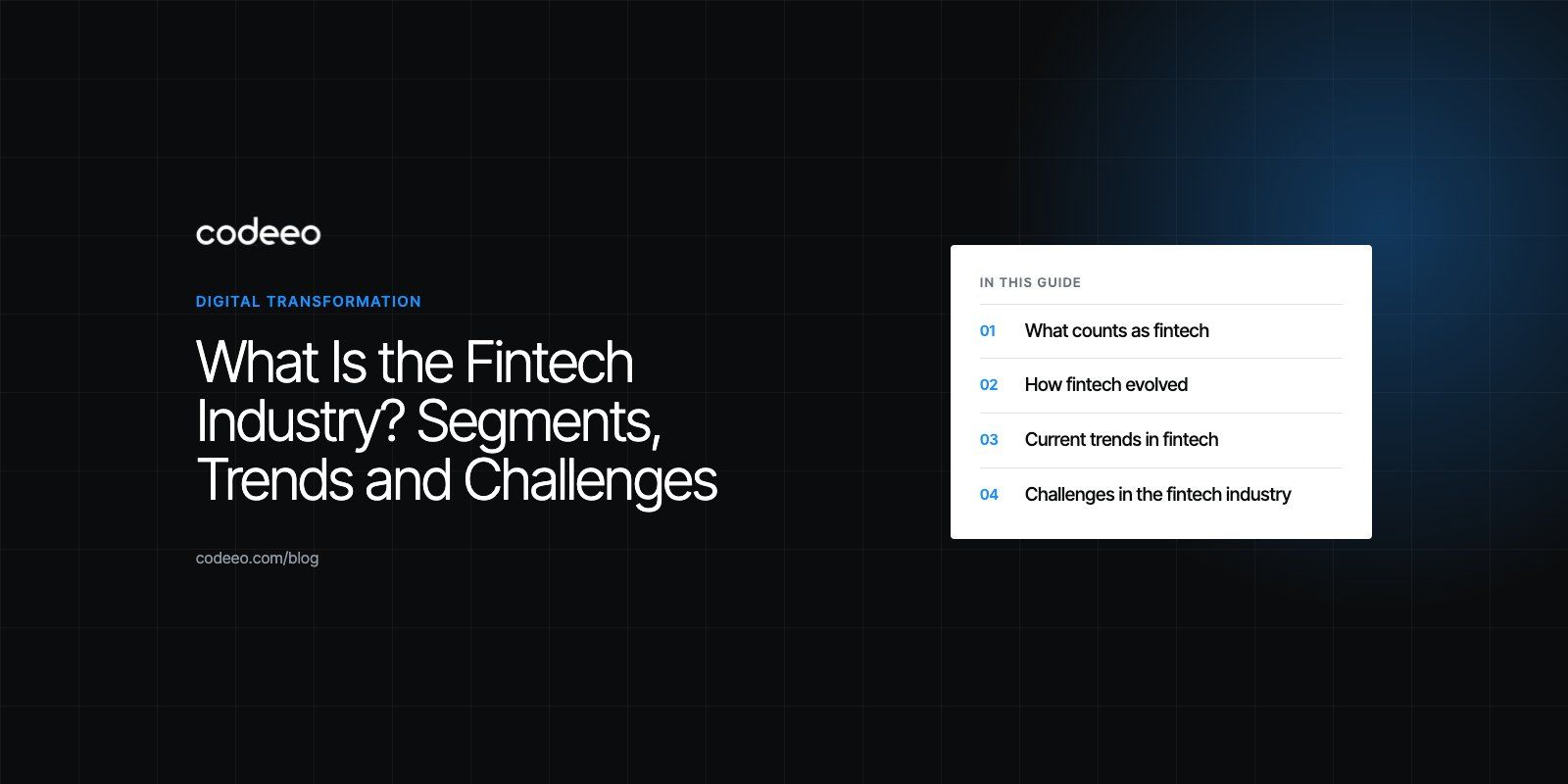
The fintech industry is the part of the economy that uses software to deliver financial services: payments, banking, lending, investing, insurance and the compliance work behind them. It includes startups, big technology companies and traditional banks that have rebuilt their services around apps and APIs. Fintech has not replaced banks; instead, the two increasingly work together, with banks providing licenses and balance sheets and fintech firms providing the customer experience and technology.
What counts as fintech
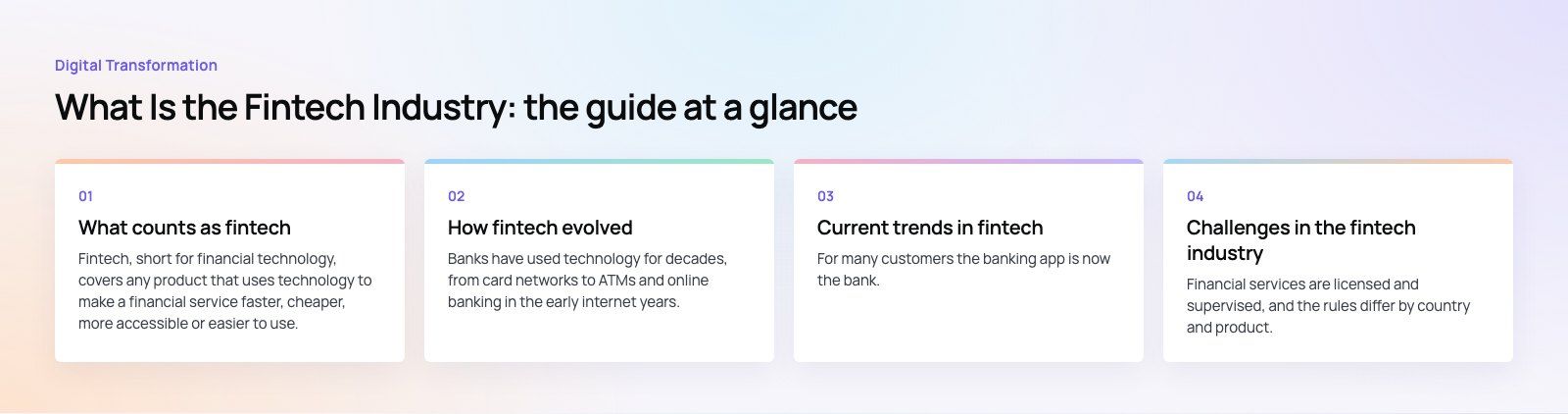
Fintech, short for financial technology, covers any product that uses technology to make a financial service faster, cheaper, more accessible or easier to use. That ranges from a mobile wallet on your phone to the software a bank uses to check transactions for fraud. Some fintech companies serve consumers directly, some serve businesses and many serve other financial institutions behind the scenes.
The main segments
| Segment | What it does | Typical examples |
|---|---|---|
| Payments | Moves money between people and businesses | Card processing, wallets, payment gateways, instant transfers |
| Digital banking | Offers accounts and cards through apps | Mobile banks, banking apps, embedded accounts |
| Lending | Assesses and provides credit online | Buy now, pay later, small business loans, digital mortgages |
| Wealth and investing | Makes investing accessible and automated | Trading apps, robo advisors, savings tools |
| Insurtech | Prices, sells and handles insurance digitally | Online policies, automated claims |
| Regtech | Automates compliance work | Identity checks, transaction monitoring, reporting |
| Digital assets | Uses blockchain to issue and transfer value | Crypto exchanges, stablecoins, tokenized assets |
How fintech evolved
Banks have used technology for decades, from card networks to ATMs and online banking in the early internet years. What changed after the 2008 financial crisis was who was building it. Lower trust in large banks, cheaper cloud computing and the arrival of smartphones let new companies offer financial services directly to customers through apps.
Since then, three shifts have shaped the industry. Payments moved into phones and checkouts. Open banking rules in several countries let customers share their bank data with other providers through secure APIs. And banks began partnering with fintech firms, or building their own digital brands, rather than competing with them head on.
Current trends in fintech
Mobile banking as the default
For many customers the banking app is now the bank. Features that once required a branch visit, such as opening an account, ordering a card, disputing a payment or applying for a loan, are expected to work on a phone in minutes.
Digital wallets and instant payments
Wallets such as Apple Pay, Google Wallet and PayPal store cards securely and let people pay with a tap or a click. Many countries also run instant payment systems that settle bank transfers in seconds. Together they are reducing the use of cash and making checkout faster online and in stores.
Embedded finance
Financial services increasingly appear inside non financial products: payments inside a ride hailing app, financing at a retailer's checkout, insurance offered while booking travel. Businesses add these through APIs from licensed providers instead of becoming banks themselves.
Buy now, pay later
Pay later services let shoppers split purchases into installments at checkout. They are now common in ecommerce in many markets, and regulators in several countries have been tightening rules around affordability checks and disclosures.
Artificial intelligence and machine learning
AI is used across fintech for fraud detection, credit decisions, customer service assistants, document processing and personalized financial insights. The challenge is explaining automated decisions to customers and regulators, especially when credit or account access is at stake.
Blockchain, stablecoins and digital currencies
Beyond cryptocurrencies, blockchain is being tested for cross border payments, tokenized assets and settlement between institutions. Many central banks are researching or piloting central bank digital currencies, and regulators are building frameworks for stablecoins and crypto service providers. The Bank for International Settlements tracks much of this work.
Regtech
As rules multiply, compliance is becoming a software problem. Regtech tools automate identity verification, sanctions screening, transaction monitoring and regulatory reporting, which reduces manual work and helps firms respond faster to new requirements.
Benefits of fintech
- Convenience. Customers can manage money any time, from anywhere, without visiting a branch.
- Financial inclusion. Mobile accounts and payments reach people who were poorly served by traditional banks. The World Bank's Global Findex database tracks how account ownership and digital payments are spreading worldwide.
- Lower operating costs. Automation reduces the cost of serving each customer, which can mean lower fees.
- Speed. Approvals, transfers and onboarding that once took days can happen in minutes.
- Better data. Businesses get clearer, faster insight into cash flow, sales and customer behavior.
Challenges in the fintech industry
Regulation
Financial services are licensed and supervised, and the rules differ by country and product. Licensing, anti-money laundering, consumer protection and data rules all add time and cost, especially for firms operating in several markets.
Security and fraud
Fintech products are attractive targets for fraud and cyber attacks. Strong authentication, encryption, monitoring and secure development practices are essential, and a single breach can destroy customer trust.
Trust and adoption
Many customers still prefer established banks for large balances and major decisions. Fintech firms earn trust through clear pricing, reliable service, good support and visible protection of customer money.
Integration with legacy systems
Banks and large companies often run core systems built decades ago. Connecting modern apps and APIs to them is slow and complex, and is one of the main reasons digital projects run late.
How fintech is used across industries
Banking and financial services
Banks use fintech to offer app based accounts, instant payments, digital lending and automated advice, and to modernize back office work such as onboarding and fraud checks.
Ecommerce and retail
Payment gateways, wallets and pay later options shape the checkout. A smooth payment step reduces abandoned carts, and offering the methods local customers prefer matters as much as design.
Insurance
Insurers use data and automation to price policies, sell them online and process simple claims quickly, while keeping people involved in complex cases.
Real estate
Digital platforms support online applications, e-signatures, rent collection and mortgage processing, which shortens transactions and reduces paperwork.
Healthcare and education
Patients and parents increasingly expect to pay bills, fees and installments online. Providers use payment platforms and portals to cut collection time and administrative work.
Where fintech is heading
- More embedded finance. Payments, lending and insurance will keep moving into the apps people already use.
- Faster, cheaper cross border payments. Instant payment links between countries and new settlement technology aim to reduce cost and delay.
- Alternative credit data. Lenders are using cash flow and payment history to assess people and small businesses with thin credit files, under growing regulatory scrutiny.
- AI under supervision. Expect more AI in service and risk decisions, along with clearer rules on fairness and explainability.
- Clearer digital asset rules. Stablecoin and crypto frameworks are maturing, which may bring more traditional institutions into the space.
For most businesses, fintech is less about becoming a financial company and more about building good payment, onboarding and finance features into their own products. Codeeo has delivered 200+ projects across the UAE and the US, including payment integrations, mobile apps and the Purpose Payment app, portals and API. Explore our fintech work or the Pioneer Auctions case study.
Frequently asked questions
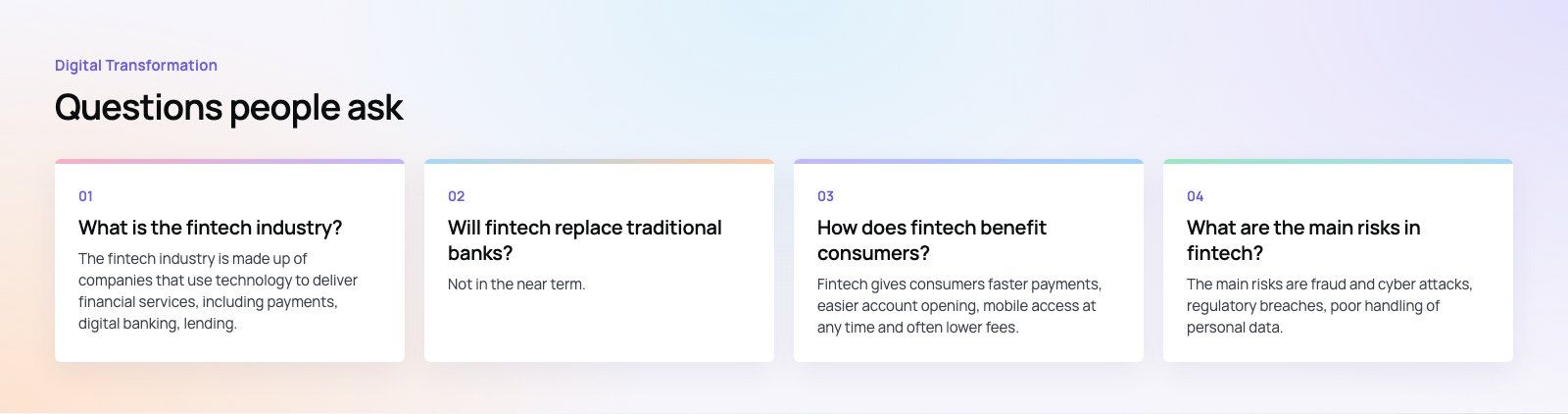
The fintech industry is made up of companies that use technology to deliver financial services, including payments, digital banking, lending, investing, insurance and compliance.
It includes startups, technology companies and traditional banks with digital products. Its aim is to make financial services faster, cheaper and easier to access, usually through apps, websites and APIs.
Digital TransformationHow Digital Transformation Is Reshaping BusinessesFive ways digital transformation is changing operations, customer experience, data, business models and work, plus the challenges and a practical roadmap. Digital TransformationStrategic Human Resource Management: Aligning HR With GoalsWhat strategic human resource management means, the components of a strategic HR model, and a six step process for aligning HR with business goals.
 Digital TransformationBest CRM for Small Businesses: 10 Options and How to ChooseTen CRM platforms that suit startups and small teams, from HubSpot and Zoho to Kommo and NetHunt, with a comparison table and a practical way to choose.
Tell us what the business needs. We will tell you what to build first.
Schedule a free consultation and get a written recommendation, with costs, before you commit to anything.
Get in touchPROVEN RESULTS
4.7 / 5verified reviews on Google