 App DevelopmentCross Platform App Development: How It Saves Time and MoneyHow shared code across iOS and Android cuts build and maintenance effort, which frameworks to consider in 2026, and when native development is still the better call.
Hiring App Developers: What to Look For Before You Sign
What to check before hiring app developers: skills, portfolio, pricing, communication, testing and support, plus key questions and in-house vs agency compared.
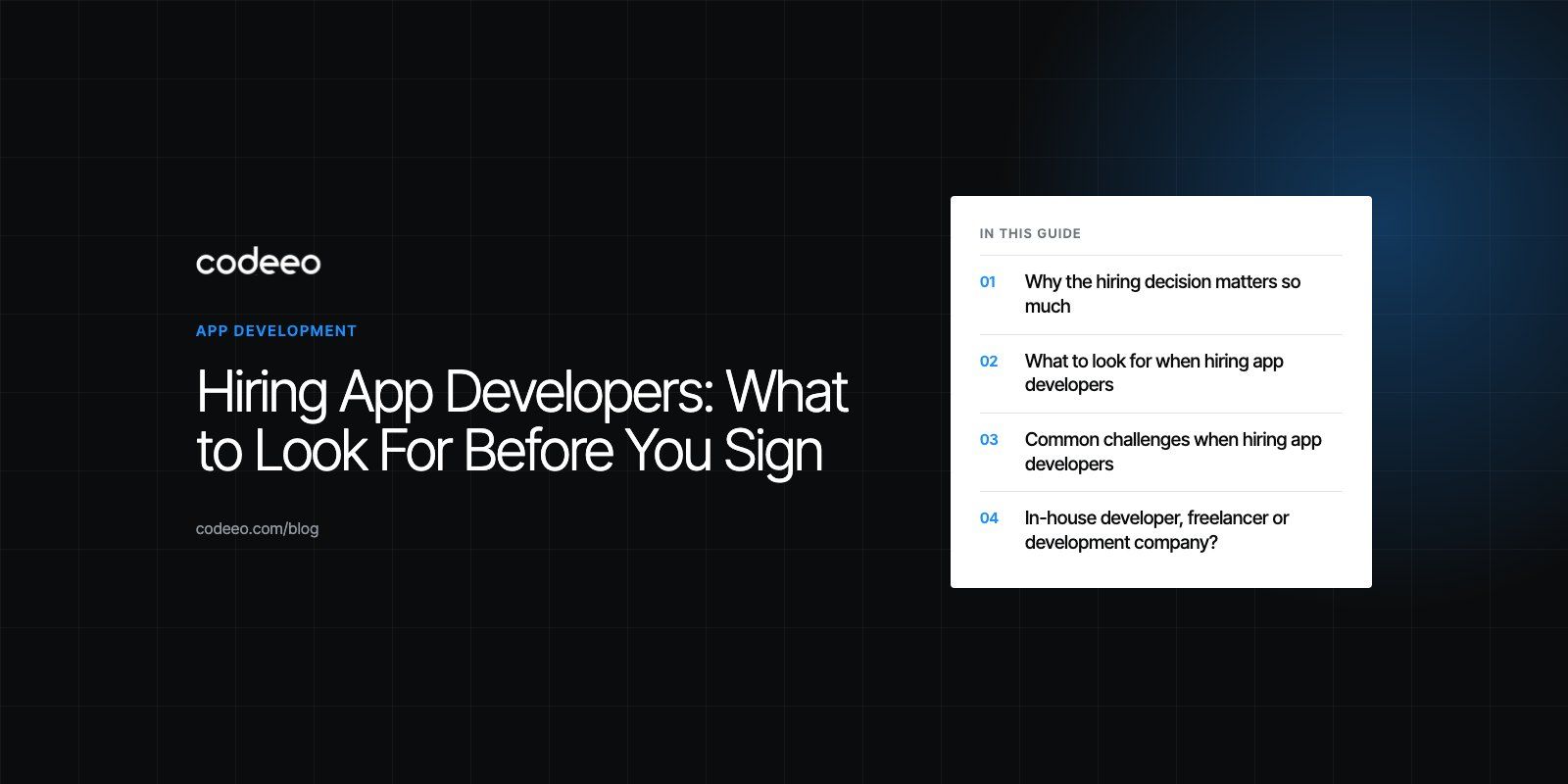
When hiring app developers, look first at relevant experience and a portfolio of apps similar to yours, then at how they communicate, test, protect your data and support the app after launch. Price matters, but the cheapest quote often costs more once rework is counted. Decide early whether you need an in-house developer, a freelancer or an app development company, because each suits a different kind of project.
This guide covers the qualities to check, the questions to ask, the common hiring challenges and how in-house hiring compares with working with a development partner.
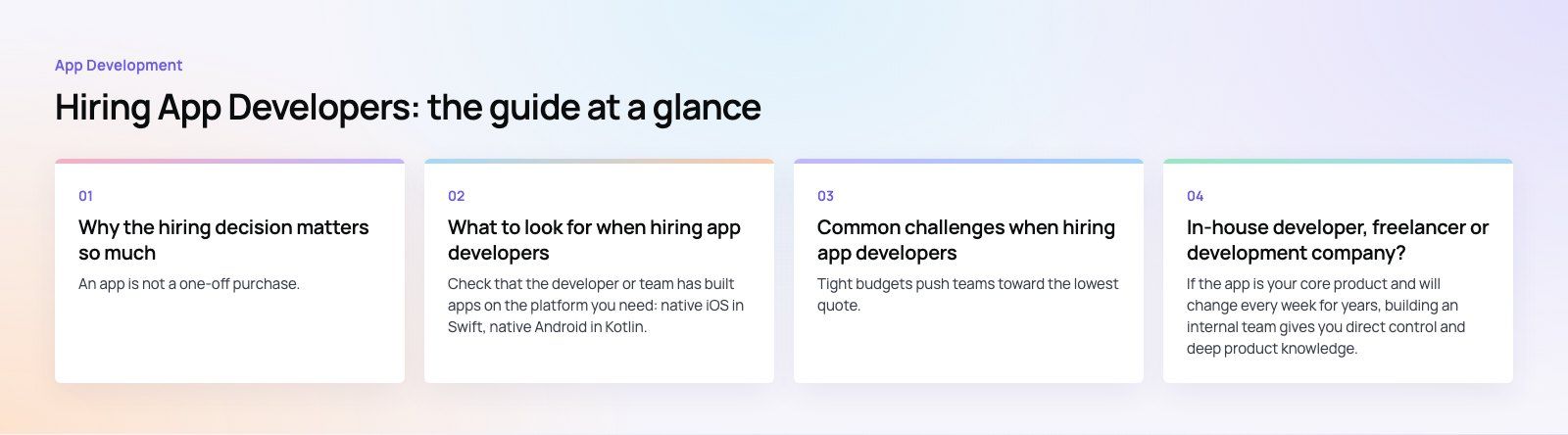
Why the hiring decision matters so much
An app is not a one-off purchase. The people who build it make architectural choices that decide how fast it runs, how secure it is and how expensive it will be to change later. A weak first build often has to be rewritten, which costs more than doing it properly once. Taking time to hire well is one of the cheapest risk controls you have.
What to look for when hiring app developers
1. Relevant experience and technical skills
Check that the developer or team has built apps on the platform you need: native iOS in Swift, native Android in Kotlin, or cross-platform with Flutter or React Native. Ask about back-end skills too, because most apps need APIs, databases and an admin panel. Experience in your type of app, such as marketplaces, bookings or payments, shortens the learning curve.
2. A portfolio you can actually test
Ask for live apps you can download, not just screenshots. Try them on your own phone. Look at speed, polish and how they handle errors or poor connections. Ask what part of each project the developer personally built, since team portfolios can hide who did the work.
3. Problem solving and product thinking
Good developers question requirements when something will not work for users, suggest simpler ways to reach the same goal and explain trade offs clearly. In interviews, describe a real feature and ask how they would approach it. Their questions tell you as much as their answers.
4. Clear, transparent pricing
Developers usually work on hourly rates, fixed price projects or monthly retainers for dedicated teams. Fixed price works when scope is clear; time and materials suits evolving products. Ask what is included: design, testing, project management, store submission and post launch support are often priced separately. Very low quotes often leave out testing or back-end work.
5. A record of delivering on time
Ask how they break projects into milestones, how they track progress and what happened on a project that slipped. A team with a clear process, regular demos and honest reporting on risks is more likely to deliver than one that promises everything by a fixed date.
6. Communication
Poor communication causes more failed projects than poor code. Check how quickly they reply, whether they can explain technical topics to non-technical people and which tools they use for updates. A small paid trial task is a good way to test working together before a long engagement.
7. Platform and device compatibility
Your app needs to work on a wide range of phones, screen sizes and operating system versions. Ask how they decide which devices to support and how they test across them, especially on Android where device variety is large.
8. Confidentiality and IP ownership
Sign a non-disclosure agreement before sharing detailed plans, and make sure the contract states that you own the source code, designs and accounts. Ask how they store credentials and client data, and check references for how they handled sensitive projects.
9. Testing and security practices
Ask about unit tests, integration tests, user acceptance testing and real device testing. For apps handling personal or payment data, ask how they follow guidance such as the OWASP Mobile Top 10. A developer who treats testing as optional will hand you a fragile app.
10. Support after launch
Every new iOS and Android release, library update and security patch can require changes. Agree in writing what post launch support covers, how fast issues are handled and how new features are estimated.
Questions to ask before you hire
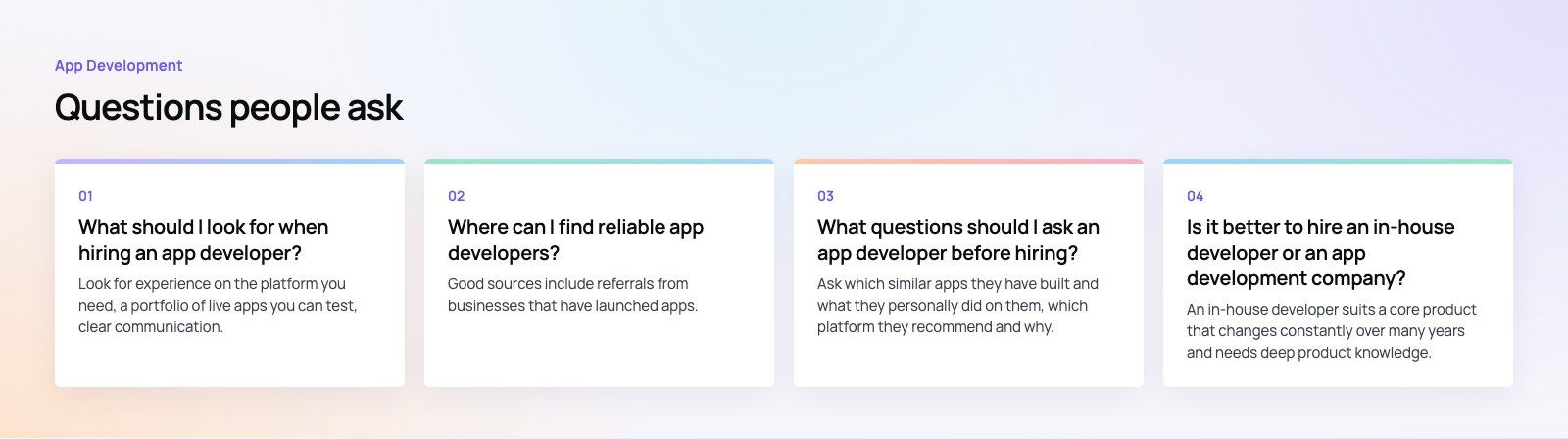
- Which apps similar to ours have you built, and can we download them?
- Which part of each project did you personally work on?
- Which platforms and frameworks would you recommend for our app, and why?
- How do you estimate, and what is not included in your quote?
- How will you keep us updated, and how often will we see working software?
- How do you test, and on which devices?
- Who owns the code, designs and app store accounts?
- What happens after launch, and how are bugs and new features handled?
- Can we speak to a past client?
Common challenges when hiring app developers
Budget pressure
Tight budgets push teams toward the lowest quote. A better approach is to reduce scope to a minimum viable product and hire a stronger team to build it, then add features based on real usage.
Time zone differences
Remote teams in distant time zones can slow decisions. Agree on overlapping working hours, response times and a fixed meeting rhythm. Written updates and recorded demos help keep work moving between calls.
Limited in-person contact
Remote projects lose the quick conversations that happen in an office. Video calls, shared boards, clear specifications and short weekly demos close most of that gap.
Different working cultures
Teams differ in how directly they raise problems and how they handle disagreement. Set expectations early: you want bad news quickly, questions asked openly and estimates that reflect reality.
In-house developer, freelancer or development company?
| Factor | In-house developer | Freelancer | Development company |
|---|---|---|---|
| Best for | Long term products central to the business | Small, well defined tasks | Full app builds and complex products |
| Skills covered | Limited to the people you hire | One person's skills | Design, front end, back end, QA and project management |
| Speed to start | Slow, hiring takes time | Fast | Fast, with a ready team |
| Control | Highest day to day control | Moderate | Shared, through agreed process |
| Scaling the team | Hard, requires more hiring | Hard | Easier to add or reduce people |
| Main risk | Single point of failure, ongoing salary cost | Availability and continuity | Choosing the wrong partner |
When in-house makes sense
If the app is your core product and will change every week for years, building an internal team gives you direct control and deep product knowledge. Expect hiring to take time and plan for cover when people leave or take leave.
When a development company makes sense
For a new product, a complex build or a business without a technical team, a development company provides a full team from day one, established processes and a wider range of skills. Many businesses start with a partner and gradually build an internal team that takes over.
Hybrid models
Dedicated developers from a partner who work as part of your team are a middle path. You direct the work, and the partner handles hiring, cover and management.
Codeeo is a team of 80+ across Dubai, Riyadh and Karachi, rated 4.7 from 23 Google reviews, with 200+ projects delivered across the UAE and the US. Projects like Distinct, a healthcare workforce platform with a design system shared by web and admin, show the kind of multi-part products we build. Explore our mobile app development service, hire dedicated developers who join your team, or ask for a codebase review if you already have an app and want an independent view. You can also contact us directly.
Frequently asked questions
Look for experience on the platform you need, a portfolio of live apps you can test, clear communication, a proven delivery process, solid testing and security practices and a clear plan for support after launch.
Make sure the contract gives you ownership of the code and accounts. Price matters, but judge it against what the quote actually includes.
App DevelopmentCross Platform App Development: How It Saves Time and MoneyHow shared code across iOS and Android cuts build and maintenance effort, which frameworks to consider in 2026, and when native development is still the better call. App DevelopmentHow to Plan an App Development Project From Start to FinishA step by step plan for an app project: define users and goals, scope an MVP, choose platforms, design, build the team, phase the timeline, test and launch.
 App DevelopmentMust Have Features of an HR Management AppThe features an HR management app needs, from onboarding and self service to payroll, performance and analytics, plus when to buy or build.
Tell us what the business needs. We will tell you what to build first.
Schedule a free consultation and get a written recommendation, with costs, before you commit to anything.
Get in touchPROVEN RESULTS
4.7 / 5verified reviews on Google