 App DevelopmentCross Platform App Development: How It Saves Time and MoneyHow shared code across iOS and Android cuts build and maintenance effort, which frameworks to consider in 2026, and when native development is still the better call.
Why Businesses Need a Mobile App: Benefits and When to Build One
The real benefits of a business mobile app, from loyalty and repeat sales to staff tools, plus the cases where a mobile website is the better choice.
A mobile app helps a business stay in direct contact with customers, make repeat purchases and bookings faster, run loyalty programs, and learn from how people actually use its service. Not every business needs one, though. An app pays off when customers return often, when the phone adds something a website cannot, such as notifications, location or offline use, or when staff and partners need a tool in the field. For occasional visitors, a fast mobile website is usually enough.
This article covers the real benefits of a business app, the cases where it is not worth building, and how to decide.
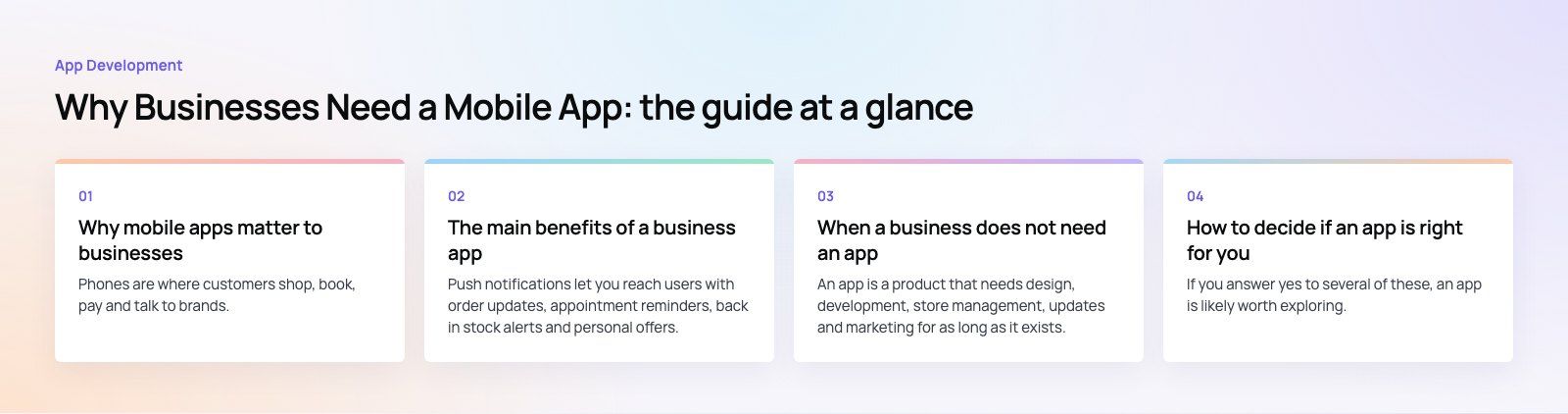
Why mobile apps matter to businesses
Phones are where customers shop, book, pay and talk to brands. A website reaches people when they search; an app stays on the home screen and gives you a direct line to customers who have already chosen you. That difference is the source of most of the benefits below.
The main benefits of a business app
1. Direct, timely engagement
Push notifications let you reach users with order updates, appointment reminders, back in stock alerts and personal offers. Both platforms put users in control: on iOS, apps must ask permission before sending alerts, as Apple's User Notifications documentation describes. That makes relevance essential. Notifications that are useful keep people engaged; promotional noise gets them turned off or the app deleted.
2. Faster repeat purchases and bookings
Apps can remember preferences, saved addresses, past orders and payment methods, so a returning customer can reorder or rebook in a few taps. Mobile wallets such as Apple Pay and Google Pay shorten checkout further. For businesses where the same customers return weekly or monthly, from food ordering to services, this convenience is often the strongest reason to build. Planning payment integration early keeps checkout simple and secure.
3. Loyalty and retention
Loyalty programs work well inside apps because points, rewards and member pricing are always visible. Exclusive content, early access and in app support add reasons to stay. The Purpose Payment app, where every purchase sends a share to the customer's chosen charity and earns reward points, is an example of rewards built into the core experience rather than added as an extra.
4. Brand visibility
An app icon on a customer's home screen is a constant reminder of your brand. A presence in the App Store and Google Play also gives people another place to find you, especially when your app solves a need they search for directly.
5. Better data and insight
With the right consent, app analytics show which features people use, where they drop out of a flow and what drives repeat use. That helps you improve the product, target marketing more precisely and spot problems early. Respect privacy rules in each market and collect only what you need.
6. Features a website cannot match
Apps can use the camera for scanning, location for nearby offers or delivery tracking, Bluetooth for connected devices, biometrics for quick secure login and offline storage for areas with poor signal. If your service depends on any of these, an app is often the only practical option.
7. Better tools for staff and partners
Not every business app faces customers. Field technicians, riders, sales teams and warehouse staff benefit from apps that show jobs, capture photos and signatures, and sync with back office systems. The Teachers Lunch platform, for example, includes a customer app, a rider app, restaurant menus, payments and an admin that sees the whole day.
Benefits at a glance
| Benefit | How the app delivers it | Best suited to |
|---|---|---|
| Engagement | Push notifications, personalization | Businesses with timely updates to share |
| Faster repeat sales | Saved details, mobile wallets, reorders | Food, retail, services with frequent repeat customers |
| Loyalty | Points, rewards, member content | Retail, hospitality, fitness, payments |
| Visibility | Home screen icon, store listings | Brands with an engaged customer base |
| Insight | Usage analytics with consent | Any business improving a digital service |
| Device features | Camera, location, biometrics, offline | Delivery, field services, connected devices |
| Operations | Staff and partner apps linked to back office | Logistics, marketplaces, on site teams |
When a business does not need an app
An app is a product that needs design, development, store management, updates and marketing for as long as it exists. It is not the right investment when:
- Customers visit rarely, such as for a one off purchase or an annual service.
- Everything the app would do can be done just as well on a fast mobile website.
- You have no plan or budget to promote the app and maintain it after launch.
- Your website, checkout or booking process still has basic problems to fix.
In those cases, a well built mobile website or a progressive web app can deliver much of the value with less effort. Our web development team often recommends starting there and adding an app once demand is proven.
How to decide if an app is right for you
Ask these questions
- How often do your customers interact with you? Weekly or monthly use favors an app.
- Would notifications genuinely help customers, not just your marketing?
- Do you need device features such as location, camera or offline access?
- Do staff or partners need a mobile tool to do their jobs?
- Can you commit to maintaining and promoting the app for several years?
If you answer yes to several of these, an app is likely worth exploring. A platform fit review can compare an app, a mobile website and a progressive web app against your specific goals.
Start small
Launch a focused first version that does one or two things very well, such as reordering and tracking, then expand based on what users do. The Jobiq marketplace shows how much a booking app can involve once it grows: customers book a technician, vendors run their teams, and the platform handles chat, dispatch and payment.
Challenges to plan for
- Cost and time: apps need a backend and an admin panel as well as screens, and cost grows with features, platforms and integrations.
- Getting installs: users must find, download and keep the app, so marketing and store optimization matter.
- Maintenance: iOS and Android update every year, and apps need regular releases to stay compatible and secure.
- Security and privacy: apps that handle accounts and payments must protect data and follow store and legal rules.
Codeeo's team of 80+ across Dubai, Riyadh and Karachi has delivered more than 200 projects across the UAE and the US. If you are weighing up an app for your business, our mobile app development team can help you decide what to build first.
Frequently asked questions
No.
An app makes the most sense when customers interact with you often, when phone features such as notifications, location or offline use add real value, or when staff need a mobile tool. Businesses with occasional customers usually get more from a fast, mobile friendly website. Start from how your customers behave rather than from what competitors have built.
App DevelopmentCross Platform App Development: How It Saves Time and MoneyHow shared code across iOS and Android cuts build and maintenance effort, which frameworks to consider in 2026, and when native development is still the better call. App DevelopmentHow to Plan an App Development Project From Start to FinishA step by step plan for an app project: define users and goals, scope an MVP, choose platforms, design, build the team, phase the timeline, test and launch.
 App DevelopmentMust Have Features of an HR Management AppThe features an HR management app needs, from onboarding and self service to payroll, performance and analytics, plus when to buy or build.
Tell us what the business needs. We will tell you what to build first.
Schedule a free consultation and get a written recommendation, with costs, before you commit to anything.
Get in touchPROVEN RESULTS
4.7 / 5verified reviews on Google