 E-Commerce10 Features of a High-Converting Ecommerce WebsiteThe ten features that turn store visitors into buyers, from product pages and checkout to speed, mobile design, social proof and ongoing testing.
Wix vs Shopify: Which Platform Fits Your Online Store?
Wix vs Shopify compared on ease of use, selling features, payments, marketing, design, SEO and scalability, with clear advice on which suits your store.
Wix is the better choice if you are a small business that wants an attractive website with a modest online shop attached. Shopify is the better choice if selling online is the core of the business and you expect your catalogue, order volume or number of markets to grow. Wix is a website builder that can sell; Shopify is a commerce platform that can publish a website.
That distinction drives almost every difference between them. Below we compare ease of use, selling features, payments, marketing, design, SEO and scalability so you can match the platform to your plans rather than to a feature list.
Wix vs Shopify at a glance
| Factor | Wix | Shopify |
|---|---|---|
| Core purpose | General website builder with ecommerce | Dedicated ecommerce platform |
| Ease of use | Very easy, freeform drag and drop | Easy, more structured, more store settings to learn |
| Design | Large template range, high layout freedom | Store focused themes, deeper customization through code |
| Selling features | Good for small catalogues | Strong for large catalogues and complex selling |
| Payments | Wix Payments plus third party providers | Shopify Payments plus a wide range of local gateways |
| Selling in several markets | Supported, simpler setup | Multiple currencies, languages and market settings |
| Apps | Wix App Market | Shopify App Store, larger commerce focused range |
| Best for | Service businesses and small shops | Product brands planning to scale |
Ease of use
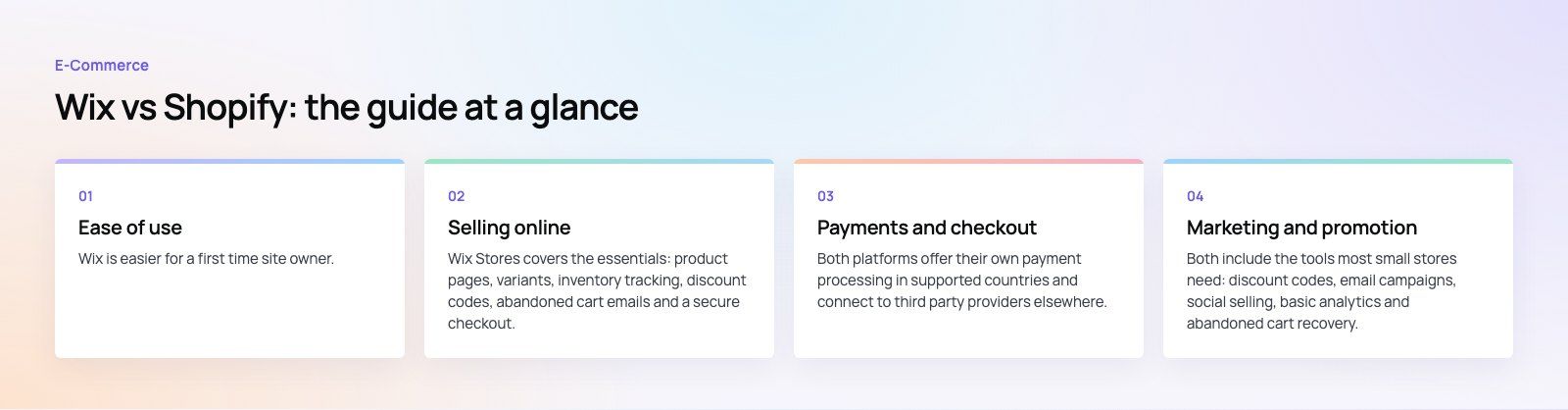
Wix is easier for a first time site owner. Its editor lets you place elements freely and see the result immediately, and setup prompts guide you through adding products, pages and payments. If you can make a slide deck, you can build a Wix site.
Shopify is also friendly, but the admin is built around products, orders, customers and settings rather than page design. There is more to learn on day one, such as shipping zones, taxes, inventory locations and checkout options. The payoff is that those tools are designed for running a store every day, not just launching one.
Verdict: Wix for the quickest start with no experience. Shopify if you will spend more time managing orders than editing pages.
Selling online
Wix Stores covers the essentials: product pages, variants, inventory tracking, discount codes, abandoned cart emails and a secure checkout. It also handles bookings and events well, which is why service businesses often pick it.
Shopify goes deeper on commerce. It handles large catalogues with many variants, multiple inventory locations, point of sale for physical shops, wholesale options, subscriptions through apps and a mature checkout. Selling through social channels and marketplaces is built into the admin.
Verdict: Shopify, clearly, once selling is the main job of the site.
Payments and checkout
Both platforms offer their own payment processing in supported countries and connect to third party providers elsewhere. Shopify has the wider list of gateways, which matters in markets where a specific local provider or a buy now, pay later option is expected at checkout. Before choosing either platform, confirm that the payment methods your customers actually use are supported in your country, and how payouts and transaction fees work when you use an outside provider.
If your checkout needs a provider the platform does not support out of the box, a payment integration specialist can tell you whether an app or custom work can fill the gap.
Marketing and promotion
Both include the tools most small stores need: discount codes, email campaigns, social selling, basic analytics and abandoned cart recovery. Wix bundles more general marketing tools into one dashboard, which is convenient if you run everything yourself.
Shopify's advantage is the app ecosystem. Reviews, loyalty programs, upsells, product bundles, advanced email and SMS tools all have mature options designed for commerce. Shopify also connects cleanly to the main ad platforms for product catalogues.
Verdict: Roughly even for a small shop; Shopify for a store that runs paid campaigns and retention programs.
Templates and design
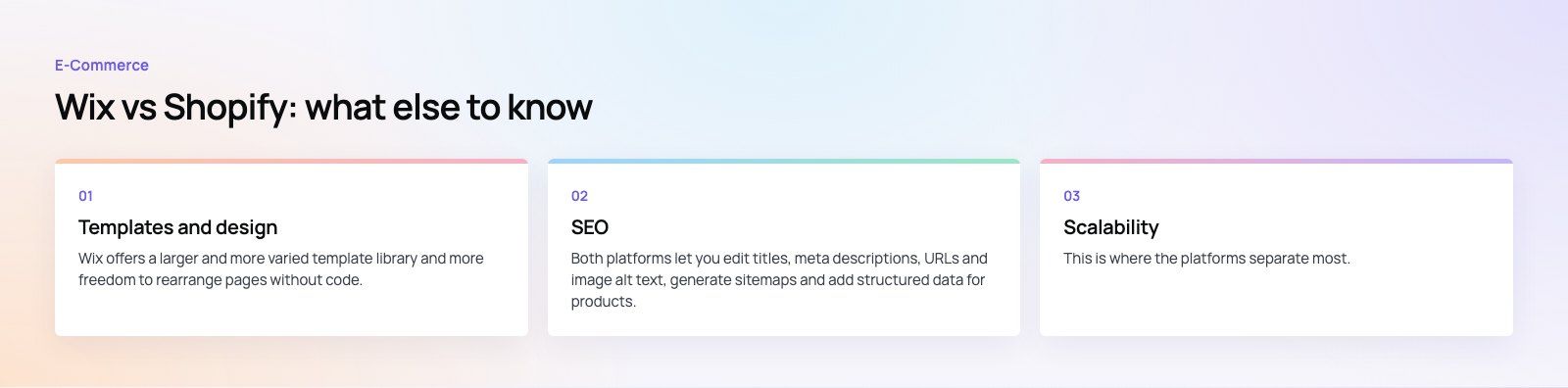
Wix offers a larger and more varied template library and more freedom to rearrange pages without code. That suits brands whose website is as much about storytelling as selling.
Shopify themes are built specifically for stores, with product galleries, collection filters and checkout flows that work well on mobile. Layout changes are more structured, but theme code is fully editable, so a developer can build almost any design on top of it.
Verdict: Wix for design freedom without a developer. Shopify for a store design that a developer can take as far as the brand needs.
SEO
Both platforms let you edit titles, meta descriptions, URLs and image alt text, generate sitemaps and add structured data for products. Neither will hold back a well run store. Shopify uses fixed URL prefixes such as /products/ and /collections/, which some SEO teams dislike but which rarely affect rankings in practice. Wix has improved its SEO tooling considerably and is fine for small sites.
Rankings will depend more on product content, category page copy, page speed and links than on the platform. A technical SEO review after launch catches the common problems on either one.
Scalability
This is where the platforms separate most. Wix works well for small to medium catalogues and simple operations. As order volume grows, businesses tend to want features such as multiple warehouses, B2B pricing, complex shipping rules, ERP connections or headless front ends, and these are areas where Shopify is far more mature.
Shopify scales from a first product to large brands, with a higher tier for enterprise needs and APIs that support headless commerce builds. Moving from Wix to Shopify later is possible, but it means rebuilding the store and redirecting URLs, so if growth is the plan it is usually cheaper to start on Shopify.
What drives the cost
Both charge a monthly subscription, with higher tiers adding features and lowering fees. The plan fee is rarely the biggest cost. Watch for:
- Transaction and payment processing fees, which differ depending on whether you use the platform's own payments or an outside gateway.
- Paid apps, which add up quickly on both platforms.
- Premium themes or custom design.
- The people who run the store day to day and the developer time for anything custom.
Model your expected order volume and the apps you need before comparing plans, and check current pricing on each platform's site for your country.
Which should you choose?
- Choose Wix if your website mainly presents your business and selling is a side activity, you have a small catalogue, or you take bookings rather than ship products.
- Choose Shopify if products are the business, you plan to grow the catalogue or sell in several countries, or you need integrations with marketplaces, warehouses or an ERP.
Codeeo has delivered 200+ projects across the UAE and the US, including the EGO Sustainable bilingual Shopify store for a GCC athleisure label selling in five markets. If you are leaning towards Shopify, our Shopify developers can set up the store properly from day one, and a platform fit review will confirm the choice before you commit.
Frequently asked questions
Wix is usually easier for complete beginners because its drag and drop editor shows every change instantly and the setup prompts are simple.
Shopify is also beginner friendly, but its admin includes more store settings such as shipping zones, taxes and inventory locations. If you mainly sell products and plan to grow, Shopify's learning curve is worth it.
E-Commerce10 Features of a High-Converting Ecommerce WebsiteThe ten features that turn store visitors into buyers, from product pages and checkout to speed, mobile design, social proof and ongoing testing. E-CommerceBenefits of Using a CMS for Ecommerce WebsitesHow a CMS helps online stores manage products, SEO, growth and security, how it compares with a custom build, and how to choose between WooCommerce, Shopify and headless.
 E-CommerceEcommerce Website Development: 9 Elements Every Store NeedsThe nine parts every online store needs, from catalog data and search to checkout, security, operations and analytics, with what to decide before you build.
Tell us what the business needs. We will tell you what to build first.
Schedule a free consultation and get a written recommendation, with costs, before you commit to anything.
Get in touchPROVEN RESULTS
4.7 / 5verified reviews on Google