 E-CommerceSquare WooCommerce Integration: A Step by Step Setup GuideHow to connect Square to WooCommerce with the official plugin, choose a system of record, test in sandbox and fix the sync problems stores hit most often.
Do You Need a Business License to Sell on Shopify?
Shopify does not ask for a license, but US law often does. Learn which local, state and federal registrations online sellers need and how to get them.
Shopify itself does not ask for a business license before you open a store, so you can sign up and start building without one. Whether the law requires a license depends on where you live, what you sell and how your business is structured. In the US, most sellers end up needing at least some registration, such as a local business license, a sales tax permit or both.
This guide explains how US licensing works for online sellers, which factors change the answer, and the practical steps to get compliant before your first order ships.
What a business license actually is
A business license is permission from a government agency to operate within its jurisdiction. That jurisdiction can be geographic, like a city, county or state, or it can be tied to an activity, like selling alcohol or preparing food. Many sellers think of "the business license" as one document, but in practice it is often a small stack of registrations from different offices.
The US Small Business Administration breaks licensing into three layers in its guide to licenses and permits (SBA, 2026):
- Federal: needed only if your activity is regulated by a federal agency, such as alcohol, firearms or certain agricultural products.
- State: states regulate more activities than the federal government, and requirements vary by state and by what you do.
- Local: cities and counties set their own rules for registration, retail activity and home based businesses.
An online store does not escape these layers just because it has no shopfront. Where you are based, where you hold inventory and where you sell can all create obligations.
Do you need a business license to sell on Shopify?
Shopify is the software you sell through, not the authority that licenses you. The platform will let you create a store, add products and take orders without uploading a license. The question is whether your city, county, state or a federal agency requires one for the activity you are carrying out.
For many small sellers the honest answer is "probably yes, at least locally." Plenty of cities expect anyone running a business from an address in their limits to register, including a spare bedroom. Others exempt very small or home based sellers. Because the rules are local and they change, the only reliable answer comes from checking your own jurisdiction.
The factors that decide your answer
Five things shape what you need. Work through each one before you launch.
| Factor | Why it matters | Where to check |
|---|---|---|
| Location | City, county and state rules differ, and some exempt small or home based businesses | Your city or county clerk and Secretary of State website |
| Products | Regulated goods such as alcohol, supplements, food, cosmetics or firearms carry extra permits | The relevant federal or state agency |
| Sales tax | Most states that levy sales tax require a seller's permit before you collect it | Your state department of revenue |
| Legal structure | An LLC or corporation must be formed with the state; a sole proprietor may need a trade name filing | Secretary of State and county clerk |
| Home operations | Zoning rules may require a home occupation permit, especially if you store stock or receive visitors | Local zoning or planning office |
Location
Licensing rules are set by states and local governments, so two sellers with identical stores can face different requirements simply because they live in different towns. Rules also change over time. If you checked a few years ago, check again.
The nature of your products
Some products bring their own licensing on top of general registration. Food, alcohol, tobacco, firearms, pharmaceuticals, supplements and cosmetics are the common examples. A quick way to spot these is to look at established sellers of the same product in your state and see which agencies they mention.
Sales tax
Even where no general business license is required, you will usually need to register for sales tax in states where you have a tax obligation. Since the Supreme Court's 2018 decision in South Dakota v. Wayfair, states can require remote sellers to collect sales tax once they pass an economic threshold in that state, so obligations can extend beyond your home state as you grow.
Shopify can calculate and collect sales tax at checkout once you tell it where you are registered. Its tax documentation explains how to set up registrations and which reports are available. The software does the arithmetic; registering with each state and filing returns is still your job unless you hand it to an accountant.
Your legal entity
Your business structure decides which filings come first. A sole proprietorship is the simplest but offers no protection for personal assets. An LLC or corporation is formed by filing with the state, which brings its own annual reports. If you trade under a name that is not your own legal name, you may also need a "doing business as" registration.
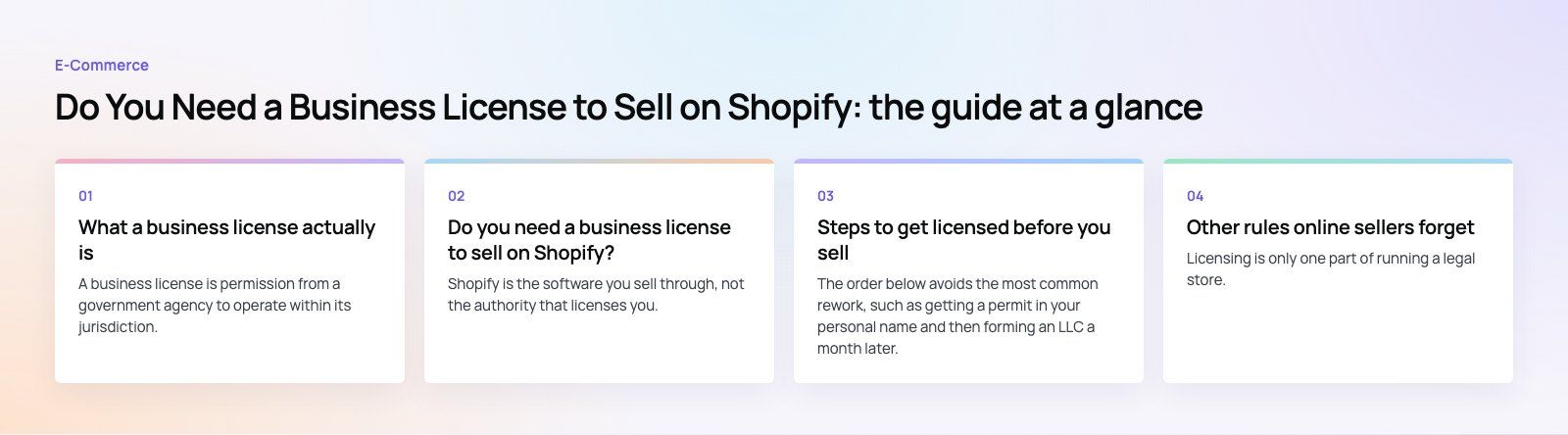
Steps to get licensed before you sell
The order below avoids the most common rework, such as getting a permit in your personal name and then forming an LLC a month later.
1. Choose your business structure
Decide between sole proprietorship, partnership, LLC or corporation. The choice affects taxes, liability and paperwork. Many small sellers start as sole proprietors and move to an LLC once revenue grows, but a short conversation with an accountant or attorney is worth it before you file anything.
2. Get an Employer Identification Number if you need one
An EIN identifies your business to the IRS. You need one if you hire staff or operate as a partnership or corporation, and many banks ask for one when you open a business account. The IRS issues EINs free through its online application, so be wary of third party sites that charge for the same thing.
3. Research the licenses and permits that apply
Start with your city or county, then your state, then any federal agency linked to your products. Typical items for an online seller include:
- A general business license or registration from your city or county
- A seller's permit or sales tax registration from your state
- A home occupation permit if you run the business from home
- Product specific permits for food, alcohol, cosmetics or other regulated goods
4. Apply and record renewal dates
Most applications ask for your business name, address, structure and a description of what you sell. Some licenses renew annually and some carry their own fees and filing deadlines. Put every renewal date in a calendar the day you receive approval.
5. Configure your store to match
Once you hold your registrations, add them to Shopify's tax settings, check that your legal business name appears correctly on invoices and policies, and make sure your contact and refund pages reflect how you actually operate.
Other rules online sellers forget
Licensing is only one part of running a legal store. A few related areas catch new sellers out:
- Zoning: storing large amounts of stock at home or having couriers collect daily can breach residential zoning rules.
- Product safety and labeling: children's products, cosmetics and food have labeling rules regardless of where you sell.
- Privacy: collecting customer emails and running tracking pixels brings privacy obligations, and some states have their own privacy laws.
- Selling abroad: shipping to other countries can trigger import duties and foreign tax registration.
Mistakes to avoid
- Assuming online means exempt. Local rules usually apply to where you operate, not where your customers click.
- Collecting tax without a permit. Charging sales tax before you are registered creates its own problems with the state.
- Registering in the wrong name. Form your entity first, then apply for permits under it.
- Forgetting renewals. A lapsed license can mean penalties and a scramble to reinstate it.
- Treating Shopify's tax tools as compliance. They calculate tax; they do not register you or file returns.
Getting the store itself right
Once the paperwork is in place, the store needs to earn its keep: fast pages, clear product information, trustworthy checkout and correct tax handling. Codeeo has delivered 200+ projects across the UAE and the US, and our Shopify developers handle store builds, theme work and app integrations. If you are still choosing a platform, our platform fit review compares options against your catalog and markets, and a checkout teardown finds friction in an existing store. For payment setup, see our payment integration work, or talk to the team about your launch.
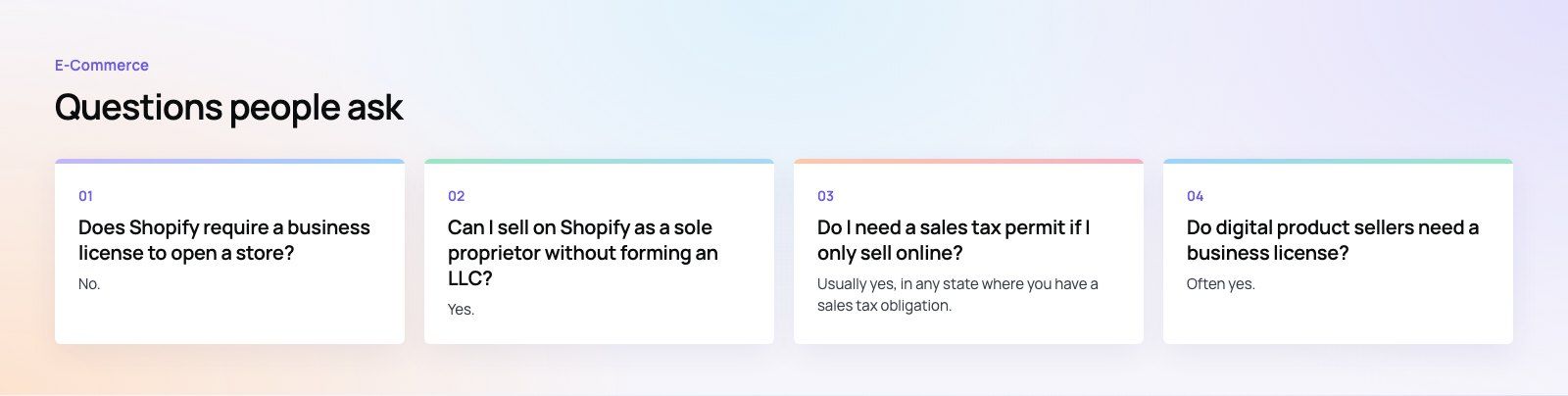
Frequently asked questions
No.
Shopify does not ask for a business license when you create a store, add products or start taking orders. Its payment setup asks for business or personal tax details, but licensing is set by your city, county, state and, for some products, federal agencies. Opening a Shopify account does not mean you are legally cleared to sell, so check your local and state requirements separately before launch.
E-CommerceSquare WooCommerce Integration: A Step by Step Setup GuideHow to connect Square to WooCommerce with the official plugin, choose a system of record, test in sandbox and fix the sync problems stores hit most often. E-CommerceDo You Need a Business License to Dropship in the US?Do you need a business license to dropship? What US sellers need: a local business license, a state seller's permit, an EIN, and when you might not need one.
 E-CommerceLiquor Store POS Systems: Key Features and BenefitsWhat a liquor store POS system should do: age verification, case and bottle inventory, reordering, reporting and compliance, plus how to choose one.
Tell us what the business needs. We will tell you what to build first.
Schedule a free consultation and get a written recommendation, with costs, before you commit to anything.
Get in touchPROVEN RESULTS
4.7 / 5verified reviews on Google