 Software DevelopmentSQL vs NoSQL Databases: Differences and How to ChooseHow SQL and NoSQL databases differ in data model, schema, scaling and consistency, where each one fits, and five questions to choose for your project.
CodeeoInsightsSoftware Development
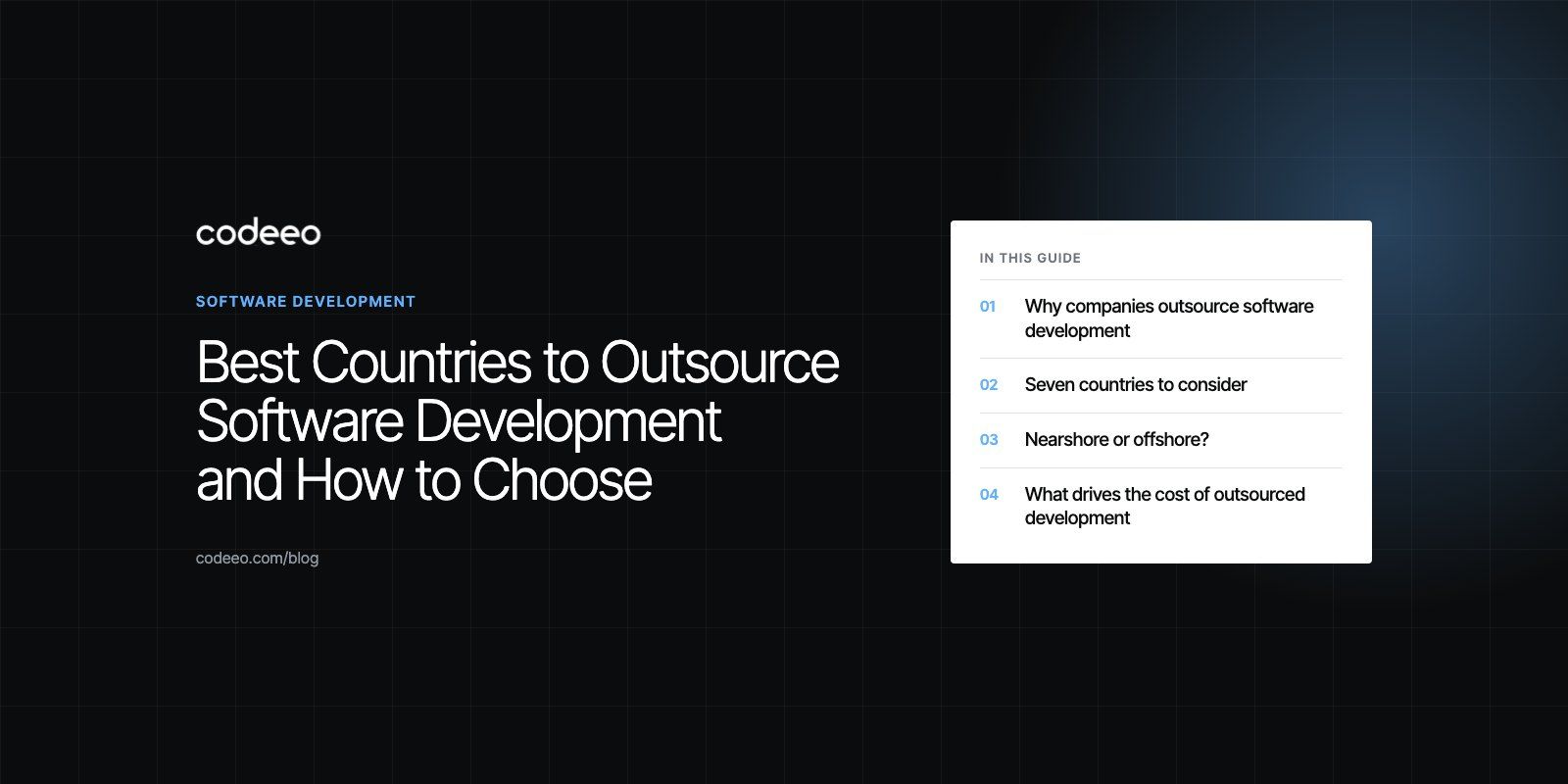
Best Countries to Outsource Software Development and How to Choose
Seven countries to consider for outsourcing software development, how nearshore and offshore compare, what drives cost, and how to choose the right partner.
The countries most businesses shortlist for outsourcing software development are India, Pakistan, Romania, Ukraine, Argentina, Brazil and Costa Rica. Each offers a different mix of talent depth, time zone overlap and cost. But the country is only the first filter: the partner you choose inside that country, and how well they handle security, process and communication, decides whether the project succeeds.
This guide compares the seven destinations, explains when offshore or nearshore makes more sense, and gives a checklist for choosing the actual team.
Why companies outsource software development
Outsourcing is rarely only about cost. Companies hand work to outside teams for several reasons:
- Access to skills. Specialists in mobile, cloud, data or a particular framework can be hard to hire locally, and slower still to hire well.
- Speed. An established team can start in weeks rather than the months a hiring round takes.
- Flexibility. You can scale a team up for a launch and down for maintenance without long term hiring commitments.
- Focus. Your in house staff can stay on product decisions and customers while delivery capacity comes from outside.
The risks are just as real: weak communication, hidden quality problems, unclear ownership of code and data, and dependency on a vendor you cannot easily replace. Choosing a country well reduces some of these risks. Choosing a partner well reduces most of them.
Seven countries to consider
India
India has one of the largest pools of software developers in the world, with experience across enterprise systems, web, mobile and cloud. Large and mid sized firms are used to serving clients in North America, Europe and the Gulf, and English is widely used in business. The trade off is variation: quality ranges widely between firms, so vetting matters more than the country label. Time zone gaps with the Americas need planned overlap hours.
Pakistan
Pakistan has a fast growing software and freelance sector, with strong skills in web, mobile, ecommerce and JavaScript frameworks. Teams in Karachi, Lahore and Islamabad commonly work with clients in the Gulf, the UK and the US. Its time zone sits close to the Gulf, which makes daily collaboration with Dubai or Riyadh straightforward. The talent pool is smaller than India's, so niche skills can take longer to source. Codeeo's own team of 80+ works across Dubai, Riyadh and Karachi.
Romania
Romania is a popular nearshore choice for European companies. As an EU member state it works under the same data protection rules, which simplifies contracts involving personal data. Developers are well regarded for engineering depth, especially in backend, embedded and enterprise software. The available pool is smaller than in Asia, so large teams take longer to assemble.
Ukraine
Ukrainian developers are known for strong technical skills in complex products, from backend systems to mobile apps built with Flutter or React Native. The country has long served European and US clients. Before signing, ask any Ukrainian vendor about their business continuity plans, distributed staffing and backup infrastructure, given the disruption the industry there has worked through in recent years.
Argentina
Argentina is a common nearshore option for North American companies because its working day overlaps well with US business hours. Developers are strong in web, mobile and product design, and many firms are used to agile delivery with US product teams. Economic volatility can affect contracts, so agree on currency and payment terms clearly.
Brazil
Brazil has one of the largest technology workforces in Latin America and a large startup sector, with depth in fintech, ecommerce and mobile. It also offers good time zone overlap with the US. English proficiency varies more than in some other markets, so confirm that the people you will talk to every day communicate comfortably in your working language.
Costa Rica
Costa Rica is a smaller market with a stable political environment, an educated workforce and a time zone aligned with US Central time. Several multinational companies run engineering and support centers there. The pool is limited, so it suits focused teams better than large scale staffing.
Comparing the seven at a glance
| Country | Time zone | Typical strengths | Things to check |
|---|---|---|---|
| India | UTC+5:30 | Very large talent pool, enterprise and cloud experience | Wide quality range between firms, overlap with the Americas |
| Pakistan | UTC+5 | Web, mobile and ecommerce skills, close to Gulf hours | Smaller pool for niche skills |
| Romania | UTC+2, UTC+3 in summer | EU data rules, strong engineering depth | Smaller pool, slower to scale large teams |
| Ukraine | UTC+2, UTC+3 in summer | Complex products, modern frameworks | Business continuity and backup arrangements |
| Argentina | UTC-3 | US hours overlap, product and design skills | Currency and contract terms |
| Brazil | UTC-3 (Brasília) | Large Latin American pool, fintech and ecommerce | English level of day to day contacts |
| Costa Rica | UTC-6 | Stable environment, US Central overlap | Limited pool for large teams |
Nearshore or offshore?
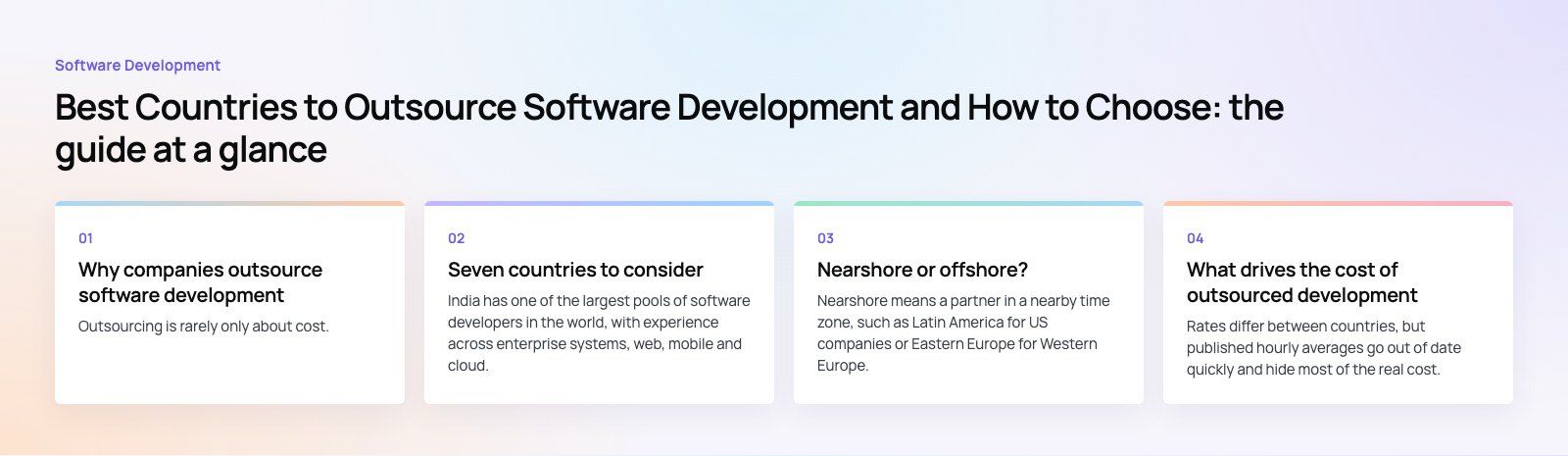
Nearshore means a partner in a nearby time zone, such as Latin America for US companies or Eastern Europe for Western Europe. Offshore means a partner further away, often in South Asia. Neither is better in general.
- Choose nearshore when your product team needs many live conversations each day, decisions change quickly, or stakeholders cannot work early or late hours.
- Choose offshore when the work is well specified, you want access to a larger pool, or a time difference can help you run development while your own team is offline.
- Consider a hybrid where a lead or product owner sits close to you and the wider team works offshore. This keeps decisions fast while giving access to more capacity.
What drives the cost of outsourced development
Rates differ between countries, but published hourly averages go out of date quickly and hide most of the real cost. These factors usually matter more:
- Seniority mix. A team with an experienced lead often costs less overall because it makes fewer expensive mistakes.
- Clarity of scope. Vague requirements lead to rework, which costs the same wherever it happens.
- Engagement model. Fixed scope projects, dedicated teams and time and materials contracts shift risk differently between you and the vendor.
- Management overhead. The time your own staff spend on calls, reviews and testing is part of the cost.
- Maintenance. Code that is hard to read or poorly tested is expensive to support for years after launch.
How to choose the right partner
Security and data protection
Ask how the vendor controls access to your code, credentials and production data, and how staff devices are secured. If personal data from Europe is involved, the EU data protection rules apply wherever the processing happens, so the contract needs proper data processing terms. Other markets, including the UAE and Saudi Arabia, have their own data protection laws to account for.
Development process and quality
Ask to see how work moves from requirement to release: backlog, code review, automated tests, staging environments and release approval. A partner who cannot describe this clearly will struggle to deliver it. An independent codebase review is a useful check if you are taking over code from a previous vendor.
Communication and working style
Agree on overlap hours, a single point of contact, a regular demo cadence and the tools you will use. Short written updates every day or two prevent most surprises.
Ability to scale
Ask how quickly they can add or replace people, and how knowledge is documented so a new developer can start without slowing the team.
Relevant experience and references
Look for work similar to yours in scope and technology, and speak to past clients where possible. Ask what went wrong on a past project and how it was handled. The answer tells you more than a portfolio.
Contract terms
Make sure the contract states that you own the code and intellectual property, defines acceptance criteria, sets out how disputes are resolved and explains how you exit, including handover of repositories, documentation and access.
Mistakes to avoid
- Choosing on rate alone and discovering the real cost in rework.
- Starting without a written scope, even a short one.
- Letting the vendor hold the only copy of the code, hosting accounts or domain.
- Skipping a paid pilot or first milestone before committing to a long contract.
- Having no technical person on your side to review the work.
If you are unsure what to brief, a short product scoping session gives any vendor a clear starting point.
Codeeo has delivered 200+ projects across the UAE and the US, with a team of 80+ across Dubai, Riyadh and Karachi. If you need extra capacity, our dedicated developers and custom software services cover both team extension and full project delivery.
Frequently asked questions
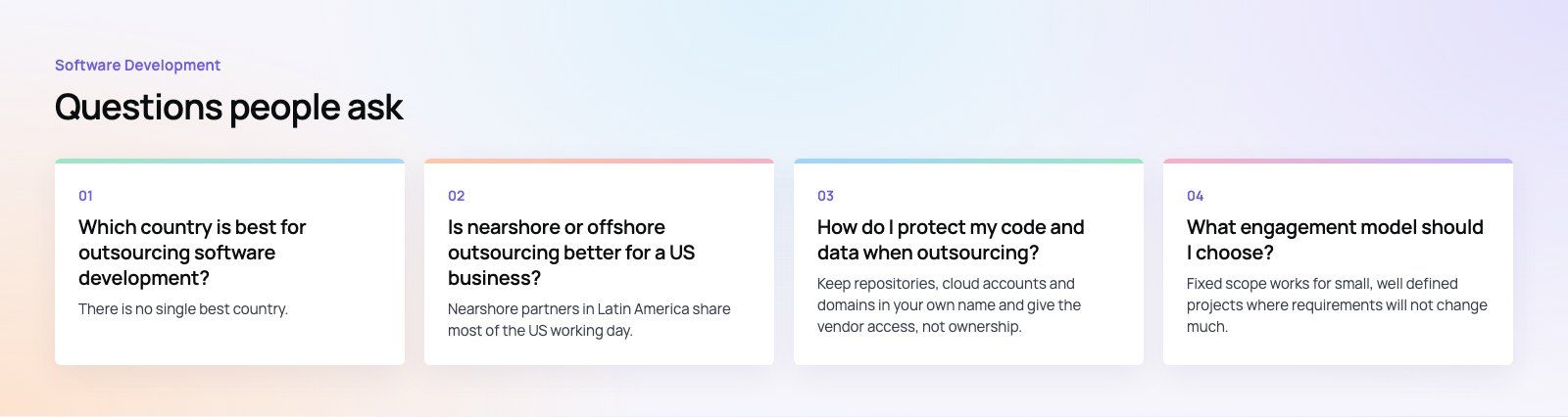
There is no single best country.
India and Pakistan offer large pools and strong overlap with Gulf hours. Romania suits European companies that want EU data rules. Argentina, Brazil and Costa Rica suit US companies that need shared working hours. Pick the region that fits your time zone and data needs, then judge individual partners on process, security and references.
Software DevelopmentSQL vs NoSQL Databases: Differences and How to ChooseHow SQL and NoSQL databases differ in data model, schema, scaling and consistency, where each one fits, and five questions to choose for your project. Software DevelopmentOpen Source Apps: Examples, Licenses and How to Build Your OwnWhat makes an app open source, well known examples, the steps to build your own, how to pick MIT, Apache or GPL, and when to customize instead.
 Software DevelopmentHow an Online HR Portal Improves Employee ExperienceWhat an online HR portal does, how self service improves employee experience, which features matter, and whether to buy, configure or build one.
Tell us what the business needs. We will tell you what to build first.
Schedule a free consultation and get a written recommendation, with costs, before you commit to anything.
Get in touchPROVEN RESULTS
4.7 / 5verified reviews on Google